Here’s a number worth knowing before anything else about peptide chemistry. Build a 30-amino-acid chain where every step works 99 percent of the time, and only about 74 percent of your chains come out complete. Drop to 98 percent and it’s 55 percent. Stretch the chain to 100 residues at 99 percent and you’re down to 37.
A lot of what chemists have built for making peptides, from the resin bead to the flow machines, is about beating that compounding. Here’s how the chemistry works, where it slips, and how far it reaches today.
What Peptide Synthesis Is
A peptide is a chain of amino acids held together by amide bonds, which chemists call peptide bonds. Peptide synthesis means building that chain on purpose, one amino acid at a time, in the order you choose. If you want the structural basics first, I break down what makes a peptide a peptide in Is TB-500 a Steroid?
The field has a long history. Da’san Jaradat’s 2018 history of it runs from 1882 through Curtius, Fischer, Bergmann and Zervas. By 1955, du Vigneaud was writing up the isolation, structure and synthesis of oxytocin. Synthetic peptides are commercial products now: a 2012 overview by Maciej Stawikowski and Gregg Fields lists examples from aspartame, a dipeptide sweetener, up to hormones like oxytocin, adrenocorticotropic hormone and calcitonin.
There are two broad ways to make a peptide. You can let cells do it, which is what Goeddel’s team did in 1979 when they put synthetic genes for the insulin A and B chains into E. coli. Or you can do it with chemistry, and for most peptides that means solid-phase peptide synthesis. Matthias D’Hondt’s 2014 review says most peptides today are made that way, and a 2024 industry analysis led by Ivy Kekessie calls it the predominant platform, ahead of liquid-phase and hybrid methods.
The Solid-Phase Idea
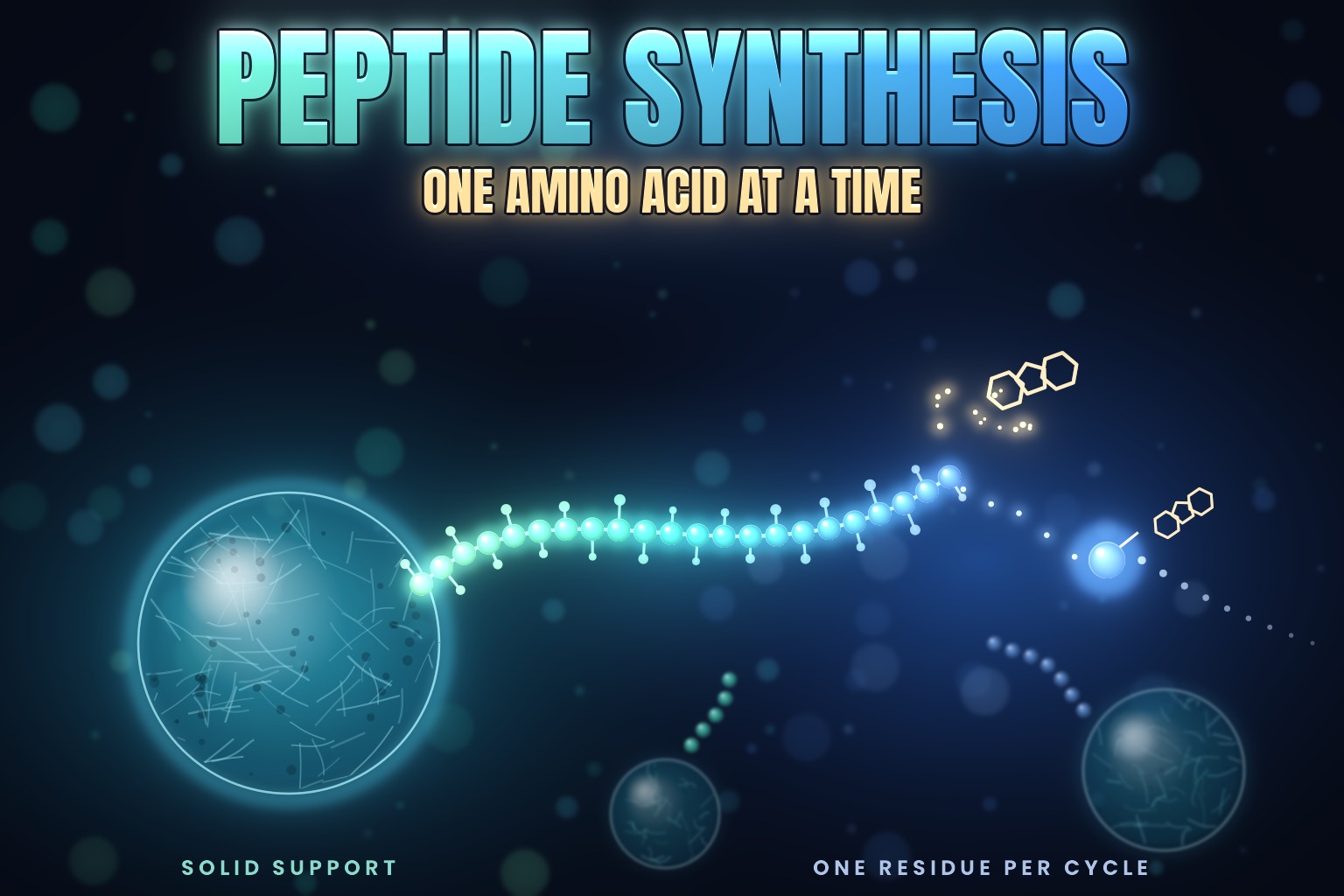
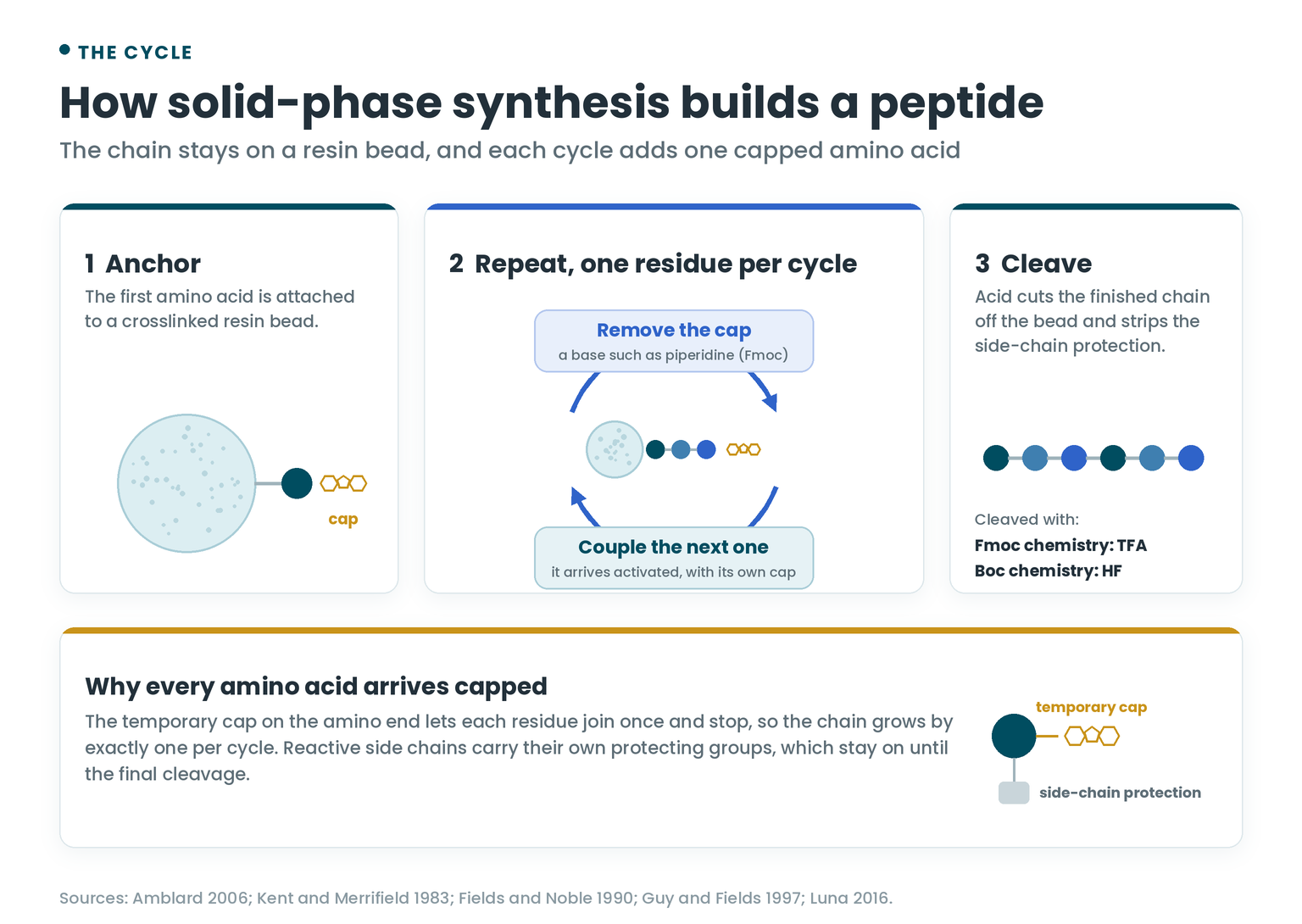
Merrifield’s idea was to fix the first amino acid to a crosslinked resin bead and grow the chain right there, one residue per cycle. Each cycle has the same moves: strip the temporary cap off the end of the chain, then couple on the next amino acid, which arrives with its own cap in place. When the chain is finished, a final cleavage step cuts it free of the bead. Muriel Amblard’s 2006 methods review breaks the process into exactly those stages: anchoring, deprotection, coupling and cleavage.
The track record built quickly. By 1964 Merrifield was publishing part 3 of his solid-phase series, an improved synthesis of bradykinin. In 1966 he and Marglin made bovine insulin by the solid-phase method, and in 1980 a team including Merrifield reported an automated solid-phase synthesis of thymosin alpha 1, the 28-residue immune peptide Goldstein’s group sequenced in 1977, which I covered in the training and immunity piece. A year later, Mojsov and Merrifield made glucagon, all 29 residues, and crystallized it from water. It was indistinguishable from natural bovine glucagon on gel electrophoresis, ion-exchange chromatography, reversed-phase HPLC, fluorescence and amino acid analysis, and fully active in a rabbit blood sugar assay.
Merrifield gave his Nobel lecture on the method in 1984. Looking back in 1997, he put its success down to how easy the procedure was, how much it sped up the work and the good yields of purified product. He also wrote that solid phase supplements solution chemistry rather than replacing it, that it shines when you need many analogs in small amounts, that it had on occasion been scaled up to kilogram quantities, and that peptide libraries, thousands or millions of peptides made at once, have been built mostly by solid-phase methods.
Fmoc vs Boc: Two Ways to Cap an Amino Acid
Every amino acid that goes onto the chain carries a temporary cap on its amino end, so it joins once and stops. The reactive side chains carry their own longer-lasting protecting groups. Two capping systems have run the field, and the difference comes down to what removes what.
| Boc strategy | Fmoc strategy | |
|---|---|---|
| Temporary cap | tert-butyloxycarbonyl (Boc) | 9-fluorenylmethoxycarbonyl (Fmoc) |
| Cap removed each cycle with | Trifluoroacetic acid (TFA) | A cyclic secondary amine base, such as piperidine |
| Final release from the resin | Hydrogen fluoride (HF) | TFA |
The Boc column comes from Kent and Merrifield’s 1983 work, and Wong and Merrifield’s 1980 thymosin alpha 1 synthesis started from a Boc aminoacyl resin. Fmoc amino acids came into solid-phase work in the late 1970s. Fields and Noble’s 1990 review called the Fmoc approach a truly “orthogonal” scheme: the cap comes off with a base, while the side-chain groups and the resin link come off with acid at the end, so each can be removed without touching the other. Guy and Fields wrote up that final TFA cleavage step in 1997.
Raymond Behrendt’s 2016 review opens by calling Fmoc solid-phase synthesis “the method of choice,” and notes that multiton production of therapeutic peptides has made high-quality Fmoc building blocks cheap. Even the base is negotiable: a 2016 comparison by Omar Luna’s group found piperidine, 4-methylpiperidine and piperazine interchangeable for removing Fmoc, with yield and purity tracking the size and hydrophobicity of the peptide more than the reagent.
Coupling: How Each Bond Gets Made
An amino acid doesn’t join a chain on its own. Its carboxyl group has to be activated first, and the reagents that do this are a whole subfield. Irene Coin’s 2007 protocol activates it with aminium-derived coupling reagents, on PEG-modified polystyrene resin.
Another route pairs a carbodiimide with an additive such as HOBt or HOAt, both of which have been reported to have explosive properties. Ramon Subirós-Funosas and Fernando Albericio’s 2009 study tested Oxyma as a replacement. It held back racemization, where an amino acid flips to its mirror-image form, beat HOBt on coupling efficiency, matched or beat HOAt, and showed a lower explosion risk in calorimetry tests.
Where Synthesis Goes Wrong
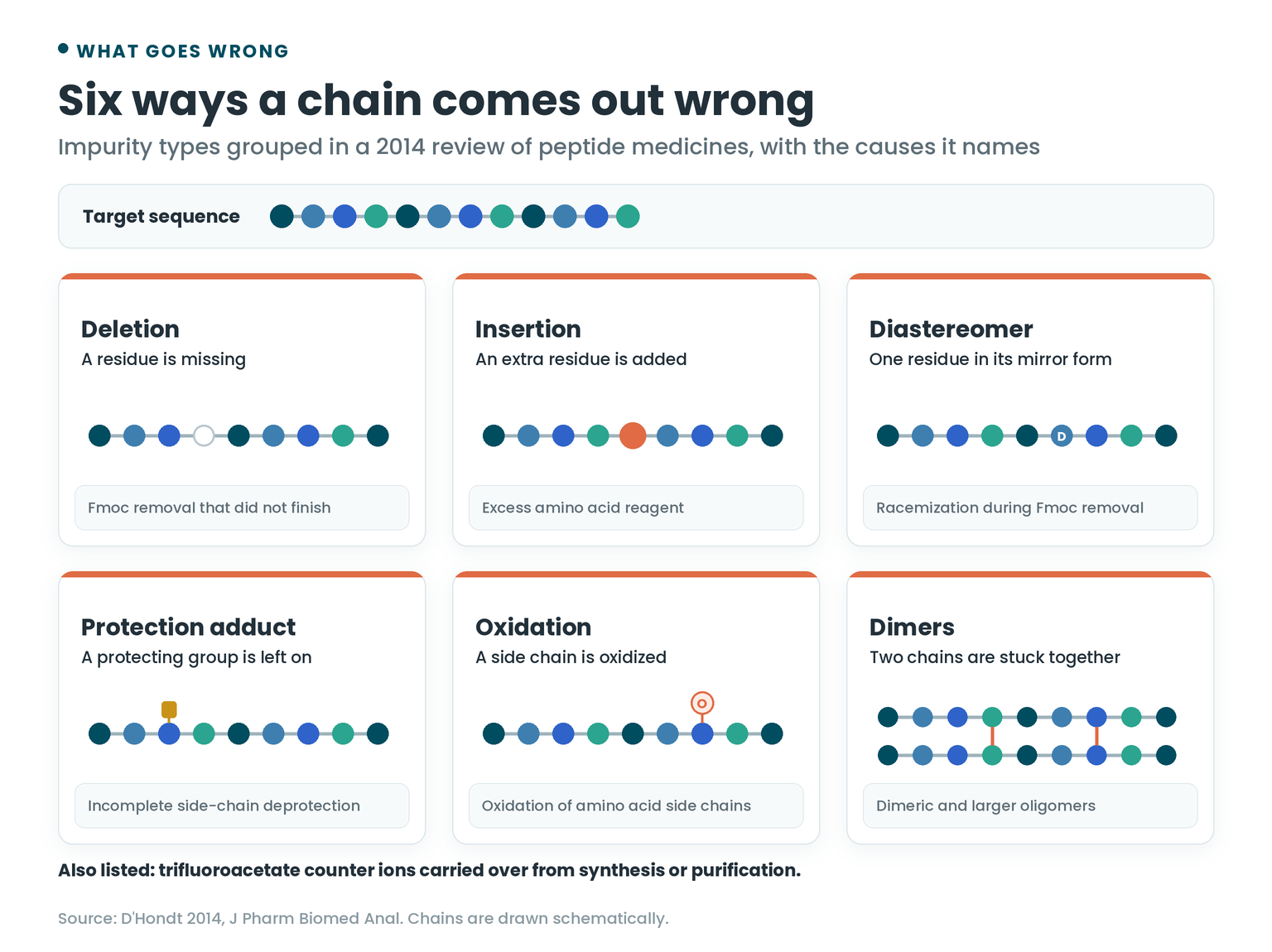
Back to the opening math. Every cycle is a chance for a chain to come out wrong, and the errors add up with length. D’Hondt’s review sorts what ends up in the flask:
- Deletions: a residue missing from the sequence, tied to Fmoc removal that didn’t finish.
- Insertions: an extra residue, tied to excess amino acid reagent.
- Diastereomers: one residue racemized during Fmoc removal.
- Protection adducts: side-chain protecting groups that never came off.
- Side-chain damage: oxidation, or unprotected side chains reacting with synthesis reagents.
- Dimers and oligomers: chains stuck together.
- Counter ions: trifluoroacetate left over from the synthesis or purification.
D’Hondt also points out why this matters past the chemistry bench: impurities can skew early studies of what a peptide does and lead to wrong conclusions.
Some sequences cause their own trouble. Aspartic acid can turn into a by-product called an aspartimide under the basic conditions used to remove Fmoc. Mergler’s group showed in 2003 how much this depends on the residue next to it, and in their test peptide it was fully suppressed by combining OtBu protection on the aspartic acid side chain with Hmb backbone protection on the neighboring glycine.
Then there’s aggregation. Coin’s protocol calls aggregation of the growing chain “the main cause of failure” in peptide chemosynthesis. The “difficult peptide” idea dates to the 1980s: as Marta Paradís-Bas and colleagues describe in their 2016 review, these sequences form beta-sheet contacts, within a chain or between chains, strong enough to clump during synthesis. Coin’s group used pseudoproline and depsipeptide units to make one such sequence, an analog of the WW domain FBP28, that the standard protocol couldn’t produce at all.
Some problems start before the synthesis does. In 1983, Kent and Merrifield chased down a common problem: shortened peptides that had been blamed on parts of the resin the reagents couldn’t reach. The real culprit was an impurity in commercial Boc amino acids. Once they used pure starting materials, terminated peptides dropped below 0.05 percent.
Run the Numbers Yourself
Set the chain length and how often each cycle works. The bar shows what 1,000 chains would look like, and the grow button builds a sample batch of 12 in front of you.
Peptide synthesis yield simulator
One cycle adds one residue. Set how long the chain is and how often each cycle works, then grow a sample batch.
This is arithmetic: complete chains = (cycle success) to the power of the chain length, and every cycle is treated as equally likely to miss. Real syntheses don't fail evenly; aggregation of the growing chain is the main cause of failure (Coin 2007).
How Purity Gets Checked
Kekessie’s analysis splits peptide manufacturing into three stages: synthesis, purification and isolation. High-performance liquid chromatography does double duty here: Mergler’s group measured their aspartimide by-products with reversed-phase HPLC, and Fields and colleagues’ 1989 solid-phase synthesis of the gramicidins used HPLC to purify them.
Purity also varies with the sequence. In a 2014 report on faster synthesis cycles, Jonathan Collins’s team measured 93 percent purity for a 10-residue fragment of acyl carrier protein and 72 percent for beta-amyloid 1-42, using UPLC-MS, which pairs the separation with mass spectrometry.
Faster Machines, Longer Chains
Speed has moved a long way. In Coin’s 2007 protocol, the 41-residue corticotropin-releasing factor took about 80 working hours. Collins’s 2014 method ran a standard cycle in 4 minutes and finished beta-amyloid 1-42 in 229 minutes while cutting total waste by 90 percent. In 2017, Alexander Mijalis and Bradley Pentelute’s group reported a fully automated flow system that formed each amide bond in 7 seconds and added a residue every 40 seconds, with crude purity and yields comparable to standard batch synthesis.
Length has moved with it. In 2020, a team led by Hartrampf used automated fast-flow chemistry to build chains up to 164 amino acids long over 327 consecutive reactions, in hours. They made nine different protein chains, including enzymes, and after purification and folding the synthetic versions behaved comparably to versions expressed in cells.
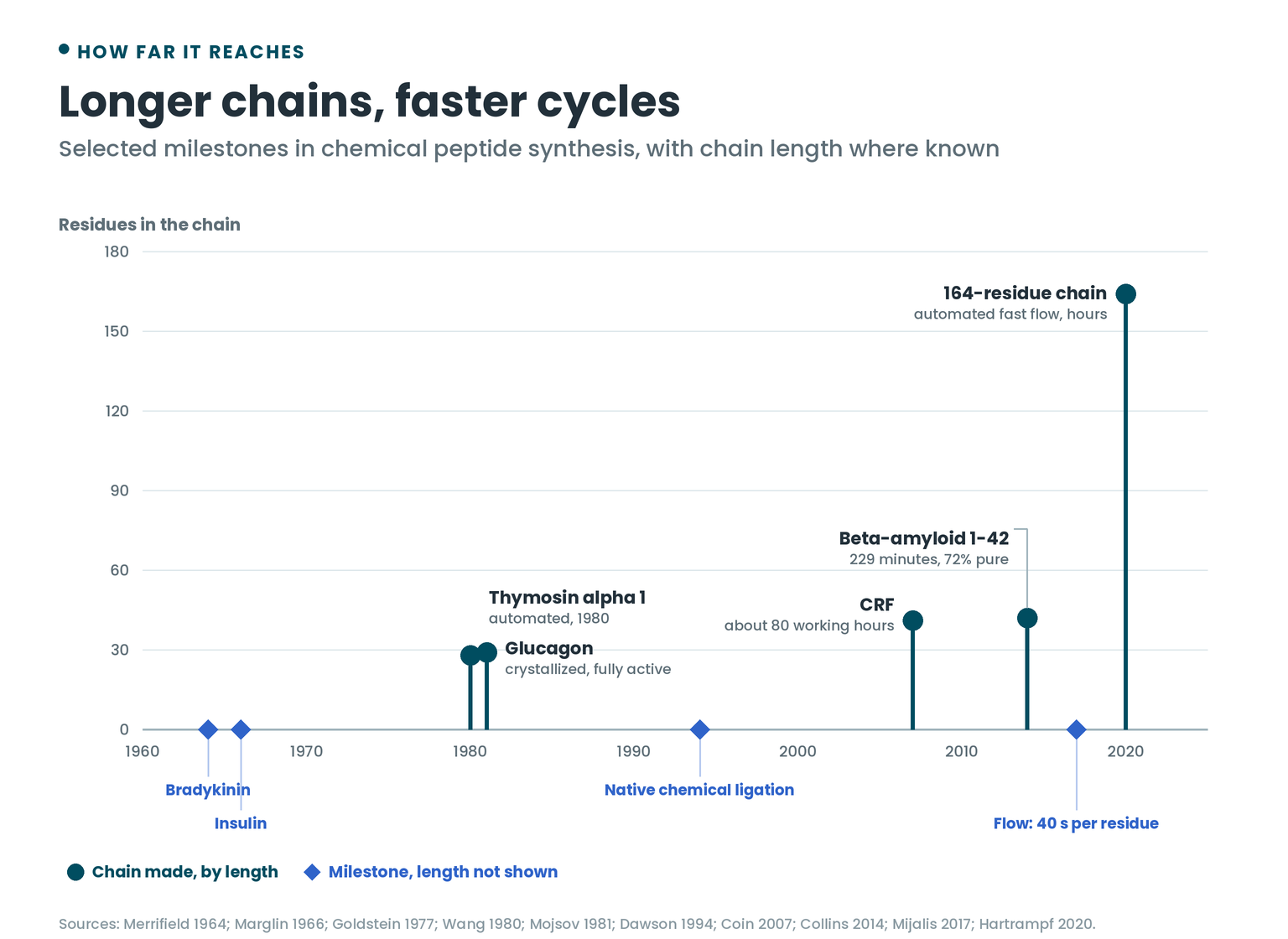
The other way to go long is to stitch pieces together. Dawson and Kent’s 1994 native chemical ligation joins two unprotected peptide segments: they first link through a thioester, which then rearranges on its own into a normal peptide bond at the join. They used it to make a cytokine with multiple disulfide bonds in one step, then folded it into the native protein.
The Solvent Bill
Solid-phase synthesis works by using excess reagents and solvents, and that has a cost. Albert Isidro-Llobet’s 2019 perspective, written by a team from the ACS Green Chemistry Institute Pharmaceutical Roundtable, says peptide synthesis still runs mostly on legacy technology that uses large amounts of highly hazardous reagents and solvents. Kekessie’s 2024 analysis put a number on it using process mass intensity, the total mass of materials used per mass of product, across 40 synthetic peptide processes from 14 companies. Solid-phase synthesis averaged about 13,000, against a median of 168 to 308 for small-molecule drugs and about 8,300 for biologics.
Frequently Asked Questions
What is solid-phase peptide synthesis?
It’s Merrifield’s method: the first amino acid is anchored to a resin bead, the chain is built on the bead one residue per cycle, and the finished peptide is cut free at the end. Most peptides today are made this way.
What’s the difference between Fmoc and Boc synthesis?
They use different temporary caps on each amino acid. Boc caps come off with acid and the final peptide is released with hydrogen fluoride, while Fmoc caps come off with a base and the final release uses TFA. Fmoc is the approach most labs use now.
Why does a synthetic peptide contain impurities?
Every cycle can fail a small fraction of the time, leaving chains with a missing, extra or altered residue, and those errors stack up over a long sequence. Purification separates the target from those by-products, and purity is given as a percentage, measured by methods like UPLC-MS.
How long can a chemically made peptide be?
Coin’s standard protocol produced a 41-residue hormone, automated fast-flow synthesis has reached 164 residues in a single run, and native chemical ligation joins synthetic segments into proteins.
Are peptides made by chemistry or by cells?
Both. Cells can be engineered to make a peptide, as with insulin chains expressed in E. coli in 1979, but most peptides today are made chemically by solid-phase synthesis.
Stay sharp,
Joe Mars
The Peptide Report
P.S. Got a question about how a peptide was made, or what a purity number actually covers? Bring it to the Skool community and we’ll work through it together.
References
- Jaradat DMM. Thirteen decades of peptide synthesis: key developments in solid phase peptide synthesis and amide bond formation utilized in peptide ligation. Amino Acids. 2018;50(1):39-68. doi:10.1007/s00726-017-2516-0
- du Vigneaud V. Oxytocin, the principal oxytocic hormone of the posterior pituitary gland: its isolation, structure, and synthesis. Experientia. 1955;(Suppl 2):9-26. PubMed 13305558
- Stawikowski M, Fields GB. Introduction to peptide synthesis. Curr Protoc Protein Sci. 2012;Chapter 18:18.1.1-18.1.13. doi:10.1002/0471140864.ps1801s69
- Goeddel DV, Kleid DG, Bolivar F, et al. Expression in Escherichia coli of chemically synthesized genes for human insulin. Proc Natl Acad Sci U S A. 1979;76(1):106-110. doi:10.1073/pnas.76.1.106
- D’Hondt M, Bracke N, Taevernier L, et al. Related impurities in peptide medicines. J Pharm Biomed Anal. 2014;101:2-30. doi:10.1016/j.jpba.2014.06.012
- Kekessie I, Wegner K, Martinez I, et al. Process mass intensity (PMI): a holistic analysis of current peptide manufacturing processes informs sustainability in peptide synthesis. J Org Chem. 2024;89(7):4261-4282. doi:10.1021/acs.joc.3c01494
- Amblard M, Fehrentz JA, Martinez J, Subra G. Methods and protocols of modern solid phase peptide synthesis. Mol Biotechnol. 2006;33(3):239-254. doi:10.1385/MB:33:3:239
- Merrifield RB. Solid-phase peptide synthesis. 3. An improved synthesis of bradykinin. Biochemistry. 1964;3:1385-1390. doi:10.1021/bi00897a032
- Marglin A, Merrifield RB. The synthesis of bovine insulin by the solid phase method. J Am Chem Soc. 1966;88(21):5051-5052. doi:10.1021/ja00973a068
- Goldstein AL, Low TL, McAdoo M, et al. Thymosin alpha1: isolation and sequence analysis of an immunologically active thymic polypeptide. Proc Natl Acad Sci U S A. 1977;74(2):725-729. doi:10.1073/pnas.74.2.725
- Wang SS, Makofske R, Bach A, Merrifield RB. Automated solid phase synthesis of thymosin alpha 1. Int J Pept Protein Res. 1980;15(1):1-4. doi:10.1111/j.1399-3011.1980.tb02543.x
- Wong TW, Merrifield RB. Solid-phase synthesis of thymosin alpha 1 using tert-butyloxycarbonylaminoacyl-4-(oxymethyl)phenylacetamidomethyl-resin. Biochemistry. 1980;19(14):3233-3238. doi:10.1021/bi00555a021
- Mojsov S, Merrifield RB. Solid-phase synthesis of crystalline glucagon. Biochemistry. 1981;20(10):2950-2956. doi:10.1021/bi00513a036
- Merrifield B. Solid phase synthesis. Nobel lecture, 8 December 1984. Biosci Rep. 1985;5(5):353-376. doi:10.1007/BF01116553
- Merrifield B. Concept and early development of solid-phase peptide synthesis. Methods Enzymol. 1997;289:3-13. doi:10.1016/s0076-6879(97)89040-4
- Kent SB, Merrifield RB. Chemical mechanism to account for artifactual formation of shortened peptides with free alpha-amino groups in solid phase peptide synthesis. Int J Pept Protein Res. 1983;22(1):57-65. doi:10.1111/j.1399-3011.1983.tb02068.x
- Fields GB, Noble RL. Solid phase peptide synthesis utilizing 9-fluorenylmethoxycarbonyl amino acids. Int J Pept Protein Res. 1990;35(3):161-214. doi:10.1111/j.1399-3011.1990.tb00939.x
- Guy CA, Fields GB. Trifluoroacetic acid cleavage and deprotection of resin-bound peptides following synthesis by Fmoc chemistry. Methods Enzymol. 1997;289:67-83. doi:10.1016/s0076-6879(97)89044-1
- Behrendt R, White P, Offer J. Advances in Fmoc solid-phase peptide synthesis. J Pept Sci. 2016;22(1):4-27. doi:10.1002/psc.2836
- Luna OF, Gomez J, Cárdenas C, et al. Deprotection reagents in Fmoc solid phase peptide synthesis: moving away from piperidine? Molecules. 2016;21(11):1542. doi:10.3390/molecules21111542
- Coin I, Beyermann M, Bienert M. Solid-phase peptide synthesis: from standard procedures to the synthesis of difficult sequences. Nat Protoc. 2007;2(12):3247-3256. doi:10.1038/nprot.2007.454
- Subirós-Funosas R, Prohens R, Barbas R, El-Faham A, Albericio F. Oxyma: an efficient additive for peptide synthesis to replace the benzotriazole-based HOBt and HOAt with a lower risk of explosion. Chemistry. 2009;15(37):9394-9403. doi:10.1002/chem.200900614
- Mergler M, Dick F, Sax B, Weiler P, Vorherr T. The aspartimide problem in Fmoc-based SPPS. Part I. J Pept Sci. 2003;9(1):36-46. doi:10.1002/psc.430
- Mergler M, Dick F, Sax B, Stähelin C, Vorherr T. The aspartimide problem in Fmoc-based SPPS. Part II. J Pept Sci. 2003;9(8):518-526. doi:10.1002/psc.473
- Paradís-Bas M, Tulla-Puche J, Albericio F. The road to the synthesis of “difficult peptides”. Chem Soc Rev. 2016;45(3):631-654. doi:10.1039/c5cs00680e
- Fields CG, Fields GB, Noble RL, Cross TA. Solid phase peptide synthesis of 15N-gramicidins A, B, and C and high performance liquid chromatographic purification. Int J Pept Protein Res. 1989;33(4):298-303. doi:10.1111/j.1399-3011.1989.tb01285.x
- Collins JM, Porter KA, Singh SK, Vanier GS. High-efficiency solid phase peptide synthesis (HE-SPPS). Org Lett. 2014;16(3):940-943. doi:10.1021/ol4036825
- Mijalis AJ, Thomas DA 3rd, Simon MD, et al. A fully automated flow-based approach for accelerated peptide synthesis. Nat Chem Biol. 2017;13(5):464-466. doi:10.1038/nchembio.2318
- Hartrampf N, Saebi A, Poskus M, et al. Synthesis of proteins by automated flow chemistry. Science. 2020;368(6494):980-987. doi:10.1126/science.abb2491
- Dawson PE, Muir TW, Clark-Lewis I, Kent SB. Synthesis of proteins by native chemical ligation. Science. 1994;266(5186):776-779. doi:10.1126/science.7973629
- Isidro-Llobet A, Kenworthy MN, Mukherjee S, et al. Sustainability challenges in peptide synthesis and purification: from R&D to production. J Org Chem. 2019;84(8):4615-4628. doi:10.1021/acs.joc.8b03001