
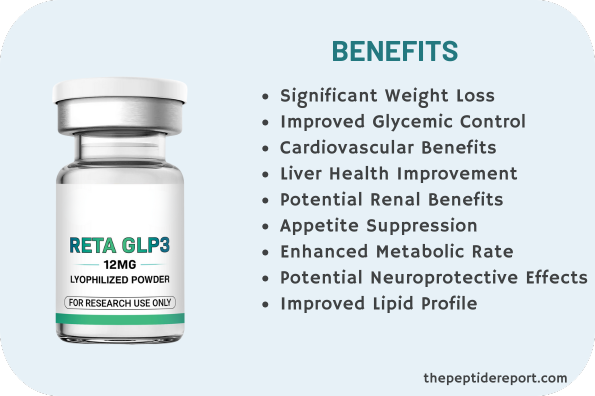
Retatrutide: Benefits, Side Effects, and What the Research Actually Shows
I get asked about Retatrutide almost every week now.
Usually the conversation starts the same way.
Someone has heard about GLP-1 medications like semaglutide or tirzepatide. They start reading about weight loss research, and then suddenly they see another name popping up everywhere.
And the first question is always the same.
“Is this the next big thing?”
The honest answer is that researchers are paying very close attention to it right now. Early studies have shown some very impressive results, especially when it comes to weight loss and metabolic health.
But like anything in peptide research, it helps to slow down and actually understand what the compound does before getting too excited.
So in this guide we are going to walk through it step by step.
What Retatrutide is.
How it works inside the body.
Why researchers think it might be different from earlier compounds.
And what the current research says about its benefits and side effects.
Nothing overly technical. Just the information you actually need to understand what is going on.
Get Your Free Copy of The Ultimate Peptide Blueprint
Exact stacks, dosages & cutting-edge protocols to cut fat, build muscle, and keep results-no fluff.
No spam. Unsubscribe anytime.
Retatrutide Overview
Category:
Peptide
Primary Areas of Research:
- Weight management
- Blood sugar regulation
- Metabolic health
Main Mechanism:
Retatrutide works by activating three hormone receptors involved in metabolism: GLP-1, GIP, and glucagon receptors.
If those names sound complicated, don’t worry. We’ll break them down in a minute.
The short version is that those hormones help control three important things:
- How hungry you feel
- How your body handles blood sugar
- How much energy your body burns
That combination is what makes this peptide interesting to researchers.
What Is Retatrutide?
Retatrutide is a synthetic peptide that was developed by the pharmaceutical company Eli Lilly.
It’s currently being studied as a possible treatment for obesity and metabolic disease.
But what makes it different is the way it works.
Most compounds in this category target a single metabolic pathway. Some newer ones target two.
Retatrutide targets three.
That’s why researchers often describe it as a triple receptor agonist.
Now that phrase sounds complicated, but the idea is actually simple.
Inside your body there are chemical signals that help regulate appetite, blood sugar, and metabolism.
Three of the important ones are:
- GLP-1
- GIP
- Glucagon
Retatrutide interacts with all three of those systems at the same time.
That means it may influence:
- Hunger signals
- Blood sugar control
- Fat metabolism
- Energy expenditure
Instead of affecting just one piece of metabolism, it may affect several pieces at once.
And that is exactly why the compound has attracted so much attention.
Peptides can get expensive, but as an FYI - BioEdge is doing 15% off this month (code mars15 at bioedgepeptides.com), one of the few suppliers that consistently delivers what their lab reports claim.
Why Researchers Are Interested in Retatrutide
To understand why Retatrutide is getting attention, it helps to look at what researchers were already working with.
For years, medications that activate the GLP-1 pathway have been used to help control blood sugar and appetite.
More recently, compounds that combine GLP-1 and GIP signaling started showing stronger metabolic effects.
Then researchers asked a simple question.
What happens if we activate three pathways instead of two?
That question led to the development of Retatrutide.
By activating GLP-1, GIP, and glucagon receptors together, the compound may help regulate appetite while also influencing how the body burns energy.
In other words, it may help people eat less while their metabolism is working more efficiently.
That combination is what researchers are most interested in.

Retatrutide and Weight Loss
The reason most people are hearing about Retatrutide right now is the weight loss research.
In a Phase-2 clinical study published in the New England Journal of Medicine, participants with obesity were given different doses of the compound over the course of the trial.
The results surprised a lot of researchers.
Some of the higher-dose groups lost more than twenty percent of their body weight.
To put that in perspective, that level of weight reduction was rarely seen with earlier metabolic drugs.
Participants in the study also experienced improvements in several other markers including:
- Waist circumference
- Blood pressure
- Insulin sensitivity
- Lipid levels
Those results are the reason Retatrutide quickly became one of the most closely watched compounds in metabolic research.
Side Effects of Retatrutide
Like most peptides that influence appetite hormones, the most common side effects reported in research studies were digestive.
These included:
- Nausea
- Vomiting
- Constipation
- Diarrhea
- Fatigue
These symptoms tend to appear early when people first start treatment and often improve as the body adjusts.
In most studies the side effects were considered mild to moderate.
More serious complications were rare but have included elevated pancreatic enzymes and occasional cases of pancreatitis.
Frequently Asked Questions
Is Retatrutide Approved?
Right now Retatrutide is still considered an investigational compound.
Large Phase-3 trials are currently underway to evaluate its safety and effectiveness for obesity and metabolic disease.
Until those studies are completed and reviewed by regulators, the compound has not been approved as a prescription medication.
That means researchers are still learning about its long-term effects.
As with any new therapy, careful study is needed before the full picture becomes clear.
If you’re researching peptides like Retatrutide, sourcing from a reliable lab matters. I’ve had consistently good experiences with BioEdge Research Labs. Their peptides are third-party tested and the quality has been solid every time I’ve ordered. If you decide to try them, use code MARS15 for 15% off.
Joe Mars
The Peptide Report
This content is for educational purposes only. Peptides should be used under proper supervision. Always consult qualified healthcare providers before beginning any peptide protocol.
P.S. Join our Skool community for protocols, Q&A, and community support.
Peptides can get expensive, but as an FYI - BioEdge is doing 15% off this month (code mars15 at bioedgepeptides.com), one of the few suppliers that consistently delivers what their lab reports claim.