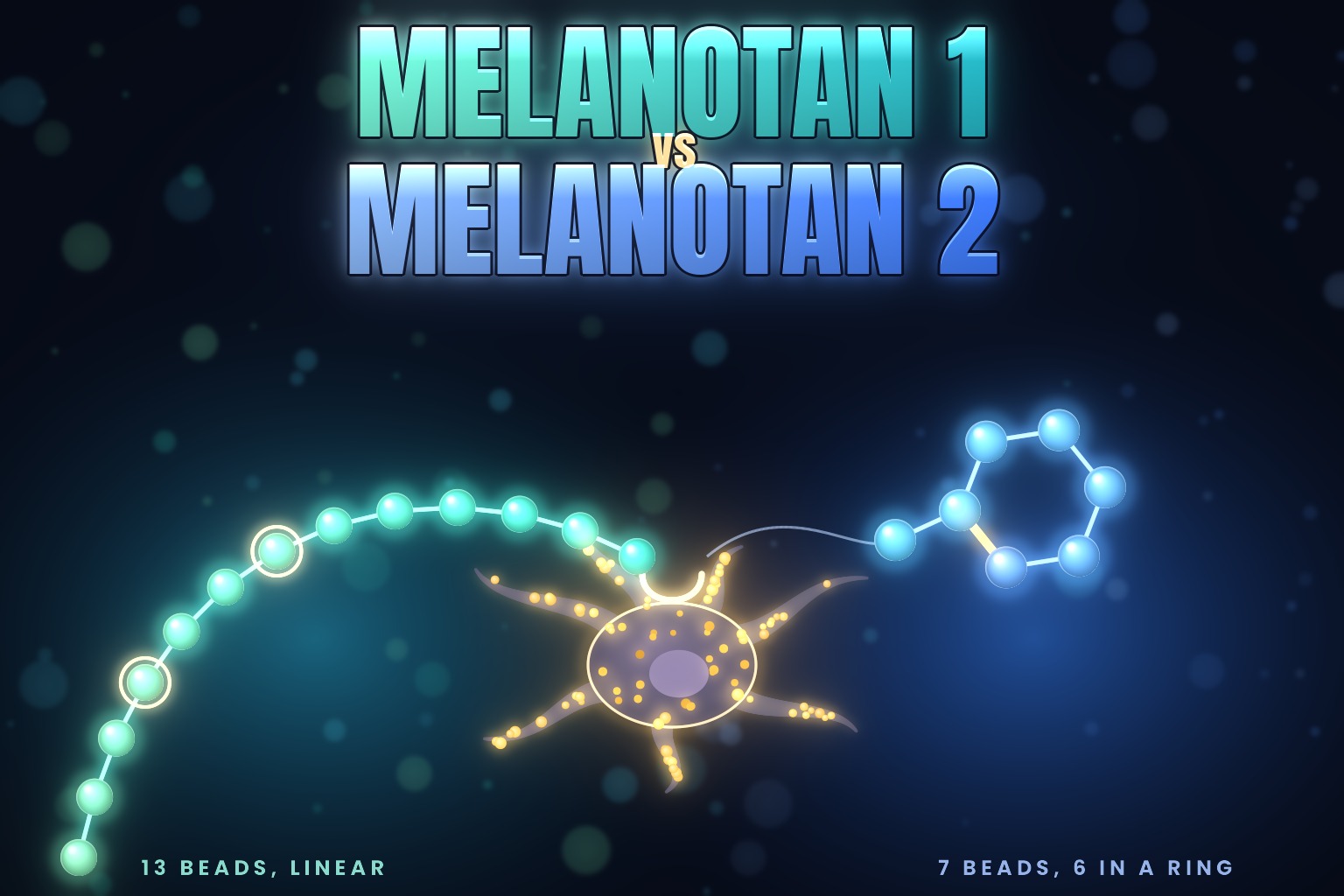
Same research group, same starting hormone, two different molecules. Melanotan 1 went on to trials with dozens of people, then into implant trials for skin disease. Melanotan 2 tanned two of the three men in its first study, and a side effect seen in that study sent it down a different path.
Here’s how the two differ, chain by chain and study by study.
Where Melanotan 1 and Melanotan 2 Come From
Both start from alpha-melanocyte-stimulating hormone (alpha-MSH), the 13-amino-acid hormone your skin uses to tan. After UV exposure, alpha-MSH binds the melanocortin-1 receptor (MC1R) on melanocytes, the pigment cells, and they step up melanin production.
Researchers including Victor Hruby and Mac Hadley set out to build versions of alpha-MSH that were stronger and lasted longer, and the same group, with Robert Dorr and Norman Levine, ran the first human studies.
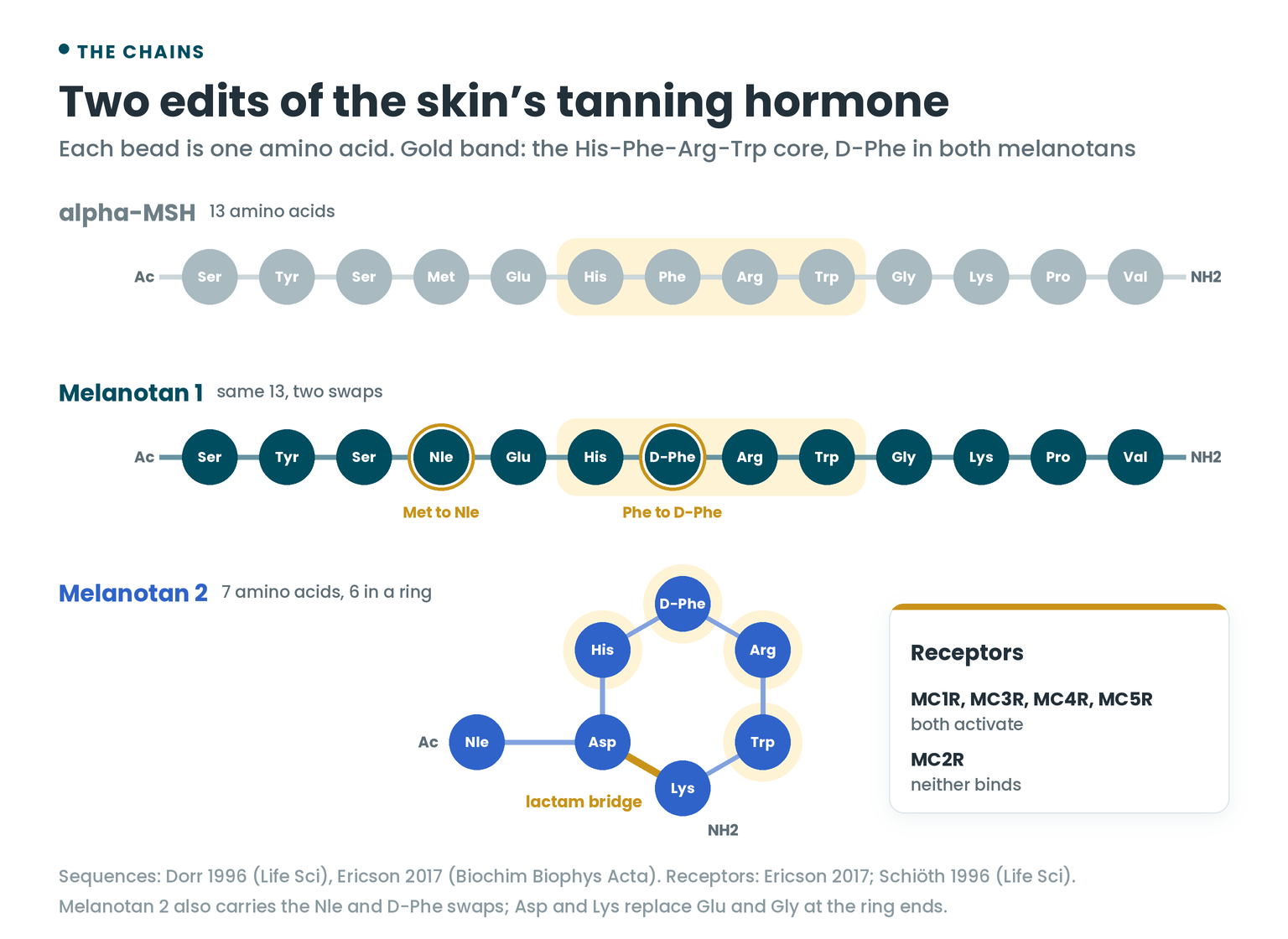
Melanotan 1 keeps all 13 amino acids and changes two. Methionine at position 4, which oxidizes easily, becomes norleucine, and phenylalanine at position 7 becomes its mirror-image form, D-phenylalanine. The result is [Nle4, D-Phe7]-alpha-MSH, or NDP-MSH, which resists breakdown and was active in early lab work at a thousandth of the concentration natural alpha-MSH needs. Its drug name is afamelanotide.
Melanotan 2 is cut down and looped. Three amino acids come off each end, leaving seven, and it carries the same two swaps as Melanotan 1. Glutamic acid at position 5 becomes aspartic acid, glycine at position 10 becomes lysine, and a lactam bridge between those two closes six of the seven into a loop, leaving norleucine as a short tail. Both molecules keep the same four-residue core, His-D-Phe-Arg-Trp, the part that activates the receptors.
Same Receptors, Different Footprints
There are five melanocortin receptors, and they do very different jobs:
- MC1R on pigment cells drives tanning.
- MC2R in the adrenal glands responds only to ACTH, the hormone that triggers cortisol.
- MC3R and MC4R are the main melanocortin receptors in the brain, where MC4R is central to appetite and energy balance and is the leading candidate for the erection effect.
- MC5R is found at high levels in exocrine glands such as the sebaceous glands; mice without it make less skin oil.
Neither peptide is choosy. Both are potent agonists at MC1R, MC3R, MC4R and MC5R. In one lab’s cell experiments, NDP-MSH bound the skin’s MC1R about 45 times more tightly than the brain’s MC4R, while MC2R ignored it completely.
The differences between the two show up in the human studies.
Tanning: What the Human Studies Measured
Melanotan 1 has the longer record:
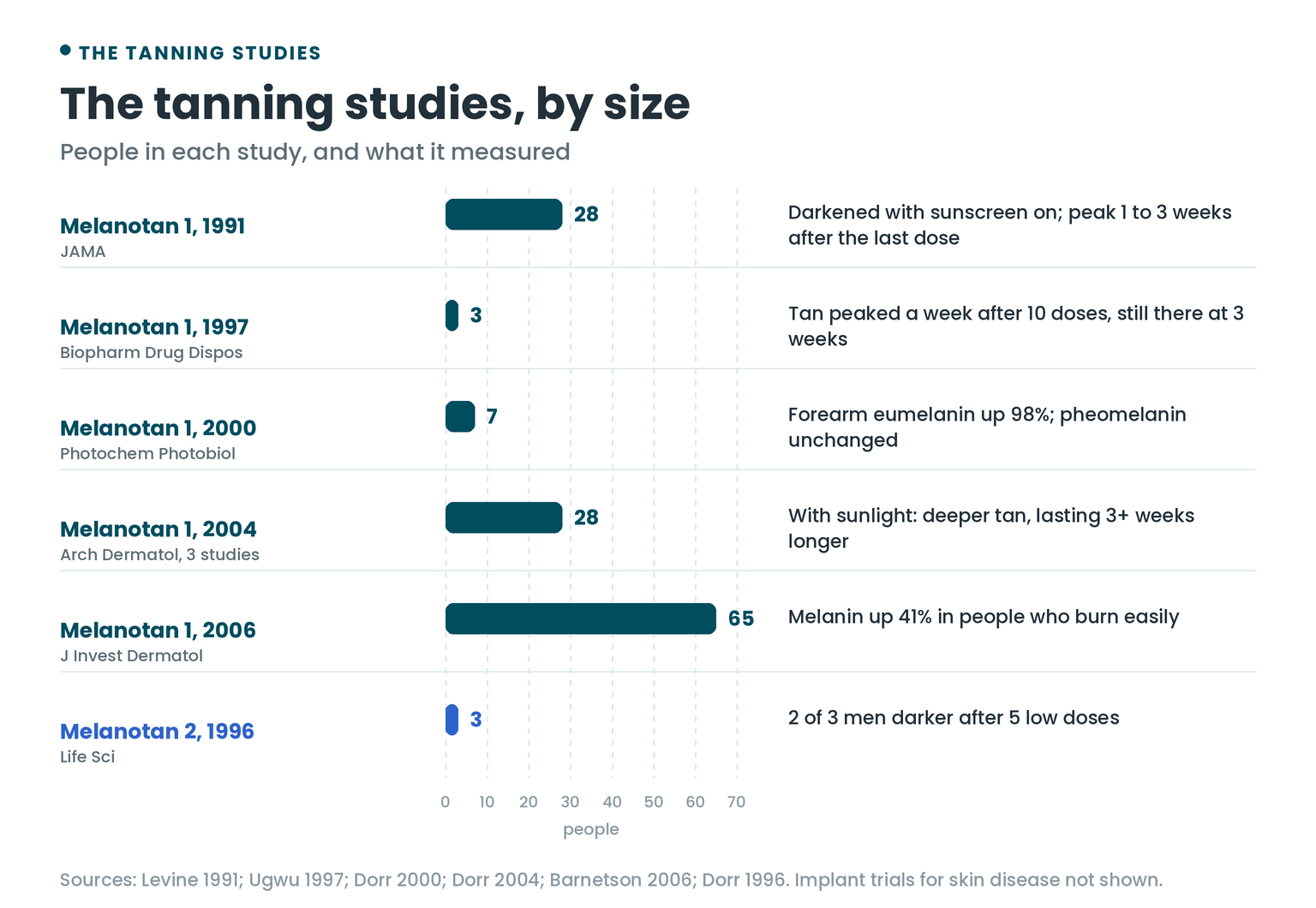
- 1991, 28 men: 10 injections over 12 days, with everyone wearing high-potency sunscreen. Skin darkened in poor tanners and good tanners alike, with the peak one to three weeks after the last dose. Nobody on placebo darkened.
- 2000, 7 volunteers: skin biopsies showed eumelanin, the brown-black pigment, up 98% on the forearm and 49% on the forehead a week after dosing, while pheomelanin, the red-yellow pigment, didn’t change.
- 2004, three small studies: paired with sunlight, Melanotan 1 deepened the tan on the back, and that tan lasted at least three weeks longer than in people who used sunlight alone. The sun-only group needed 50% more time in the sun for an equal tan.
- 2006, 65 fair-skinned volunteers: three 10-day courses over three months raised melanin by 41% in people who burn easily and 12% in those who burn less easily. In the easy-burners, sunburn cells after a measured UV dose dropped by more than half, and DNA damage in the form of thymine dimers fell 59% in the basal layer, the deepest layer of the epidermis.
Melanotan 2 has one tanning study: a 1996 pilot in three men. After five low doses, two of them were visibly darker on the face, upper body and buttocks a week after dosing ended.
How fast the tan shows up
In a 1997 study of three men, Melanotan 1’s tan peaked a week after the last of 10 doses and was still there three weeks after dosing ended. The peptide itself clears quickly, with a half-life of about 0.8 to 1.7 hours after an injection under the skin, and none was detectable in the blood when it was taken by mouth. The pigment it triggers outlasts the drug by weeks.
Melanotan 1 in Medicine
As afamelanotide, Melanotan 1 moved from cosmetic tanning into skin disease, given as an implant under the skin:
- Erythropoietic protoporphyria (EPP), a genetic condition that makes sunlight painful. Two randomized trials with 168 patients in total tested the implants against placebo. Pain-free time in direct sunlight totaled a median 69.4 hours against 40.8 on placebo over six months in the US trial, and 6.0 against 0.8 hours over nine months in the European one, which also recorded fewer phototoxic reactions, 77 against 146.
- Vitiligo: in 55 patients on narrowband UVB light therapy, adding the implants raised repigmentation to 48.6% against 33.3% with light alone by day 168, and it showed up sooner on the face and arms.
- Acne: a three-patient pilot saw fewer lesions in all three, along with darker skin, especially on the face.
Melanotan 2 and the Erection Discovery
The 1996 Melanotan 2 pilot recorded something nobody had asked for. A stretching and yawning spell came on with spontaneous erections that lasted on and off for one to five hours after a dose.
The same group followed it up in men with erectile dysfunction:
- 1998, 10 men with psychogenic ED: erections in 8 of 10, with strong rigidity lasting a mean 38 minutes against 3 on placebo.
- 2000, 10 men with organic risk factors: erections after 12 of 19 injections against 1 of 21 placebo doses, with sexual desire rated higher too.
Rat work traced the effect to melanocortin receptors in the brain and the lower spinal cord, rather than in the penis itself. Bremelanotide, a close relative studied for low sexual desire in women, is Melanotan 2 with an acid group in place of the amide at its tail end.
The Research, Side by Side
Every human study above, plus key animal work and a selection of the published case reports, on one timeline. Tap a dot for what the study found; the bigger the dot, the more people in it.
Side Effects in the Studies and the Case Reports
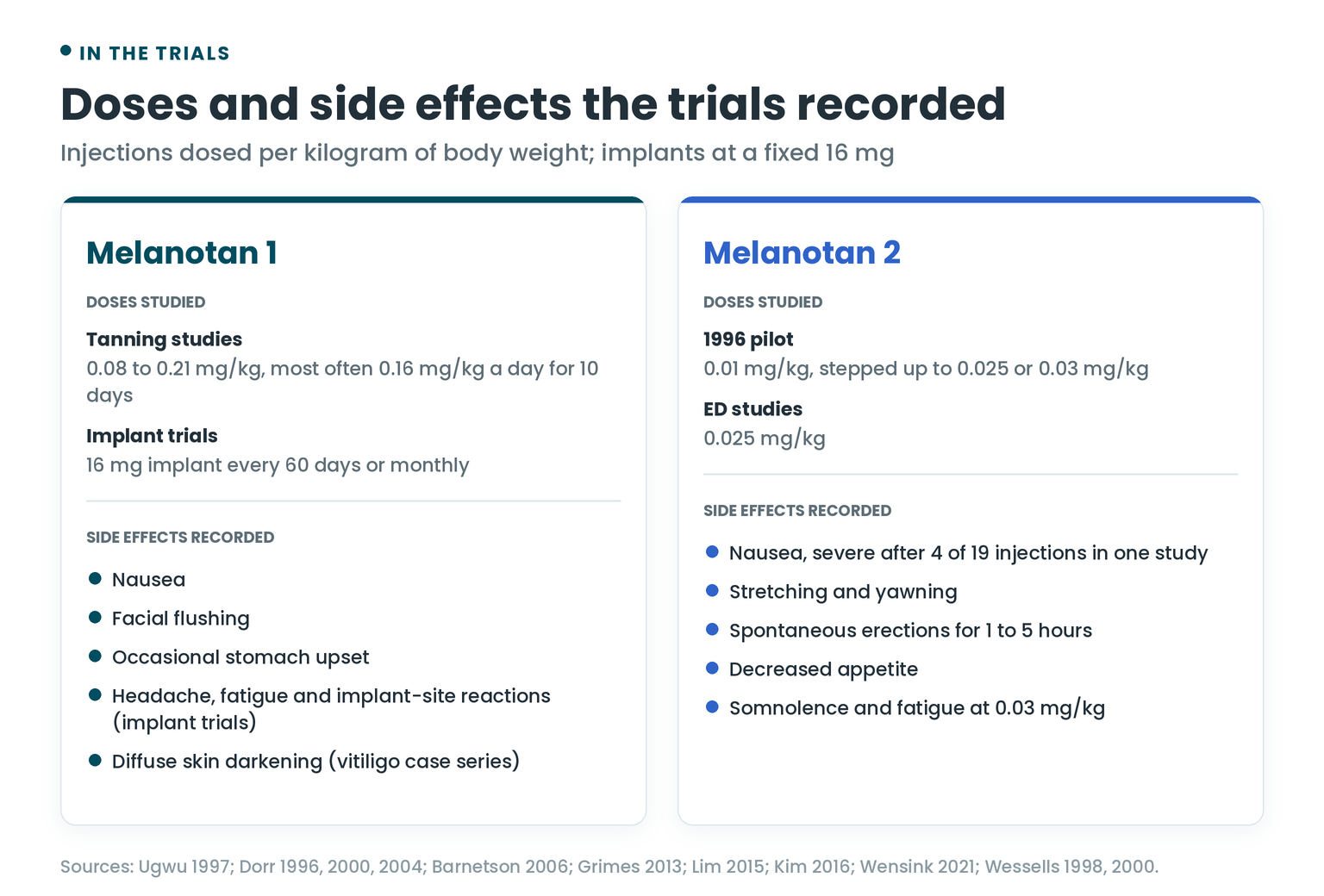
In the trials, Melanotan 1’s side effects were occasional stomach upset, nausea and facial flushing. The implant trials add headache, fatigue and implant-site reactions, and the four people in a vitiligo case series all developed diffuse darkening of their skin.
Melanotan 2’s small trials logged nausea at most doses (severe after 4 of 19 injections in the 2000 study), the stretching and yawning, decreased appetite, and somnolence and fatigue in one of two men at 0.03 mg/kg, its highest dose.
Outside the trials, case reports describe people injecting products sold as melanotan, often named as Melanotan 2:
- Moles: new and atypical moles, and existing moles darkening, in one case within a day of a single injection. A 2017 review linked both Melanotan 1 and 2 to these changes and counted four melanomas arising from existing moles during or shortly after use, while noting that conclusive evidence of a link is lacking.
- Melanoma: a 20-year-old woman with fair skin developed a melanoma three months after a three-to-four-week course of Melanotan 2 combined with sunbeds.
- Muscle and kidneys: one man injected 6 mg of Melanotan 2 and needed intensive care for systemic toxicity and rhabdomyolysis, with creatine kinase peaking at 17,773 IU/L; another case linked Melanotan 2 to a kidney infarction.
- Priapism: erections that wouldn’t go down, one needing surgery to drain.
In one of the starkest reports, a man with a past melanoma and multiple atypical moles developed new crops of moles, many of them atypical, while injecting synthetic alpha-MSH, and they faded after he stopped. The ABCDE mole checks are laid out in our Melanotan 2 guide.
Doses Used in the Research
- Melanotan 1, tanning studies: 0.08 to 0.21 mg/kg under the skin, most often 0.16 mg/kg a day for 10 days
- Melanotan 1, implant trials: 16 mg every 60 days (EPP) or monthly for four months (vitiligo)
- Melanotan 2, 1996 pilot: 0.01 mg/kg, stepped up to 0.025 or 0.03 mg/kg
- Melanotan 2, ED studies: 0.025 mg/kg
Per kilogram, the Melanotan 2 doses were roughly a sixth of Melanotan 1’s. For more on Melanotan 1 specifically, see Melanotan 1 Dosage.
FAQ
What is the difference between Melanotan 1 and Melanotan 2?
Melanotan 1 is the full 13-amino-acid alpha-MSH chain with two swaps. Melanotan 2 is a seven-residue chain, six of them closed into a ring, built around the same His-D-Phe-Arg-Trp core.
Is Melanotan 1 the same as afamelanotide?
Yes. Afamelanotide is the drug name for Melanotan 1, [Nle4, D-Phe7]-alpha-MSH.
Which melanotan has more human research?
Melanotan 1, with tanning studies of up to 65 people and implant trials with 168 EPP patients. Melanotan 2’s human studies had three and ten men.
Why does Melanotan 2 cause erections?
In rats, it acted on melanocortin receptors in the brain and lower spinal cord rather than in the penis, and MC4R is the leading candidate receptor for the effect.
Does Melanotan 1 work without sun?
In the 1991 study, men darkened while wearing high-potency sunscreen, and the authors concluded tanning appeared possible without harmful UV exposure. Paired with sunlight in 2004, it produced a deeper, longer-lasting tan.
References
- Levine N, et al. Induction of skin tanning by subcutaneous administration of a potent synthetic melanotropin. JAMA. 1991;266(19):2730-2736. PubMed
- Dorr RT, et al. Toxicologic studies of a superpotent alpha-melanotropin, [Nle4, D-Phe7]alpha-MSH. Invest New Drugs. 1988;6(4):251-258. DOI
- Ugwu SO, et al. Skin pigmentation and pharmacokinetics of melanotan-I in humans. Biopharm Drug Dispos. 1997;18(3):259-269. PubMed
- Dorr RT, et al. Increased eumelanin expression and tanning is induced by a superpotent melanotropin [Nle4-D-Phe7]-alpha-MSH in humans. Photochem Photobiol. 2000;72(4):526-532. PubMed
- Dorr RT, et al. Effects of a superpotent melanotropic peptide in combination with solar UV radiation on tanning of the skin in human volunteers. Arch Dermatol. 2004;140(7):827-835. DOI
- Barnetson RStC, et al. [Nle4-D-Phe7]-alpha-melanocyte-stimulating hormone significantly increased pigmentation and decreased UV damage in fair-skinned Caucasian volunteers. J Invest Dermatol. 2006;126(8):1869-1878. DOI
- Dorr RT, et al. Evaluation of melanotan-II, a superpotent cyclic melanotropic peptide in a pilot phase-I clinical study. Life Sci. 1996;58(20):1777-1784. DOI
- Wessells H, et al. Synthetic melanotropic peptide initiates erections in men with psychogenic erectile dysfunction: double-blind, placebo controlled crossover study. J Urol. 1998;160(2):389-393. PubMed
- Wessells H, et al. Effect of an alpha-melanocyte stimulating hormone analog on penile erection and sexual desire in men with organic erectile dysfunction. Urology. 2000;56(4):641-646. DOI
- Wessells H, et al. Ac-Nle-c[Asp-His-DPhe-Arg-Trp-Lys]-NH2 induces penile erection via brain and spinal melanocortin receptors. Neuroscience. 2003;118(3):755-762. DOI
- King SH, et al. Melanocortin receptors, melanotropic peptides and penile erection. Curr Top Med Chem. 2007;7(11):1098-1106. PubMed
- Ericson MD, et al. Bench-top to clinical therapies: a review of melanocortin ligands from 1954 to 2016. Biochim Biophys Acta Mol Basis Dis. 2017;1863(10 Pt A):2414-2435. DOI
- Schiöth HB, et al. Characterisation of melanocortin receptor subtypes by radioligand binding analysis. Eur J Pharmacol. 1995;288(3):311-317. DOI
- Schiöth HB, et al. Characterisation of the melanocortin 4 receptor by radioligand binding. Pharmacol Toxicol. 1996;79(3):161-165. DOI
- Schiöth HB, et al. Major pharmacological distinction of the ACTH receptor from other melanocortin receptors. Life Sci. 1996;59(10):797-801. DOI
- Chen W, et al. Exocrine gland dysfunction in MC5-R-deficient mice: evidence for coordinated regulation of exocrine gland function by melanocortin peptides. Cell. 1997;91(6):789-798. DOI
- Fani L, et al. The melanocortin-4 receptor as target for obesity treatment: a systematic review of emerging pharmacological therapeutic options. Int J Obes (Lond). 2014;38(2):163-169. DOI
- Langendonk JG, et al. Afamelanotide for erythropoietic protoporphyria. N Engl J Med. 2015;373(1):48-59. DOI
- Lim HW, et al. Afamelanotide and narrowband UV-B phototherapy for the treatment of vitiligo: a randomized multicenter trial. JAMA Dermatol. 2015;151(1):42-50. DOI
- Grimes PE, et al. The efficacy of afamelanotide and narrowband UV-B phototherapy for repigmentation of vitiligo. JAMA Dermatol. 2013;149(1):68-73. DOI
- Böhm M, et al. Beneficial effects of the melanocortin analogue Nle4-D-Phe7-α-MSH in acne vulgaris. J Eur Acad Dermatol Venereol. 2014;28(1):108-111. DOI
- Kim ES, Garnock-Jones KP. Afamelanotide: a review in erythropoietic protoporphyria. Am J Clin Dermatol. 2016;17(2):179-185. DOI
- Wensink D, et al. Afamelanotide for prevention of phototoxicity in erythropoietic protoporphyria. Expert Rev Clin Pharmacol. 2021;14(2):151-160. DOI
- Habbema L, et al. Risks of unregulated use of alpha-melanocyte-stimulating hormone analogues: a review. Int J Dermatol. 2017;56(10):975-980. DOI
- Cardones AR, Grichnik JM. alpha-Melanocyte-stimulating hormone-induced eruptive nevi. Arch Dermatol. 2009;145(4):441-444. DOI
- Schulze F, et al. Eruptive naevi and darkening of pre-existing naevi 24 h after a single mono-dose injection of melanotan II. Eur J Dermatol. 2014;24(1):107-109. DOI
- Hjuler KF, Lorentzen HF. Melanoma associated with the use of melanotan-II. Dermatology. 2014;228(1):34-36. DOI
- Nelson ME, et al. Melanotan II injection resulting in systemic toxicity and rhabdomyolysis. Clin Toxicol (Phila). 2012;50(10):1169-1173. DOI
- Peters B, et al. Melanotan II: a possible cause of renal infarction: review of the literature and case report. CEN Case Rep. 2020;9(2):159-161. DOI
- Mallory CW, et al. Melanotan tanning injection: a rare cause of priapism. Sex Med. 2021;9(1):100298. DOI
- Alsabbagh AY, et al. Melanotan II nasal spray: a possible risk factor for oral mucosal malignant melanoma? Int J Oral Maxillofac Surg. 2025;54(9):806-808. DOI
Stay sharp,
Joe Mars
The Peptide Report
P.S. Got a question about either melanotan, or a study you’d like a second pair of eyes on? Bring it to the Peptides and Biohacking Hub on Skool and let’s work through it. See you inside.