
Table of Contents

Look, I get it.
You want a tan without spending hours in the sun.
You’ve probably heard about Melanotan peptides and now you’re trying to figure out which one actually makes sense.
Melanotan 1 or Melanotan 2?
I’ve been around peptides for over ten years. I’ve watched how different people respond and which compounds people actually stick with long term.
This guide keeps it simple.
No guessing. No overthinking. Just a clear breakdown.
Get Your Free Copy of The Ultimate Peptide Blueprint
Exact stacks, dosages & cutting-edge protocols to cut fat, build muscle, and keep results-no fluff.
No spam. Unsubscribe anytime.
What Are Melanotan Peptides?
Melanotan peptides are compounds that signal your body to produce more melanin.
Melanin is the pigment responsible for skin color.
The more melanin your skin produces, the darker your skin becomes.
Melanotan peptides work by mimicking a natural hormone that controls pigmentation. Instead of relying on constant sun exposure, your skin becomes more efficient at tanning with far less UV exposure.
That’s why Melanotan peptides are often used to build a base tan and maintain color with less time in the sun.
Melanotan 1 vs Melanotan 2: The Key Difference
Both Melanotan 1 and Melanotan 2 are tanning peptides.
Both increase melanin production.
But they do not behave the same way.
Melanotan 1 works gradually. The tan builds slowly and tends to look more natural.
Melanotan 2 works faster, but that speed is not always necessary and often harder to manage.
For most people, especially those new to tanning peptides, Melanotan 1 is the more practical option.
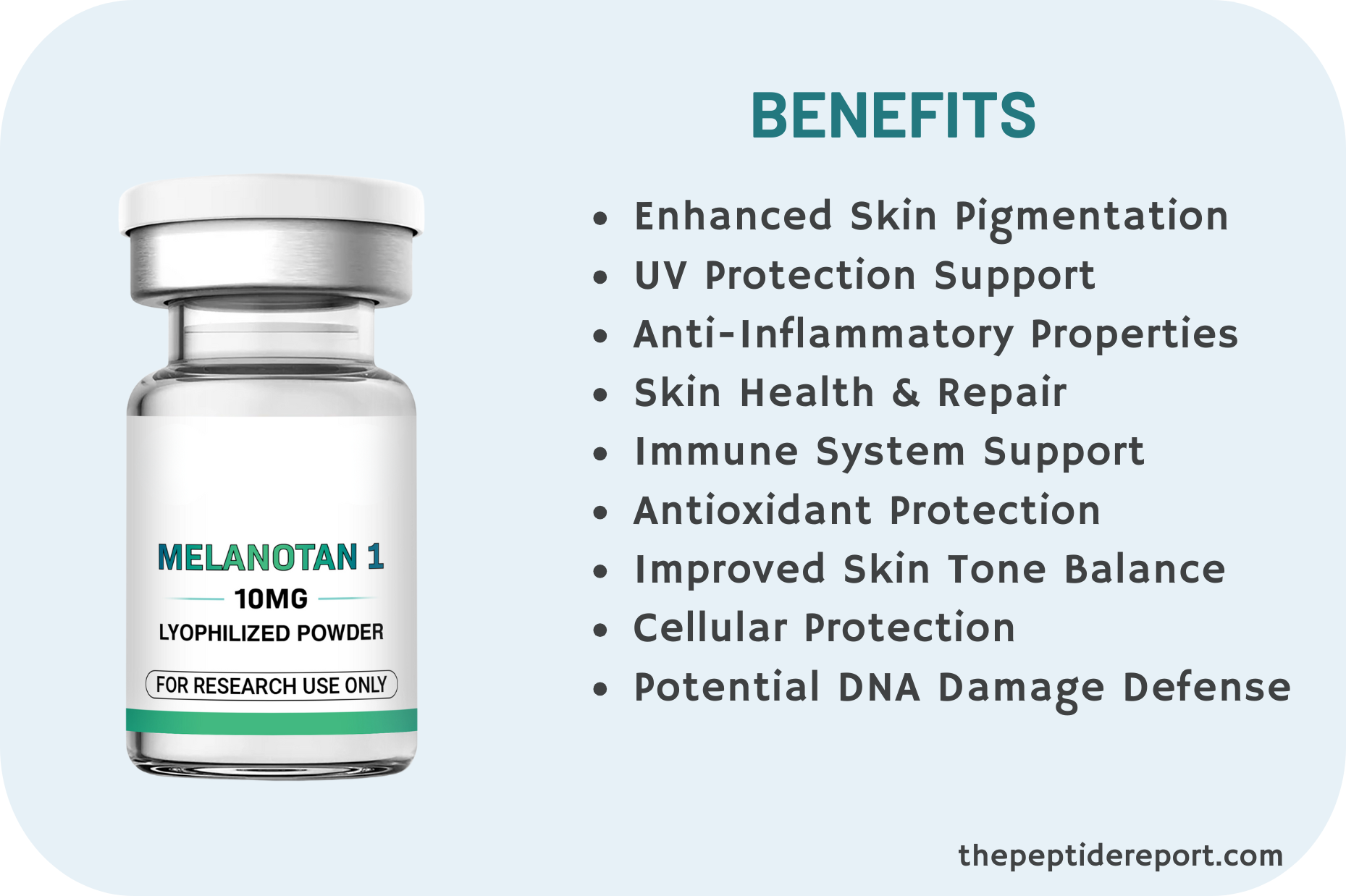
Why Melanotan 1 Is the Preferred Tanning Peptide
When people ask me which tanning peptide I recommend starting with, the answer is almost always Melanotan 1.
Melanotan 1 supports the body’s natural tanning response instead of pushing rapid pigment changes.
The results come on steadily. The color looks even. And once a base tan develops, it is easier to maintain.
Melanotan 1 is especially popular with people who want consistent results without constantly adjusting dosing.
If your goal is a controlled, predictable tan, Melanotan 1 for tanning makes more sense than jumping straight to Melanotan 2.
How Melanotan 1 Works in the Body
Melanotan 1 binds to receptors on melanocytes.
Melanocytes are the cells responsible for producing melanin.
Once those receptors are activated, melanin production increases over time. That pigment then spreads throughout the skin.
This is why Melanotan 1 results tend to look natural and last longer compared to short term tanning methods.
You are not forcing color onto the skin. You are supporting a process your body already knows how to run.
What Results to Expect From Melanotan 1
Melanotan 1 is not instant.
Most people begin to notice Melanotan 1 results within three to four weeks.
Color develops gradually and becomes easier to maintain once a base tan is established.
Some sun exposure still plays a role, but far less is needed compared to traditional tanning. Short, controlled exposure is usually enough.
For many people, Melanotan 1 becomes a long term solution rather than something they cycle on and off.
How to Approach Melanotan 1 Dosing
Dosing matters.
Starting low and staying consistent produces better Melanotan 1 results than rushing the process.
Melanotan 1 is typically injected subcutaneously. Injection sites should be rotated and adjustments made gradually based on how your skin responds.
Patience here pays off.
Choosing a Reliable Melanotan 1 Source
This part is important.
Melanotan peptides are not regulated like prescription medications. Quality can vary widely depending on the source.
If you are looking to buy Melanotan 1, sourcing from a lab that provides verified testing matters.
I personally use Melanotan 1 from BioEdge Research Labs. Their Melanotan 1 peptide is consistently dosed and matches what their lab reports show.
Peptides can get expensive, but as an FYI - BioEdge is doing 15% off this month (code mars15 at bioedgepeptides.com), one of the few suppliers that consistently delivers what their lab reports claim.
Where Melanotan 2 Fits In
Melanotan 2 exists and it does increase melanin more aggressively.
But for most users, that extra intensity is not required.
If you are new to Melanotan peptides or simply want a smoother, more predictable experience, Melanotan 1 is usually the better place to start.
That is also why it is the option most people continue using.
If you want to try Melanotan 1, I get mine from BioEdge Research Labs. Third-party tested. Reliable. Use code MARS15 for 15% off your order.
Joe Mars
The Peptide Report
This content is for educational purposes only. Peptides should be used under proper supervision. Always consult qualified healthcare providers before beginning any peptide protocol.
P.S. Join Our Skool Group for real protocols, Q&A, and community support.

I’m Joe Mars, and I’ve dedicated the past ten years to understanding peptide therapy, longevity, and how to optimize the body through practical, real-life testing. My journey started when I was tired, inflamed, and aging faster than I should have been. Clear information on peptides was almost impossible to find, so I dug in, researched nonstop, and tested protocols on myself.
Over the years, I have learned from experts like Jay Campbell, Dr. Seeds, Jim LaValle, and Ben Greenfield, and I have completely transformed my health. Now in my fifties, I feel stronger and sharper than I did in my twenties. That experience is why I write. I want to give people simple and honest guidance so they can use peptides safely and effectively.
I believe in data, smart protocols, and taking responsibility for your own health. You are the protocol. Your habits, your consistency, and your awareness shape your results. Through The Peptide Report, I share what actually works so you can make informed decisions and build a healthier, more resilient body.
Peptides can get expensive, but as an FYI - BioEdge is doing 15% off this month (code mars15 at bioedgepeptides.com), one of the few suppliers that consistently delivers what their lab reports claim.