When people talk about a mitochondrial stack, you hear the same three names every time. MOTS-c. SS-31. NAD+.
Nobody is talking about Humanin.
That is a problem, because Humanin is one of the most important peptides in this entire category. It was the first mitochondrial-derived peptide ever discovered, back in 2001. Your own mitochondria wrote the code for it. And it does a job none of the other three do.
The other three are about output. More energy, more new mitochondria, more efficient electron flow. Humanin is about protection. It guards the mitochondria you already have from the stress and damage that wear them down as you age. Leave it out of your stack and you are working hard to build and fuel engines while ignoring the wear and tear killing the ones you have.
I have spent 10 years in this space, and Humanin is one of the more interesting peptides I have come across, because it flips the whole “optimize your output” mindset on its head. This is the full breakdown. What it does at the mitochondrial level, what the research points to for the brain, heart, and metabolism, how to dose it without falling into the trap that catches almost everyone, and how it fits into a complete mitochondrial recovery stack.
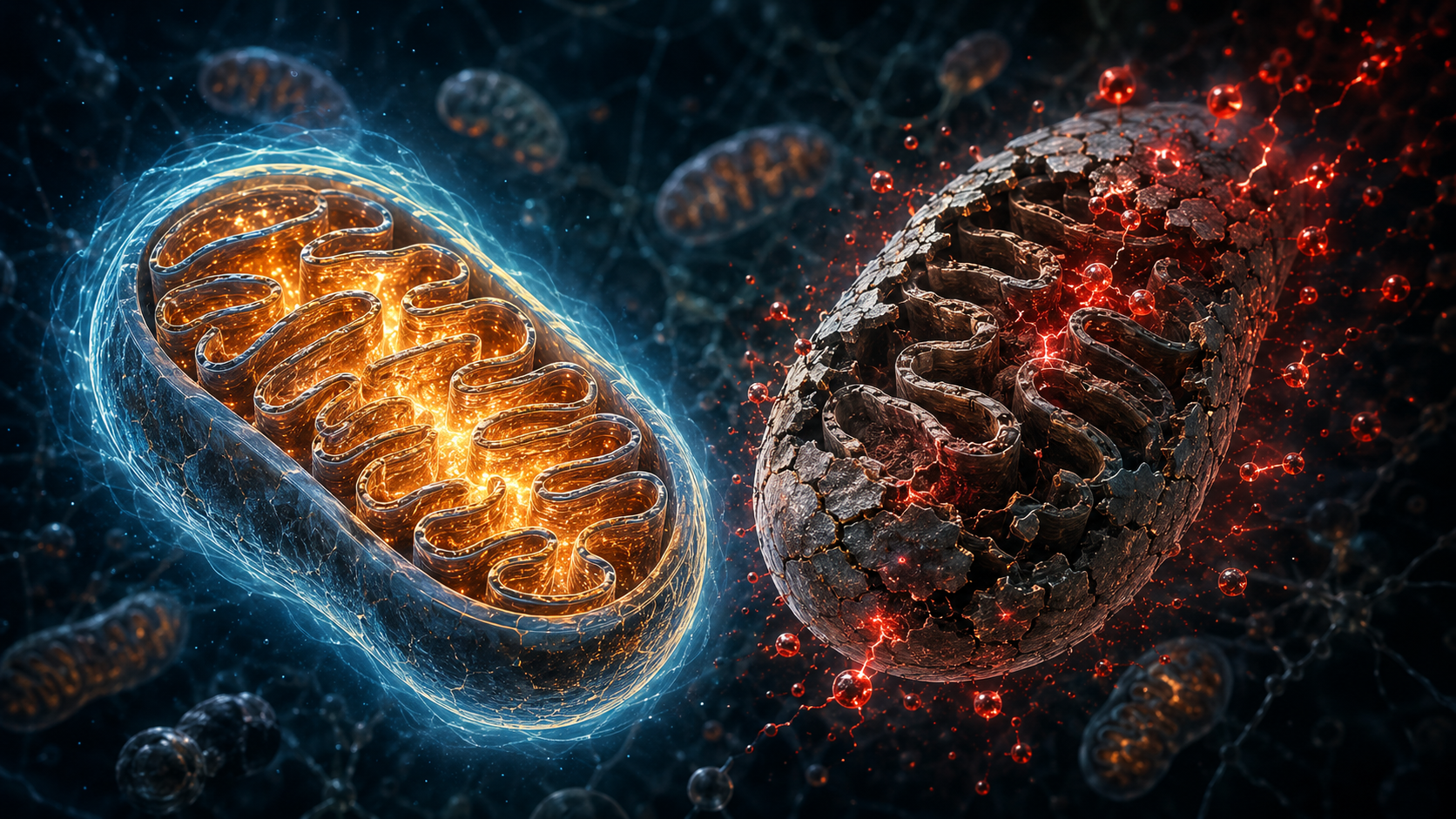
Humanin does not push mitochondria to work harder. It keeps them sealed, charged, and alive under the oxidative stress that wears them down with age.
What Is Humanin?
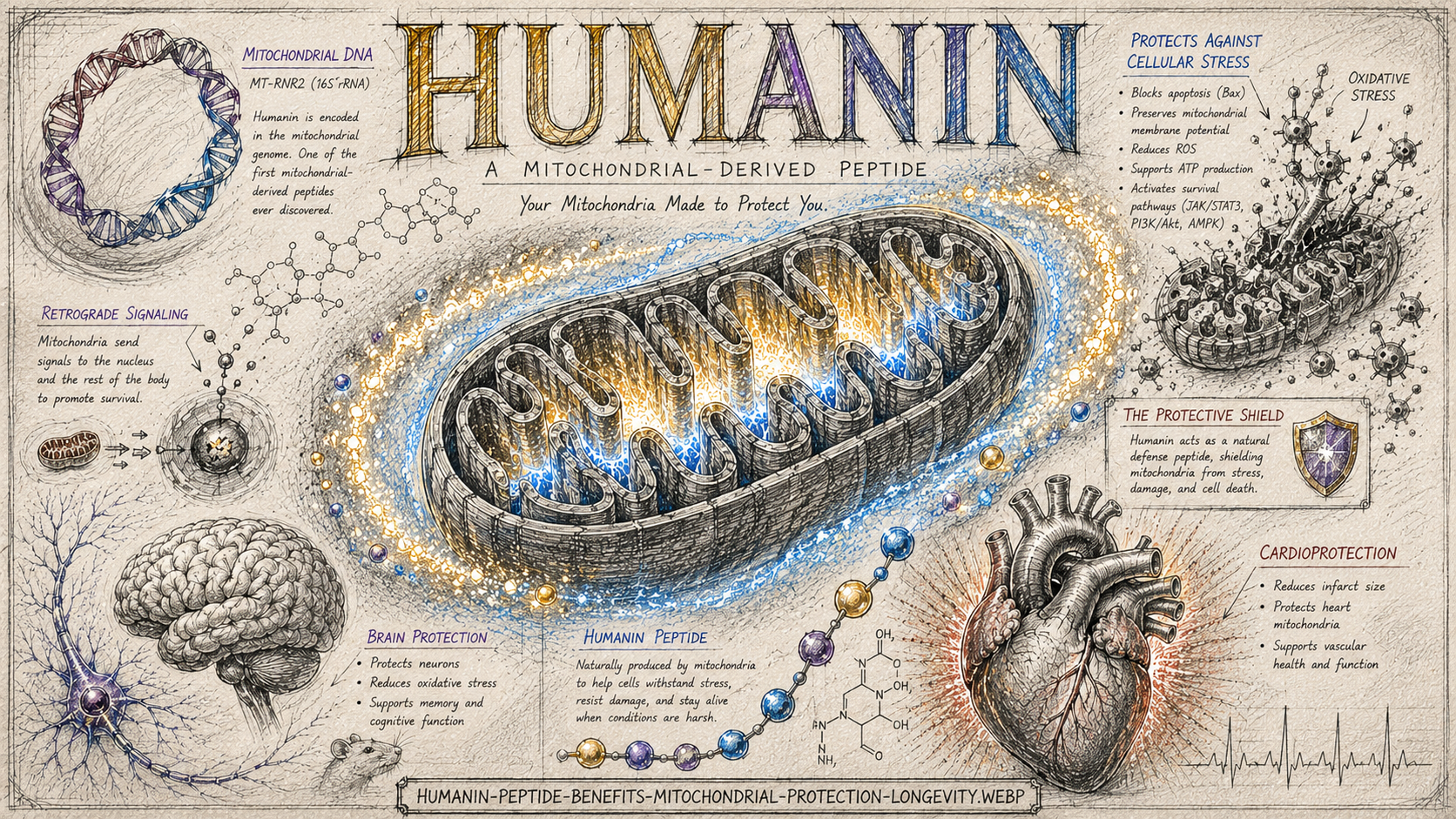
Humanin is a mitochondrial-derived peptide, or MDP. That means it is not coded by the DNA in the nucleus of your cells like almost every other protein in your body. It is coded inside your mitochondria, in a region of the mitochondrial genome called the 16S rRNA gene (MT-RNR2).
It was the first MDP ever discovered. Researchers found it in 2001 during Alzheimer’s research, as a factor that kept neurons alive against the toxic proteins tied to the disease. That discovery opened up an entire new category of biology. MOTS-c and the SHLP peptides came later. Humanin was first.
The peptide is 24 amino acids long when it is made in the cell body, 21 when it is made inside the mitochondria. Small peptide. Big job. It shows up throughout the body, in the heart, blood vessels, kidney, brain, and skeletal muscle.
Here is the part that still gets me. Your mitochondria are not just power plants sitting there burning fuel. They send signals out to the rest of the cell. They talk. Researchers call it retrograde signaling, the mitochondria reaching back to the cell and the body to say “here is what I need to survive stress.” Humanin is one of those messages.
And Humanin levels drop as you age. Same story as MOTS-c. The signal that keeps your mitochondria protected gets quieter right when you need it most.
How Humanin Works at the Mitochondrial Level
This is where it gets good. The research here is preclinical, meaning cell and animal studies plus some human association data, not completed human trials. I will say that again later because it matters. But the mechanisms are well mapped.
Humanin is cytoprotective and anti-apoptotic. In plain English, it stops cells from dying when they are under stress. And it does it largely by protecting the mitochondria.
Here is how it works at the engine level:
It blocks the death switch. Inside every cell there is a pathway that triggers cell death, called the intrinsic or mitochondrial apoptosis pathway. It runs through a family of proteins, with one bad actor named Bax. When Bax pokes holes in the mitochondrial membrane, the cell dies. Humanin binds Bax and blocks that. It keeps the membrane intact.
It defends mitochondrial membrane potential. Your mitochondria run on an electrical gradient across their membrane. Lose that gradient and the engine stalls. In cardiac cell studies, when researchers hit cells with oxidative stress, Humanin preserved the membrane potential, preserved ATP levels, and preserved the actual physical structure of the mitochondria.
It cuts oxidative stress. Mitochondria are the main place your body makes reactive oxygen species, or ROS. Too much ROS and you get damage. Humanin lowers intracellular ROS and fires up your own antioxidant defenses.
It works through known signaling pathways. Humanin acts through receptors on the cell surface (FPRL1 and the IGFBP-3 interaction) and through pathways inside the cell. The big ones are JAK/STAT3 and PI3K/Akt, and it touches AMPK too. These are the same pathways that govern survival and energy balance.
It can lift ATP. Some research notes Humanin can raise cellular ATP even when there is no obvious energy shortage. So it is not only damage control. It supports the actual energy output of the cell.
Put it together. Humanin does not make your mitochondria produce more. It keeps them alive, keeps them sealed, keeps them charged, and keeps the damage down. That is a completely different job than anything else in your stack.
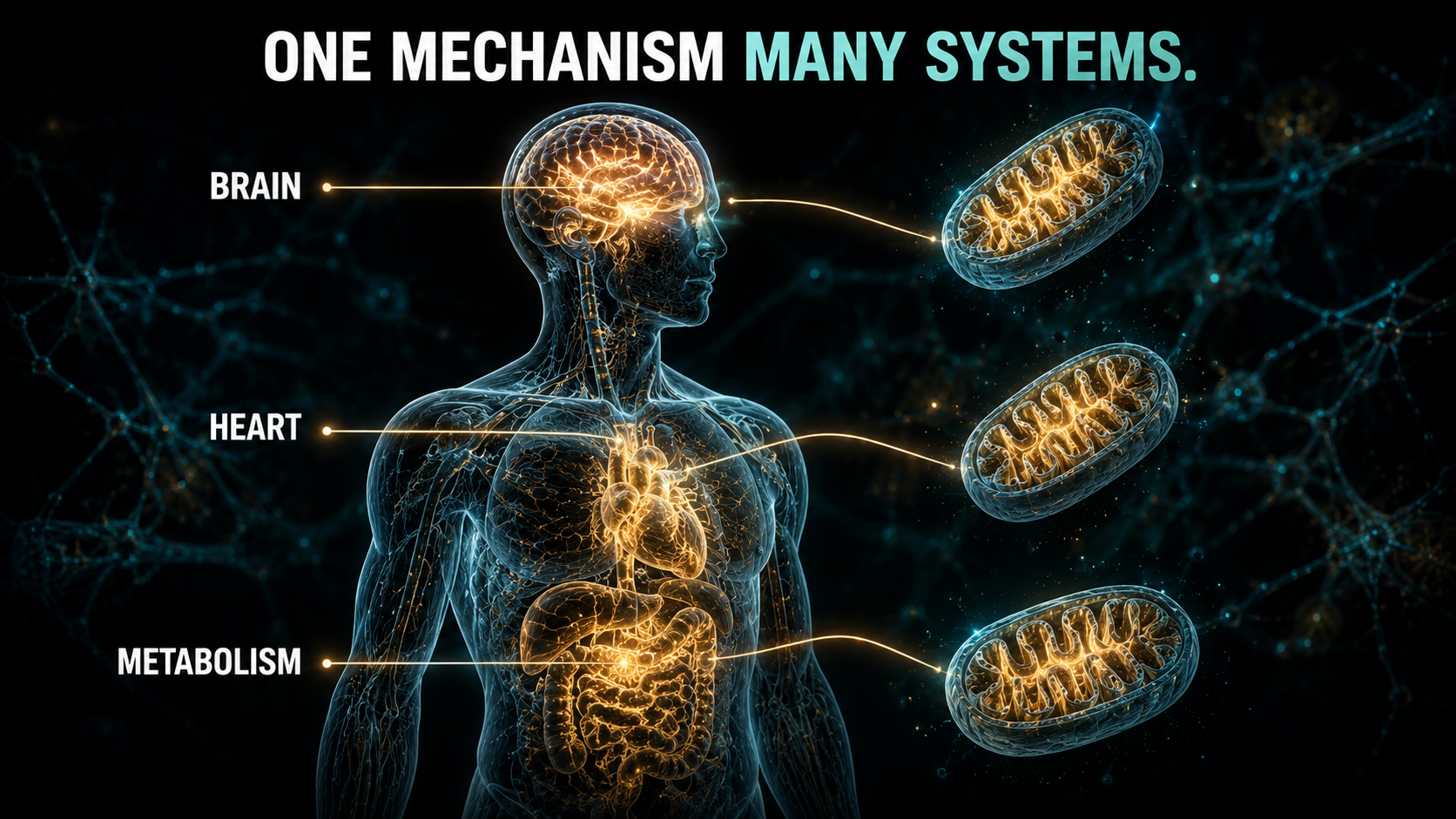
The thread across the research is the same everywhere it reaches. Protect the mitochondria, protect the cell, and the brain, heart, and metabolism hold up better.
Humanin Benefits: What the Research Points To
The mitochondrial protection is the core of it, but the research on Humanin reaches into a lot of areas that matter as you age. Keep in mind this is preclinical and association data, not proof in humans. But the picture is consistent.
Brain and Memory
Humanin was discovered in Alzheimer’s research in the first place, because it kept neurons alive against the toxic proteins tied to the disease. Animal work shows Humanin can improve memory and cognition in aged mice, with the effect tied to better mitochondrial function. In people, lower Humanin levels track with faster cognitive aging and higher dementia risk. The brain runs on mitochondria, so a peptide that protects them showing up in the brain data makes sense.
Heart and Cardiovascular Health
This is one of the strongest areas. In animal models of heart attack and reperfusion injury, Humanin analogs cut infarct size, improved heart function, and protected the heart’s mitochondria from dysfunction. In people, lower circulating Humanin tracks with worse coronary function and more atherosclerosis. The body even appears to crank out more Humanin as a protective response when oxidative stress climbs.
Blood Sugar and Metabolism
Humanin levels run lower in people with type 2 diabetes, and they track inversely with markers like HbA1c and glucose. In diabetic animals, Humanin improved insulin sensitivity in both the liver and muscle, and a potent form sharply lowered blood sugar. This is part of why people focused on metabolic health pay attention to it.
Longevity
This is the one that gets the most attention. Humanin levels decline with age across species. The standouts are the exceptions. The naked mole rat, which barely seems to age, keeps stable Humanin. And children of centenarians, who tend to become centenarians themselves, carry much higher Humanin than their peers. One landmark study was the first to show that boosting Humanin was enough to extend lifespan, working through the same insulin and IGF-1 (FOXO) pathways tied to aging across the animal kingdom.
Protecting Healthy Cells During Chemo
A consistent finding is that Humanin shields normal cells from the collateral damage of chemotherapy, things like nerve damage, chemo brain, and fertility loss in animal models. There is an important caveat here that cuts both ways, and I cover it in the safety section below.
The thread running through all of it is the same. Protect the mitochondria, protect the cell, and a lot of downstream systems hold up better.
Humanin vs MOTS-c: What Is the Difference?
This comes up constantly, because they are the two best-known mitochondrial-derived peptides and people assume they do the same thing. They do not.
MOTS-c is the metabolic one. It activates AMPK, drives mitochondrial biogenesis (the making of new mitochondria), and works on glucose and fat metabolism. Some people call it “exercise in a bottle.” It is about building and output.
Humanin is the protective one. It works more along the survival and anti-oxidative pathways, guarding the mitochondria you already have. It is the one most clearly tied to longevity in the genetic studies.
They are not competitors. They hit different aspects of mitochondrial health, which is exactly why they work well together. MOTS-c builds the engines, Humanin protects them. That is the whole logic behind stacking them, which I will lay out next.
How to Dose Humanin
Quick disclaimer before the numbers. None of this is medical advice and none of it is established human dosing. There are no completed human clinical trials on Humanin, so every number here comes from animal research and what experienced people have actually run. These are some of the doses that have been published and passed around, but there are no hard human studies to lock any of it in. Do your own research and land on a dose that fits your own circumstances, goals, and body.
First, clear up something that confuses almost everyone. There are two forms of Humanin out there.
The natural form, the exact sequence your mitochondria make, and a synthetic analog called HNG (S14G-Humanin), where one amino acid gets swapped to make it more stable and far more potent. We are talking roughly 1,000 times more potent than the natural version.
This is why you see wildly different numbers online. If you go on Reddit you will find people throwing around milligram doses, like 1mg or 2mg. Those numbers are for the natural form. Almost every lyophilized vial actually being sold is the synthetic type. Same name on the label, totally different potency. So if you take a natural-form milligram dose with the synthetic analog, you are massively overdosing.
For what it is worth, the company I use, BioEdge Research Labs, sells the synthetic form and it is made in the US.
For the synthetic form, here is the range that shows up in practitioner and research context:
| Starting dose | Around 100 mcg to assess your response |
| Working dose | 250 to 500 mcg per dose |
| Frequency | 2 to 3 times per week, or daily during a focused recovery block |
| Cycle length | 4 to 8 weeks, then a break |
| Route | Subcutaneous injection (oral does not work, stomach acid destroys it) |
Should you dose every day? It depends on what you are after. Humanin has a short half-life, around 30 minutes, so no single shot gives you long coverage. That is the case for dosing more often. If you are pushing active recovery or covering a hard stress window, daily or every other day keeps the signal more consistent. For general maintenance, 2 to 3 times per week is the more common rhythm and it stretches your product a lot further. Daily is not clearly better for outcomes, since nobody has run that head to head in humans. It just gives steadier coverage and uses more product.
Reconstitution and storage. Reconstitute with bacteriostatic water. Lyophilized powder holds up to about 6 months refrigerated. Once reconstituted, keep it cold and use it within about 5 days, or freeze it.
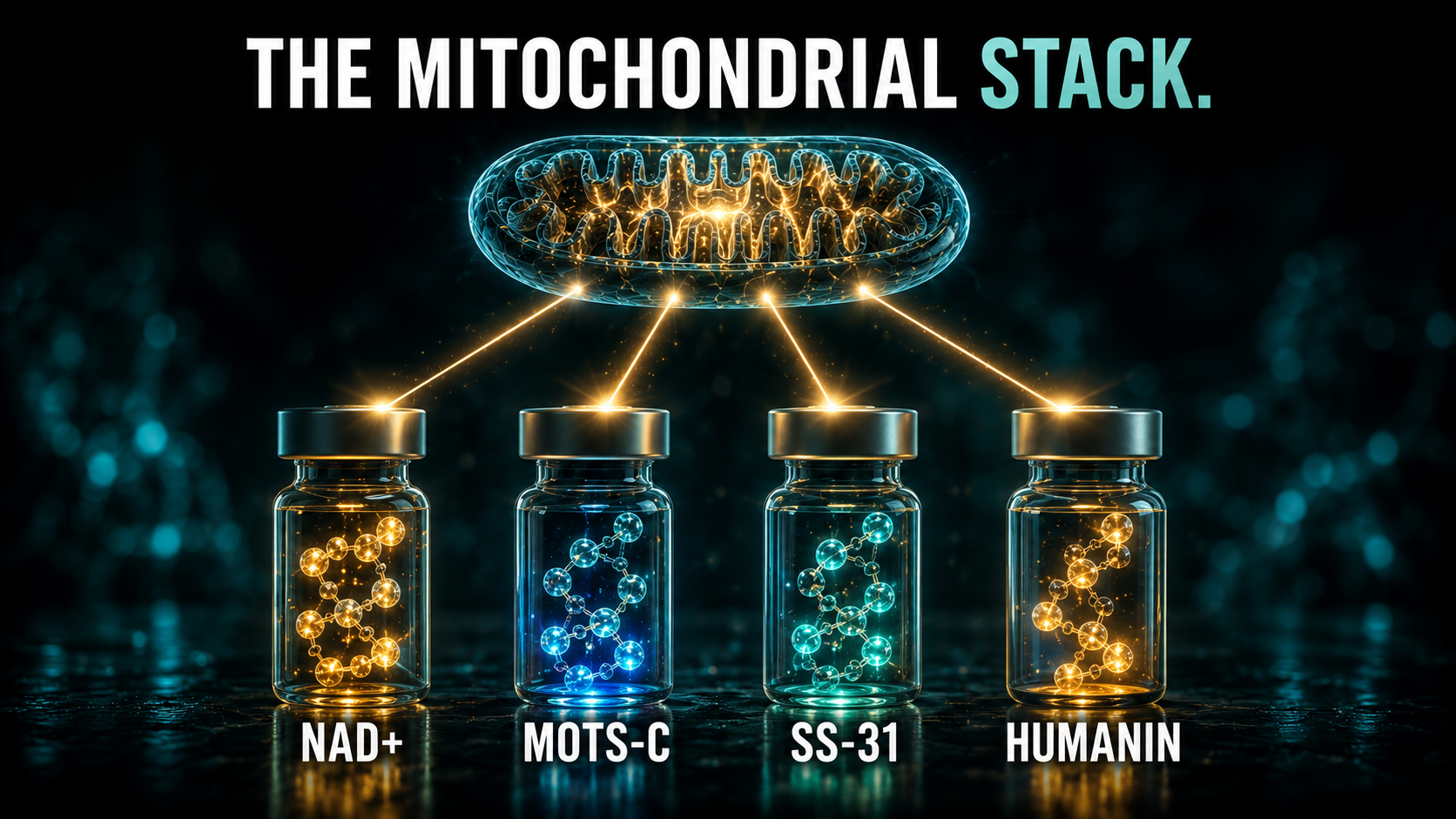
Four angles, four jobs. Fuel the mitochondria, build more of them, tune the ones you have, and protect them from the damage that ages you.
The Full Mitochondrial Recovery Stack
Here is how I would put the whole thing together if the goal is mitochondrial recovery, covering every angle. Fuel, build, tune, protect. Each peptide does a different job, which is why they belong together instead of competing.
NAD+ is the fuel. It restores the coenzyme your existing mitochondria need to actually produce energy and run repair. Without it, the engine has no gas.
MOTS-c is the builder. It activates AMPK and drives new mitochondria production, plus it works on glucose and fat metabolism. It tells the body to make more engines.
SS-31 is the tune-up. It targets the inner mitochondrial membrane and stabilizes cardiolipin, the structural fat the electron transport chain sits on. Clean up that membrane and the engine runs more efficiently with less leaked stress.
Humanin is the guard. It protects the mitochondria you have from stress and death. It keeps the membrane sealed, the ATP up, and the damage down.
Here is a sample protocol that covers all four. Again, these are published and community ranges, not numbers from completed human trials. Use them as a map, not gospel.
| NAD+ (fuel) | Loading phase: 100 to 200 mg SubQ daily for 7 to 10 days (50 mg to start if sensitive). Maintenance: 100 to 200 mg SubQ, 2 to 3x per week, mornings. Run continuously. |
| MOTS-c (build) | 5 mg SubQ, 3x per week, mornings. 10 weeks on, then a 4 to 6 week break. |
| SS-31 (tune) | 2 to 5 mg SubQ daily for 6 weeks, then a break. |
| Humanin (protect) | 250 to 500 mcg SubQ, 2 to 3x per week, cycled 4 to 8 weeks. |
BioEdge Research Labs carries the full stack — Humanin, MOTS-c, NAD+, SS31 (They Call It Mito). Use MARS15 for 15% off.
You do not have to run all four at once to get value. If you are just starting, NAD+ and MOTS-c are the foundation. That covers fuel and production. Add Humanin when you want the protection layer, especially if you are older, training hard, or under heavy stress. SS-31 rounds it out for membrane efficiency.
A clean way to run it: NAD+ and MOTS-c as your base year-round rhythm, then bring in a focused 4 to 8 week Humanin block when you want to lean into recovery and cellular protection. Your age, your goals, your stress load, and how you respond all matter. Start conservative, pay attention, and dial it in for your own situation.
How to Actually Run the Mitochondrial Stack
Knowing what each peptide does is one thing. Knowing how to sequence them so you are not slamming everything in on day one is another. Here is how I would phase it. The idea is to build a base first, then layer in the rest, so you can tell what is doing what.
Phase 1: Build the Base (Weeks 1 to 2)
Start with NAD+ on its own. This is your fuel layer, and it is the one most people feel first. Run the loading phase here, 100 to 200 mg SubQ daily for 7 to 10 days. If you are sensitive or new to NAD+, start at 50 mg and work up. Take it in the morning. NAD+ can feel stimulating, and dosing it late can wreck your sleep.
Go slow on the injection itself. Fast NAD+ pushes can cause a wave of chest pressure or flushing. Inject it slowly and the feeling passes. Two weeks of loading gets your levels up before you add anything else.
Phase 2: Add the Builder (Weeks 2 to 3)
Once NAD+ is established, bring in MOTS-c. 5 mg SubQ, 3 times per week, in the morning. MOTS-c works on the same energy and metabolic machinery NAD+ feeds, so they pair naturally. This is your “make more engines” layer.
At this point NAD+ drops to maintenance, 100 to 200 mg, 2 to 3 times per week, mornings. You now have fuel and production running together. For a lot of people, this two-peptide base is the whole program, and it is a complete one.
Phase 3: Layer in Protection and Tuning (Weeks 3 to 4)
Now add Humanin and, if you are running it, SS-31. This is where the stack goes from output to full recovery.
Humanin at 250 to 500 mcg SubQ, 2 to 3 times per week. If you are coming off a hard training block, illness, or a high-stress stretch, this is where you can run it daily or every other day for a focused 4 to 8 week protection push. SS-31 at 2 to 5 mg SubQ daily for 6 weeks if membrane efficiency is your target.
Adding these last means that if anything feels off, you know it came from the new layer, not the base.
Putting the Week Together
Here is what a full week looks like once everything is layered in and you are past the NAD+ loading phase. Everything is dosed in the morning.
| Monday | NAD+ + MOTS-c + Humanin |
| Tuesday | SS-31 (if running) |
| Wednesday | NAD+ + MOTS-c + Humanin + SS-31 |
| Thursday | SS-31 (if running) |
| Friday | NAD+ + MOTS-c + Humanin + SS-31 |
| Saturday | SS-31 (if running) |
| Sunday | Off / SS-31 (if running) |
You can combine compatible peptides in the same syringe or rotate injection sites and do them separately. Either works. Keep the morning timing tight, since NAD+ and MOTS-c both run better early and worse at night.
Cycling and Time Off
The base can run long. NAD+ is fine continuously. MOTS-c runs 10 weeks on, then a 4 to 6 week break, which gives your AMPK pathway a rest so it stays responsive. Humanin runs in 4 to 8 week blocks, then off. SS-31 runs its 6 week course, then off.
A simple yearly rhythm: NAD+ and MOTS-c as your steady base with MOTS-c cycling on and off, and then two or three focused recovery blocks across the year where you layer in Humanin and SS-31, timed to whenever you are training hardest, recovering from something, or feeling the wear pile up. You do not need to be on everything all the time. The protection layers hit hardest when you bring them in around real stress.
What to Track
Since none of this is backed by completed human trials, you are your own data. Worth watching: energy through the day, sleep quality, recovery between workouts, mental clarity, and if you run a CGM, your glucose response. Give it weeks, not days. Mitochondrial peptides build quietly. The wins show up as “I have not crashed at 3pm in a month,” not a same-day jolt.
Ready to build your stack?
Now that you have the protocol, you need research-grade peptides to run it. The company I personally use is BioEdge Research Labs — US-made, third-party tested, and they stock the full mitochondrial lineup. Use code MARS15 for 15% off at bioedgeresearchlabs.com.
Humanin Side Effects and Safety
The main concern with Humanin is the same thing that makes it useful. It is strongly anti-apoptotic, meaning it keeps cells from dying. That is great for healthy cells under stress. It raises a real question about cells you would want to die, like cancerous ones. Some animal work has suggested that systemic Humanin could actually help certain tumors, like breast cancer, grow and resist chemo. This is not settled, but it is enough that anyone with active cancer or a strong family history should stay away.
It also has insulin-sensitizing effects, so if you are diabetic or on insulin, that is something to watch.
Beyond that, reported effects in research and community use are mild. Injection site reactions and occasional fatigue, the usual for a research peptide.
The Bottom Line
Humanin is the protection layer your mitochondrial stack is probably missing.
NAD+ fuels. MOTS-c builds. SS-31 tunes. Humanin guards. If you are serious about mitochondrial health, especially as you get older, you want every angle covered, not just the ones that make you feel productive.
The research is preclinical and the human dosing is not settled. Respect that. Start low, pay attention to how you respond, and treat it like what it is, a research compound that happens to be one of the most fascinating signals your own mitochondria ever invented. Your cells wrote this peptide to survive. That tells you something about what it is for.