
Dosage Guide
BPC-157 concentration and U-100 unit calculations for a 10 mg vial. The schedules below are author examples, not validated clinical regimens. They do not establish a safe or effective treatment dose.
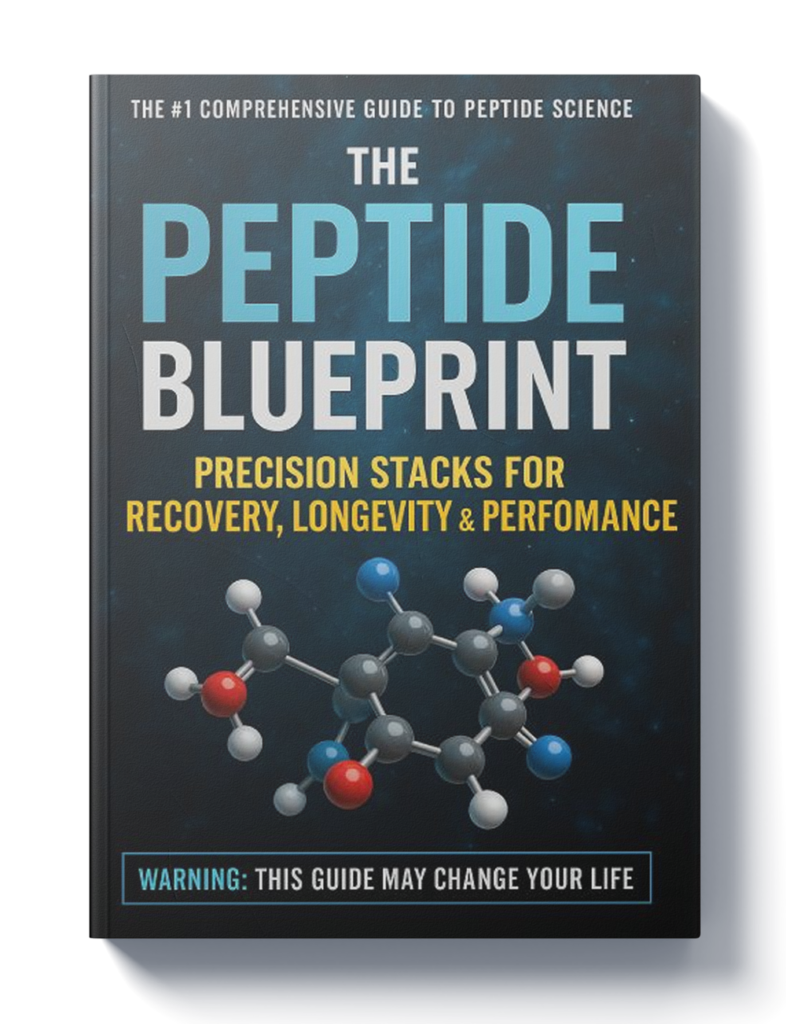
Free Download – The #1 Reference Guide
The Ultimate Peptide Blueprint
Reconstitute
3.0mL bacteriostatic water
3.33 mg/mL
Amount Examples
Amount examples only; no validated titration.
Storage
Lyophilized: Freeze at−20 °C (−4 °F)
Storage and expiry need verified data for the exact preparation. A general mixing example cannot establish a 1–2 week shelf life.
Free Download
Want the Complete Stack?
This page explains concentration math for a 10 mg vial. BPC-157 is an experimental peptide with limited human evidence. Correct arithmetic does not establish a safe dose, route, or treatment schedule. See the separate overview for research context.
Educational guide for reconstitution and daily dosing.
Amount example A
Amount: 200 MCG (0.2 mg)
Amount example B
Amount: 400 MCG (0.4 mg)
12 units (0.12 mL)
Amount example C
Amount: 600 MCG (0.6 mg)
18 units (0.18 mL)
Schedule limit
No validated cycle
These amounts do not define a clinical schedule.
Important
Independent arithmetic examples, not a titration plan.
A summary of the math and its limits.
Storage cannot be set from concentration math alone.
Free Download – Complete Peptide Reference
The Ultimate Peptide Blueprint
Supply arithmetic examples only. Vial yields below assume 10 mg per vial and exclude waste. Counts do not establish a treatment schedule or storage life.
Bacteriostatic water: This calculation example uses 3.0 mL for a 10 mg vial (about 3.33 mg/mL).
This dosage reference focuses on concentration and amount conversions. Cell and animal research on BPC-157 does not establish a human dosing schedule. The separate BPC-157 overview discusses mechanisms and the limited human evidence.
in preclinical injury models.
is studied mainly in animals.
is a preclinical research question.
Promoting neuroprotection
is not a proven human treatment.
Dose, route, formulation, and study population all matter. A daily microgram example is not interchangeable with a dose injected into a joint or given by intravenous infusion in a study.
The following labels describe research areas, mainly examined in cells or animals. They should not be read as proven human benefits or evidence supporting the example schedule.
Athlete anecdotes cannot establish efficacy, dose, or a recovery timeline.
Nervous-system findings are mainly preclinical. They do not establish human neurological treatment.
Organ-injury experiments do not establish protection against human poisoning or medication harm.
Tissue Repair
Preclinical tissue-injury research.
Human gut-repair benefit is not established.
Inflammation Control
Human chronic-pain benefit is not established.
Nerve Support
Mainly preclinical nervous-system findings.
Athletic Recovery
Anecdotes do not prove faster recovery.
Most tissue-repair evidence is preclinical. Small human reports include a retrospective knee-injection study (PMID 34324435) and an intravenous pilot in two adults (PMID 40131143). Their routes and study designs do not validate the daily subcutaneous examples above. For detailed research discussion, see the BPC-157 overview.
Growth and blood-vessel pathways raise questions for further study. The evidence does not establish that BPC-157 causes cancer, and it also does not establish safety in people with cancer. Small reports cannot exclude rare or delayed harm.
Human safety is not established by small reports or animal tolerability findings. Long-term effects, interactions, and effects in children, pregnancy, or breastfeeding remain poorly defined. Correct concentration math does not make a preparation safe to inject.
A claim of local targeting does not establish that systemic effects are absent or that injection near an injury is better.
A relationship to a natural peptide sequence does not rule out immune reactions. Formulation, route, and impurities matter.
Preclinical protection against tissue injury does not establish treatment of human ulcers, colitis, or medication-related damage.
Oxidative-stress findings describe experimental models. They do not prove clinical benefit or make a dosing schedule safe.
Correct calculations do not establish clinical safety.
Important

Joe Mars
Founder, The Peptide Report
I’m Joe Mars, and I’ve dedicated the past ten years to understanding peptide therapy, longevity, and how to optimize the body through practical, real-life testing. My journey started when I was tired, inflamed, and aging faster than I should have been. Clear information on peptides was almost impossible to find, so I dug in, researched nonstop, and tested protocols on myself.
Over the years, I have learned from experts like Jay Campbell, Dr. Seeds, Jim LaValle, and Ben Greenfield, and I have completely transformed my health. Now in my fifties, I feel stronger and sharper than I did in my twenties. That experience is why I write. I want to give people simple and honest guidance so they can use peptides safely and effectively.
I believe in data, smart protocols, and taking responsibility for your own health. You are the protocol. Your habits, your consistency, and your awareness shape your results. Through The Peptide Report, I share what actually works so you can make informed decisions and build a healthier, more resilient body.
Instant e-Book Download