
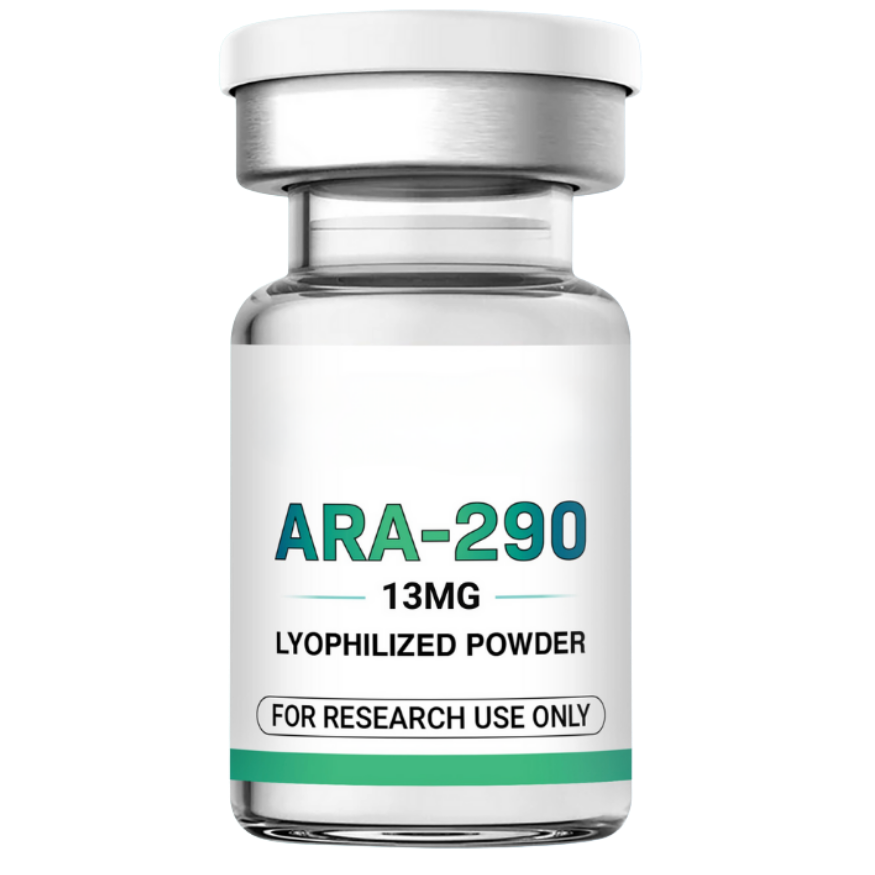
ARA-290 (13mg Vial) Dosage Protocol
Quickstart Highlights
ARA 290, also called cibinetide, is an 11-amino-acid peptide derived from the tissue-protective portion of erythropoietin (EPO). It was engineered to keep EPO's healing and anti-inflammatory actions without increasing red blood cell counts.
In plain terms, ARA 290 targets stressed or damaged tissues and activates local repair systems to reduce inflammation and promote regeneration.
Who might notice benefits? People with:
- Burning, tingling, or numbness in the hands or feet.
- Chronic inflammatory discomfort.
- Slow wound healing.
- Microvascular-related cognitive issues.
The peptide emerged from work on the innate repair receptor and has progressed through Phase II trials for conditions such as sarcoidosis-related small fiber neuropathy and diabetic neuropathy.
This article provides concise research summaries and practical notes to help you assess whether ARA 290 is relevant to your research and wellness goals.

Dosing & Reconstitution Guide
Educational guide for reconstitution and daily dosing
Standard / Gradual Approach (3 mL = ~3.33 mg/mL)z
WEEK | DAILY DOSE | UNITS (PER INJECTION) (ML) |
|---|---|---|
Weeks 1 | 2 mg (2,000 mcg) | 31 units (0.31 mL) |
Weeks 2–8 (or up to 16) | 400 mcg (0.4 mg) | 62 units (0.62 mL) |
Cell | Cell | Cell |
Cell | Cell | Cell |
Reconstitution Steps
Important: This guide is for educational purposes only and is not medical advice. For research use only. Not for human or animal use. LAB ONLY.
Dosing Overview
Suggested daily titration approach.
Storage Instructions
Proper storage preserves peptide quality and potency.
How ARA 290 Works in the Body
The peptide targets the innate repair receptor, a cell surface complex found on immune, nerve, and vascular cells. Binding here starts local, tissue-protective signaling rather than the classic blood-making pathway of erythropoietin.
When it attaches to that receptor, it shifts the immune response from damage-focused to repair-focused. Pro-inflammatory signals fall. Macrophages and microglia move toward a healing phenotype.
Cytokines such as TNF alpha and IL-6 decline, oxidative stress eases, and mitochondrial resilience improves. In small nerves, this creates an environment where injured axons can recover and abnormal firing quiets down. Blood vessel function and microcirculation also benefit, so tissues get more oxygen and nutrients during repair. These combined effects explain why people may feel less burning, numbness, or hypersensitivity over time.
Because the peptide acts on the innate repair receptor rather than the erythropoietin receptor, it does not increase red blood cell production.
Next, we will look at the specific benefits researchers are exploring.
Key Benefits of ARA 290
Key benefits include targeted anti-inflammatory action, nerve protective effects, improved microcirculation, and potential symptom relief for neuropathic pain.
Studies and early reports indicate reduced burning, less tingling, and faster recovery after nerve injury. It is not a cure but a promising adjunct to standard therapies for many people worldwide.
Below, we unpack three specific ways ARA 290 may help.
Reducing Inflammation
Less pain.
By activating the innate repair receptor, the peptide recalibrates immune signaling toward repair. Pro-inflammatory cytokines fall, and immune cells adopt a healing profile. The result is less swelling, fewer pain signals, and lower oxidative damage at the site of injury or chronic inflammation, promoting tissue remodeling.
Patients in small trials report quicker drops in tenderness and heat. Lab markers such as CRP trend down. Those signals match the mechanistic shift and suggest meaningful biological effects.
Common anti-inflammatory outcomes include:
- Reduced pro-inflammatory cytokines (TNF alpha IL-6).
- Lowered CRP and inflammatory markers.
- Less tissue swelling and redness.
For clinicians, this means a tool that can modulate chronic inflammation without broadly suppressing immunity in practice. Evidence is not definitive yet. Larger trials are in progress. But for patients with stubborn inflammatory symptoms, ARA 290 offers a targeted option worth watching.
Supporting Nerve Repair and Protection
Healing.
Small nerves are fragile. When microcirculation falters, they stop working. The peptide improves local perfusion and reduces harmful signaling that causes nerve pain. That lets nerves focus on repair rather than firing off pain constantly.
At the cellular level, ARA 290 supports mitochondrial function and reduces oxidative stress in neurons. Less mitochondrial damage keeps axonal transport running. Proteins for rebuilding reach damaged sites. Over weeks, this supports clinically measurable improvements in sensation and functional tests used in neuropathy research.
Does it reverse long-term loss?
Not always.
But in many cases, small fiber density increases and pain thresholds improve. Patients often say they notice warmth returning, better balance, or less burning. Those reports line up with objective tests in several small studies.
This is why clinicians are interested. It is not a blunt anti-inflammatory. It is a precision repair signal that helps nerves reestablish circuits. When integrated with glucose control, physical therapy, and symptom management, it can be a meaningful tool for patients seeking better function.
Potential Role in Chronic Conditions
Chronic problems need new tools.
ARA 290 may act as an adjunct across conditions marked by tissue stress. It does not suppress immunity systemically. Instead, it rebalances local repair responses. That quality makes it attractive for conditions where inflammation and nerve damage coexist, such as metabolic, autoimmune, and infectious syndromes.
Which conditions?
Researchers are testing a range. Early data points to benefits in neuropathy and inflammatory complications. Small trials have also looked at autoimmune small fiber issues. More work is needed, but the pattern is consistent with the drug mechanism.
Examples under study:
- Neuropathic pain and small fiber neuropathy.
- Diabetic complications tied to microvascular dysfunction.
- Autoimmune conditions with neuroinflammation components.
Clinical Studies on ARA 290 Peptide Therapy
Research into ARA 290 has moved from small pilot experiments to controlled trials with measurable outcomes.
A small, early randomized pilot in sarcoidosis patients tested intravenous ARA 290 (2 mg, three times weekly for four weeks) versus placebo in 22 participants. The trial found significant symptom improvement on small fiber neuropathy scales and no major safety signals.
A larger, placebo-controlled Phase 2b trial used daily subcutaneous doses (1, 4, or 8 mg for 28 days) in patients with sarcoidosis-related small fiber loss. The 4 mg group showed significant increases in corneal nerve fiber measures by corneal confocal microscopy and meaningful reductions in pain for those with moderate to severe baseline symptoms. These objective nerve-regeneration signals were striking for a 28-day study.
Could this mean real-world improvements for people with stubborn neuropathic pain?
That’s the exciting question.
Separate investigator-initiated work in type 2 diabetes reported improved neuropathic symptoms and signs plus favorable trends in metabolic markers after a 28-day course of ARA 290, supporting the peptide’s dual tissue-protective and metabolic effects observed in preclinical models.
Beyond human trials, mechanistic studies show ARA 290 can reduce nociceptor sensitization and modulate pathways linked to TRPV1 and oxidative stress, offering plausible biological explanations for the clinical findings.
Multiple dose-ranging studies are registered (see ClinicalTrials.gov and EU trial registers), reflecting active exploration of optimal regimen, objective nerve endpoints, and patient-reported pain outcomes across neuropathic and inflammatory indications.
Across trials, the safety profile has been favorable; importantly, ARA 290 acts via the innate repair receptor and has not produced erythropoietic effects at studied doses. That said, most datasets are small and duration short.
Bottom line: Early human data are promising: objective nerve regeneration, symptom relief, and a clean short-term safety record. Larger, longer trials are needed to confirm durability, optimal dose, and which patient groups benefit most.
Safety, Side Effects, and Considerations
ARA 290 has shown a reassuring short-term safety profile in trials, but it remains investigational. Safety depends on dose, duration, and the patient’s underlying health.
Safety
To date, clinical studies report no erythropoietic effects at studied doses and few serious adverse events. That matters because the peptide was designed to avoid red blood cell stimulation while keeping tissue repair signals. Always use medical oversight when trying experimental peptides.
Suggested dosing examples:
- Low: 250 mcg subcutaneously once daily, a conservative starting point for tolerance.
- Moderate: ~1.32 mg per day (example: 0.33 mL of a 4 mg/mL solution) for a 30-day course when monitoring is possible.
- Trial Range: 2 mg to 4 mg SC daily in several studies showing objective nerve changes.
Start low. Titrate slowly only if tolerated and under clinician guidance.
Side Effects
Common effects are generally mild and transient.
- Injection site redness or minor discomfort.
- Brief headache or fatigue reported by some participants.
- Occasional transient nausea or lightheadedness.
One clear point: serious blood-related effects have not been seen in trials at typical research doses. Reports are mostly short-lived and manageable when monitored.
Supplies Needed

Get Your Free Copy of The Ultimate Peptide Blueprint
Exact stacks, dosages & cutting-edge protocols to cut fat, build muscle, and keep results-no fluff.
No spam. Unsubscribe anytime.
Important Notes
Proper storage preserves peptide quality and potency.
Peptides can get expensive, but as an FYI - BioEdge is doing 10% off this month (code pep10 at bioedgepeptides.com), one of the few suppliers that consistently delivers what their lab reports claim.

I’m Joe Mars, and I’ve dedicated the past ten years to understanding peptide therapy, longevity, and how to optimize the body through practical, real-life testing. My journey started when I was tired, inflamed, and aging faster than I should have been. Clear information on peptides was almost impossible to find, so I dug in, researched nonstop, and tested protocols on myself.
Over the years, I have learned from experts like Jay Campbell, Dr. Seeds, Jim LaValle, and Ben Greenfield, and I have completely transformed my health. Now in my fifties, I feel stronger and sharper than I did in my twenties. That experience is why I write. I want to give people simple and honest guidance so they can use peptides safely and effectively.
I believe in data, smart protocols, and taking responsibility for your own health. You are the protocol. Your habits, your consistency, and your awareness shape your results. Through The Peptide Report, I share what actually works so you can make informed decisions and build a healthier, more resilient body.