
My mom is 74. She injured her hip a while back and it never came back.
Constant wobble when she walked. Pain that would not go away. The slow decline most people her age just accept as part of getting older. The orthopedic answer was the usual one manage it, take Advil, come back when it gets bad enough for a replacement.
We ran her on a cycle of Cartalax paired with KLOW.
She is walking two miles a day now. With no more wobble or pain.
One person is not a clinical trial. But when you watch it happen in real time with someone you love, and you understand the mechanism behind why it happened, you start paying attention. This is the full breakdown of what Cartalax is, how it works, and why it may be the most important peptide you have not heard of for cartilage repair, ACL recovery, and age-related joint wear.
What Is Cartalax
Cartalax is a short-chain peptide bioregulator. A tetrapeptide made of four amino acids — alanine, glutamic acid, aspartic acid, and lysine. The sequence is Ala-Glu-Asp-Lys.
It was developed by Professor Vladimir Khavinson’s research program in Russia. The same program that gave us Epithalon, Pinealon, Prostamax, and the entire class of short peptide bioregulators that have been used clinically in Russia for over 40 years. Khavinson spent his career mapping which short peptide sequences correspond to which tissues in the body, and Cartalax is the one built specifically for cartilage.
The core idea behind bioregulators is simple. Short peptides act as switches that tell specific tissues to turn their own repair genes back on. Cartalax is not a growth factor. It does not force anything. It tells chondrocytes — the cells that build and maintain cartilage — to do the work they already know how to do but stopped doing reliably due to age or injury.
Why Cartilage Repair Is So Hard
Cartilage has one major problem. No blood supply.
Every other tissue in the body gets a direct delivery of nutrients, immune cells, and repair signals through capillaries. Cartilage does not. It is avascular. The chondrocytes get their nutrients through diffusion from the surrounding synovial fluid, which is why a torn meniscus in the outer edge can sometimes heal but a tear in the inner two-thirds basically never does on its own. No blood, no repair crew.
This is also why anti-inflammatory painkillers are the wrong long-term answer. Advil, Aleve, Motrin, and prescription versions like meloxicam work by shutting down inflammation. That feels like relief but inflammation is the signal the body uses to flag damaged tissue and call in repair. Shut it down chronically and you shut down the repair response. The research shows long-term NSAID use is associated with accelerated cartilage breakdown. You are trading short-term comfort for long-term damage to the exact tissue you are trying to protect.
The question becomes — how do you deliver a repair signal to a tissue with no delivery system, without suppressing the inflammation the body is using to direct the work? That is the gap Cartalax is designed to fill.
How Cartalax Actually Works
When cartilage gets injured or starts wearing down, the chondrocytes in the damaged area either die or go dormant. The ones that survive start producing matrix metalloproteinases — enzymes that break down the existing cartilage matrix. Inflammatory cytokines flood the joint. The whole environment shifts from build mode to break down mode.
In a young healthy body the chondrocytes eventually switch back on and start laying down new collagen type II and proteoglycans to rebuild. As you age or if the injury is significant, that switch does not flip reliably. The joint stays stuck in a low-grade inflammatory, degrading state. That is osteoarthritis.
The Russian research on Cartalax describes the peptide binding to specific sites in chondrocyte DNA and upregulating the genes responsible for matrix production. In plain English, it flips the switch back to build.
What the published preclinical work describes:
- Increased chondrocyte proliferation in cell cultures
- Increased synthesis of type II and type XI collagen, the primary structural proteins in cartilage
- Boosted proteoglycan and aggrecan expression for water retention and compressive strength
- Reduced MMP-9 activity, the main enzyme breaking down cartilage matrix
- Reduced IL-1β and TNF-α inflammatory cytokines
- Reduced caspase-3 expression, which protects chondrocytes from programmed cell death
- Enhanced TGF-β signaling for cartilage repair
Human clinical data out of Russian orthopedic clinics describes improvements in joint function and pain scores in osteoarthritis patients. These are not double-blind Western trials and a lot of the research sits in Russian-language journals that never got translated or indexed in PubMed. That is why Cartalax is still classified as a research compound rather than an approved pharmaceutical. But the body of evidence is real if you are willing to read it.
The Four Cartalax Benefits You Actually Care About
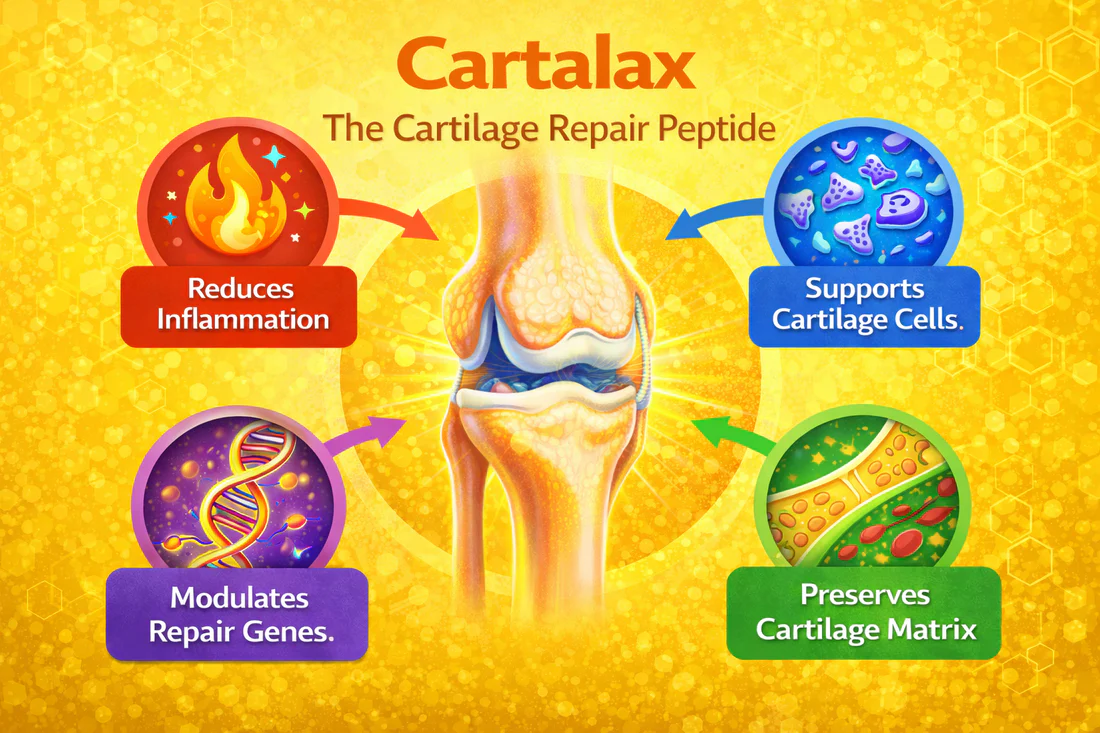
Supports Cartilage Cells. Cartalax directly targets chondrocytes, the cell population responsible for building and maintaining cartilage. This is the core mechanism and what separates it from every other repair peptide in the space.
Modulates Repair Genes. The peptide influences gene expression at the DNA level in chondrocytes. Upregulates the genes for building cartilage matrix. Downregulates the genes producing the enzymes that break it down.
Preserves Cartilage Matrix. By reducing MMP activity and boosting collagen and proteoglycan synthesis, Cartalax shifts the joint environment back toward net build instead of net breakdown.
Reduces Inflammation. Works by downregulating inflammatory cytokine expression at the gene level rather than blocking enzymes the way NSAIDs do. You get inflammation reduction without shutting down the signals the body needs for actual repair.
Who Cartalax Is Built For
Two groups tend to get the most value out of Cartalax.
Post-surgical and athletic injury. ACL reconstructions that plateaued at 70 or 80 percent. Meniscus tears that got trimmed instead of repaired. Rotator cuff reconstructions with residual cartilage wear. Ankle reconstructions. Post-surgical knees and shoulders. The soft tissue repair gets handled by the surgeon but the cartilage environment gets ignored, because once cartilage is damaged the standard of care has almost nothing to offer for actual regeneration.
Age-related joint wear. Hips and knees that have been used hard for 40, 50, 60 years. Morning stiffness. Grinding. Stairs getting harder. The walk getting slower. This is the population where bioregulators have the longest track record in Russian clinical practice — decades of documented use in osteoarthritis and degenerative joint disease. My mom falls into this category. Cartalax is not going to reverse a bone-on-bone joint. If you need a hip replacement, no peptide is going to rebuild the cartilage back to youth levels. But for the earlier and middle phases of wear, or for anyone trying to extend the life of the joint they still have, the mechanism is sound and the risk profile is essentially zero.
Cartalax Dosage and Protocol
Cartalax is run as a subcutaneous injection. Under the skin. Not into the joint and not into the muscle.
The standard research protocol in the Russian literature is 1 to 2 mg daily for 20 days, followed by a break. Bioregulators work through cumulative cycles rather than constant dosing. You run the course, you stop, you let the tissue respond, and you come back for another cycle every three to six months. Two cycles per year is a common maintenance pattern. For active injuries or more advanced wear, people tend to run them closer together on the front end and then taper back.
The reported side effect profile in the Russian clinical literature is essentially zero. 40 years of clinical use, no significant adverse event patterns documented. That tracks with the rest of the bioregulator category. The doses are tiny, the peptides are short, they do not bind to hormone receptors or interfere with major regulatory systems. They act as weak tissue-specific signals.
The Best Cartalax Stacks for Joint Repair
Bioregulators flip switches. They do not supply the raw materials. If you tell chondrocytes to start building cartilage again but the rest of the joint environment is inflamed, poorly vascularized, and missing the signaling molecules for connective tissue repair, you are asking the cells to build a house without lumber.
Every serious joint protocol pairs Cartalax with something that covers the supply side. There are three main ways to approach this depending on what you are dealing with.
Cartalax and BPC-157
BPC-157 is a pentadecapeptide originally isolated from human gastric juice. It is one of the most studied peptides in the research compound space for healing. What makes it relevant for joints is that it stimulates angiogenesis the formation of new blood vessels. In a tissue like cartilage that is starved for delivery, anything that increases vascularization in the surrounding synovium and subchondral bone is a big deal.
Pair BPC-157 with Cartalax and you have one signal flowing in from the environment and another flowing out through the chondrocytes. This is the combo for anyone dealing with a tendon or ligament issue tied to the joint injury. Meniscus plus MCL. ACL reconstruction that did not fully come back. Rotator cuff with accompanying cartilage wear.
Cartalax and TB-500
TB-500 is a synthetic fragment of thymosin beta-4, a protein naturally produced in most cells. Where BPC-157 is heavier on local repair and vascular work, TB-500 tends to be described as systemic. Stem cell migration to injury sites, broad anti-inflammatory effects, connective tissue healing throughout the body.
Stack TB-500 with Cartalax when the issue is older, more diffuse, or spread across multiple joints. Years of hard use. Chronic inflammation without a single structural tear to point at. Multiple joints acting up at once.
Cartalax and KLOW
KLOW is a four-compound injectable blend. KPV, BPC-157, TB-500, and GHK-Cu.
KPV is a tripeptide fragment of alpha-MSH with strong anti-inflammatory effects across gut, skin, and systemic tissue. BPC-157 handles angiogenesis and tendon-ligament repair. TB-500 drives systemic healing and cell migration. GHK-Cu is a copper peptide involved in connective tissue remodeling and collagen synthesis. Combine those four and you are hitting inflammation control, vascular growth, systemic repair, and collagen rebuild all at once. Add Cartalax on top and the chondrocytes get their signal in an environment that is already primed for repair.
KLOW plus Cartalax is the bigger swing. More compounds, more complexity, more likely to move the needle on a stubborn joint. This is what I reached for with my mom because at 74 with a hip that had been declining, half-measures were not going to cut it. Two miles a day with no wobble and no pain was the outcome.
Cartalax and the Khavinson Bioregulator Family
Khavinson’s research program produced bioregulators for virtually every organ system. Epithalon for the pineal gland and aging. Pinealon for the brain. Cartalax for cartilage. Prostamax for prostate. Vladonix for thymus and immune function. Sigumir for bone and joint interface. Ventfort for vascular tissue. Dozens more.
Most Western researchers have never heard of most of them. Most Western practitioners have never used any of them. That is starting to change.
For joint and longevity protocols, Cartalax stacks well with other bioregulators depending on the goal. Sigumir addresses the subchondral bone side of joint health. Ventfort handles vascular support which matters in older users. Epithalon stacks on top for systemic aging and sleep. Vladonix covers immune modulation which plays a role in inflammatory joint conditions.
The whole category is strange from a Western pharma perspective. The compounds do not look like drugs. They look more like signaling molecules. The doses are tiny. The side effect profiles are essentially zero. There is no economic incentive for pharma to run trials on them because you cannot patent a short amino acid sequence published in a Russian journal in the 1980s. So they sit in the research compound world, available to people willing to read the literature and think for themselves.
The Bottom Line on Cartalax
The orthopedic world has two tools. Cut it out or fuse it together. There is not a lot of regenerative medicine being offered at the local ortho.
Cartalax is one of the most interesting research compounds in the peptide space for anyone dealing with cartilage damage, post-surgical joint recovery, ACL reconstructions that plateaued, or age-related joint wear. Paired with the right repair peptides underneath it, the logic is strong. BPC-157 for local tissue and vascular work. TB-500 for systemic and chronic. KLOW when you want the whole toolkit.
My mom is walking two miles a day at 74. That is one data point. But the mechanism is sound, the Russian clinical track record is 40 years deep, and the risk profile is essentially zero. For the right candidate, Cartalax is worth serious attention.
Read the research. Think for yourself. Draw your own conclusions.
— Joe Mars
Founder of The Peptide Report | 10+ Years in the Peptide Research Industry
Frequently Asked Questions About Cartalax
What is Cartalax used for?
Cartalax is a Russian peptide bioregulator researched for cartilage repair, joint function support, and osteoarthritis. It is used in research contexts for post-surgical joint recovery, ACL recovery, meniscus damage, and age-related joint wear.
How does Cartalax work?
Cartalax works at the gene expression level in chondrocytes, the cells that build and maintain cartilage. It upregulates genes for collagen and proteoglycan production while downregulating genes for matrix-degrading enzymes and inflammatory cytokines.
What is the typical Cartalax dosage?
The standard research protocol is 1 to 2 mg daily via subcutaneous injection for 10 to 20 days per cycle, followed by a break of three to six months before the next cycle.
What does Cartalax stack with?
Cartalax stacks well with BPC-157, TB-500, and KLOW for joint and cartilage repair. It also pairs with other Khavinson bioregulators including Sigumir, Ventfort, and Epithalon depending on the protocol goal.
Are there Cartalax side effects?
The Russian clinical literature reports essentially no significant side effects across 40 years of use. Bioregulators in general have very low side effect profiles due to their short peptide structure, tiny doses, and tissue-specific signaling mechanism.
How long does Cartalax take to work?
Most users of Cartalax in research settings report noticeable improvements in joint function within two to four weeks of starting a cycle, with continued improvements stacking over subsequent cycles. Gene regulation effects are cumulative over multiple cycles.
Disclaimer: This article is for educational and informational purposes only. Cartalax and other research peptides referenced are sold for research purposes only and are not intended for human consumption. Nothing in this article constitutes medical advice. Always consult a qualified healthcare practitioner before making any health decisions.