MK-677 and Hair Loss: Fact or Fiction?
If you’re looking into MK-677 and wondering whether it’s going to wreck your hair or grow it back, you’re not alone.
This is one of the most common questions I get in our community.
And the answer isn’t as clean as most articles make it sound.
The short version: MK-677 can go either way on hair.
The growth hormone and IGF-1 boost is good for hair follicles. The cortisol spike, prolactin elevation, and potential DHT increase can work against you.
It depends on your genetics. Your dose. And how your body handles the hormonal shifts.
I’ve been in the peptide space for over 10 years. I’ve talked to hundreds of guys running MK-677. Some report thicker hair. Some report shedding. Most of the confusion comes from people not understanding what MK-677 actually does to your hormones beyond just raising growth hormone.
Let me break it down.
How Growth Hormone Affects Hair
Before we get into MK-677 specifically, you need to understand the relationship between growth hormone, IGF-1, and your hair.
Growth hormone itself doesn’t directly grow hair.
What it does is trigger the production of IGF-1.
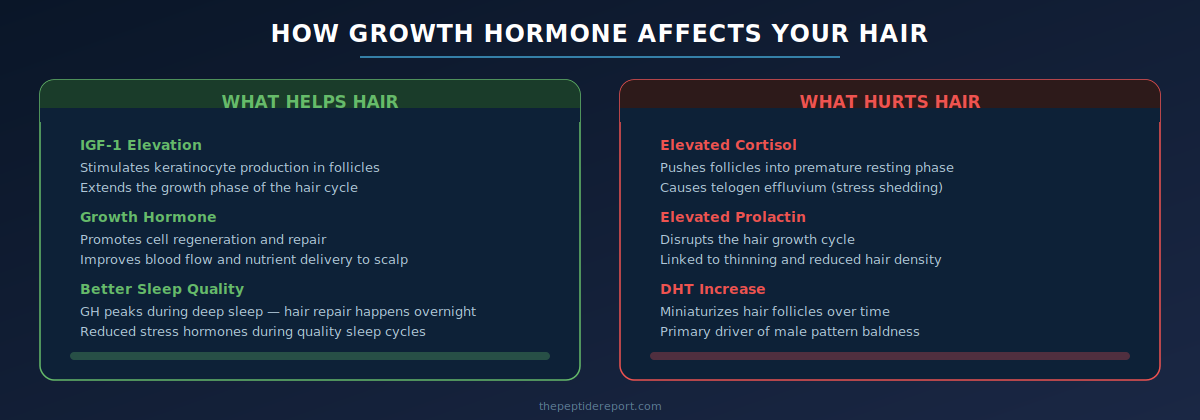
IGF-1 is the downstream hormone that actually stimulates hair follicle activity. It promotes keratinocyte production, which builds the hair strand. It also extends the anagen phase, which is the active growth phase of the cycle.
So in theory, anything that raises GH and IGF-1 should be good for your hair.
That part is true.
But hair health isn’t just about IGF-1. Several other hormones play a role. This is where it gets complicated.
Cortisol. Your stress hormone. When cortisol stays elevated, it pushes hair follicles into the telogen phase early. That’s the resting phase where hair stops growing and falls out. Chronic cortisol elevation causes telogen effluvium. Stress-related shedding. Same mechanism as people who lose hair during a brutal divorce or major illness.
Prolactin. Disrupts the hair growth cycle when it’s elevated. High prolactin has been linked to reduced hair density and thinning, especially in men.
DHT. Dihydrotestosterone. The primary driver of male pattern baldness. DHT shrinks hair follicles over time, making them produce thinner and shorter strands until they stop producing hair at all. If you’re genetically sensitive to DHT, anything that increases it accelerates that process.
So here’s the real question with any GH-boosting compound:
Does it raise the good stuff (IGF-1) without also raising the bad stuff (cortisol, prolactin, DHT)?
What MK-677 Actually Does to Your Hormones
MK-677 is a ghrelin mimetic. It raises growth hormone by mimicking ghrelin, the hunger hormone.
And because ghrelin touches multiple systems in your body, MK-677 doesn’t just raise GH.
It raises a bunch of other things too.
Here’s what the research and real-world experience show:
IGF-1 goes up. This is the benefit. Higher IGF-1 supports hair follicle activity and can promote thicker, stronger hair growth. This is the part that makes people think MK-677 is a hair growth compound.
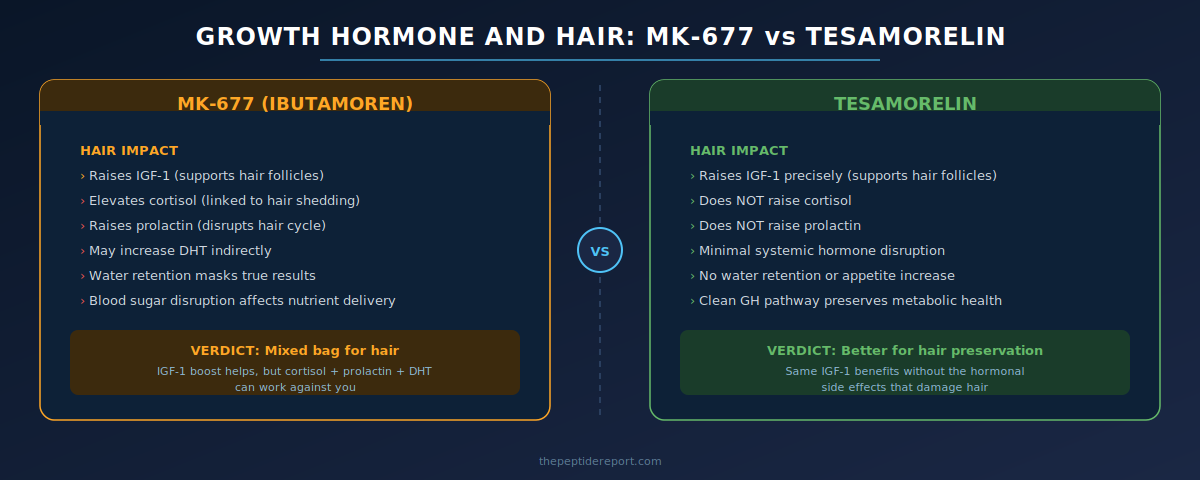
Cortisol goes up. MK-677 has been shown to elevate cortisol levels. Well-documented in clinical research. If your cortisol stays elevated over weeks or months, that’s a direct pathway to shedding. The IGF-1 boost is trying to grow your hair while cortisol is trying to push it out. Two forces working against each other.
Prolactin goes up. Elevated prolactin disrupts the hair cycle and contributes to thinning. Most hair loss articles ignore this completely.
DHT may increase indirectly. When you raise growth hormone, it can influence the conversion of testosterone to DHT. If you’re genetically prone to male pattern baldness, this is a real concern. The effect varies person to person, which is exactly why some guys report no hair issues on MK-677 and others notice shedding within weeks.
This is the fundamental problem with MK-677 for hair.
You’re getting the IGF-1 benefit. But you’re also getting cortisol, prolactin, and potentially DHT working against you at the same time.
It’s a mixed bag. Outcome depends heavily on your individual hormone profile and genetics.
Why Tesamorelin Is the Cleaner Option for Hair
If you want the IGF-1 and growth hormone benefits without the hormonal noise that can damage your hair, Tesamorelin is the better path.
Tesamorelin is a GHRH analog. It works directly on the pituitary gland to stimulate growth hormone release.
That’s it. Clean. Targeted. Predictable.
Here’s why that matters for hair:
It raises IGF-1 precisely. Same follicle-stimulating benefit that makes growth hormone therapy attractive for hair in the first place.
It does NOT raise cortisol. This is the critical difference. No cortisol spike means no stress-related shedding. Your follicles stay in the growth phase where they belong.
It does NOT raise prolactin. No disruption to the hair cycle from prolactin elevation.
Minimal systemic hormone disruption. Tesamorelin stays in its lane. It signals the pituitary to release GH, and that’s the extent of it. You don’t get the broad hormonal cascade that comes with ghrelin mimetics like MK-677.
If your goal is supporting hair health through GH optimization, Tesamorelin gives you the benefits with dramatically less risk.
Full dosing protocol is in our Tesamorelin Dosage Guide.
If You Still Want to Run MK-677
I’m not going to tell you MK-677 is useless.
It does raise GH and IGF-1 effectively. Some people use it without hair issues.
If you’re set on running it, here’s how to minimize the risk:
Keep the dose moderate. 10 to 15mg per day is a reasonable starting point. Higher doses amplify all the side effects, including cortisol and prolactin elevation. Don’t go above 25mg.
Run shorter cycles. 8 to 12 weeks on, then take a break. Prolonged MK-677 use means prolonged cortisol elevation. That’s when the shedding really shows up.
Monitor your bloodwork. Get baseline levels for IGF-1, cortisol, prolactin, and DHT before you start. Retest at 4 to 6 weeks. If cortisol or prolactin are climbing significantly, that’s your signal to either drop the dose or come off.
Support your hair nutritionally. Biotin, zinc, iron, vitamins A, C, and E all support hair health. Make sure your diet covers these bases. Hydration and sleep quality matter too. GH peaks during deep sleep and that’s when hair repair happens.
Watch for early signs. Increased shedding in the shower or on your pillow within the first few weeks isn’t always cause for alarm. Some initial shedding can happen as the body adjusts. But if it continues past week 3 or 4, or if it’s getting worse, your body is telling you something.
What About SARMs and Hair Loss?
This question often comes up alongside MK-677, so let me address SARMs broadly.
SARMs bind to androgen receptors. Some can influence DHT levels or compete with testosterone in ways that affect hair follicles.
Impact varies by compound:
Ostarine (MK-2866). Generally considered one of the milder SARMs for hair. Most users don’t report significant shedding. Individual response varies.
RAD-140 and LGD-4033. Stronger androgenic profiles. More users report hair thinning or shedding, especially at higher doses or longer cycles.
YK-11. One of the more aggressive compounds. Higher risk for hair-related side effects.
Bottom line with SARMs and hair is the same as with MK-677.
If you’re genetically predisposed to male pattern baldness, anything that messes with your androgen signaling is going to increase your risk.
No way around that.
The only question is how much risk you’re willing to accept.
Where to Source What You Need
For Tesamorelin, grab it through our vetted source here.
For everything else, I source from BioEdge Research Labs. Third-party tested every batch. Consistent quality. Honestly the best pricing I’ve found for research-grade material. Use code MARS15 for 15% off. They run bundles at 20-25% off retail too, so stacking the code gets you roughly 35% off the full protocol. Pay with ACH or Cash App and that’s another 10% on top.
Quick heads up: Make sure you’re on the real BioEdge site at bioedgeresearchlabs.com. There are copycat sites using similar names. If the URL isn’t bioedgeresearchlabs.com, it’s not them.
Frequently Asked Questions About MK-677 and Hair
Does MK-677 cause hair loss?
It can, but it’s not guaranteed. MK-677 raises IGF-1 (good for hair) but also elevates cortisol and prolactin (bad for hair) and may indirectly increase DHT. If you’re genetically prone to male pattern baldness, the risk goes up. Outcomes vary heavily by individual.
Does MK-677 increase DHT?
Indirectly, yes. By raising growth hormone levels, MK-677 can influence the conversion of testosterone to DHT in some people. The effect isn’t consistent across all users, but if you’re DHT-sensitive, it’s a real concern worth tracking with bloodwork.
How long until hair loss shows up on MK-677?
If it’s going to happen, most people notice increased shedding between weeks 3 and 8. Some initial shedding in the first couple weeks can be normal as the body adjusts. Persistent or accelerating shedding past that window is a real signal to reassess.
Is Tesamorelin better than MK-677 for hair?
For hair specifically, yes. Tesamorelin raises IGF-1 cleanly through GHRH signaling without elevating cortisol or prolactin. You get the follicle benefits without the hormonal side effects that drive shedding. It’s the smarter choice if hair is a priority for you.
Can I take finasteride with MK-677 to protect my hair?
Some people do this. Finasteride blocks the conversion of testosterone to DHT, which addresses one of MK-677’s hair risks. But it doesn’t do anything about the cortisol and prolactin elevation. Talk to a doctor before stacking. Finasteride has its own side effect profile.
What labs should I run before starting MK-677?
At minimum: IGF-1, cortisol, prolactin, total and free testosterone, DHT, and a full thyroid panel. Get baseline before you start. Retest at 4 to 6 weeks. This is how you catch problems before they become permanent.
The Bottom Line on MK-677 and Hair
MK-677 and hair loss isn’t fact or fiction.
It’s both. Depending on who you are.
The IGF-1 increase from MK-677 supports hair growth. That’s real.
But the cortisol elevation, prolactin increase, and potential DHT effects can work against you just as hard.
If you’re genetically prone to hair loss, MK-677 is a coin flip at best.
If you want growth hormone benefits with the least risk to your hair, Tesamorelin is the smarter call. Same IGF-1 pathway. None of the hormonal side effects.
Whatever you decide, get bloodwork before and during your cycle.
Don’t guess.
Let the labs tell you what’s actually happening.
Stay sharp.
Joe Mars
The Peptide Report
This content is for educational and informational purposes only. It is not intended as medical advice. Peptides are sold for research purposes. Always consult with a qualified healthcare professional before starting any new protocol.
P.S. Want to go deeper? Join Our Skool Group where we break down peptide protocols, share real results, and answer your questions in real time.