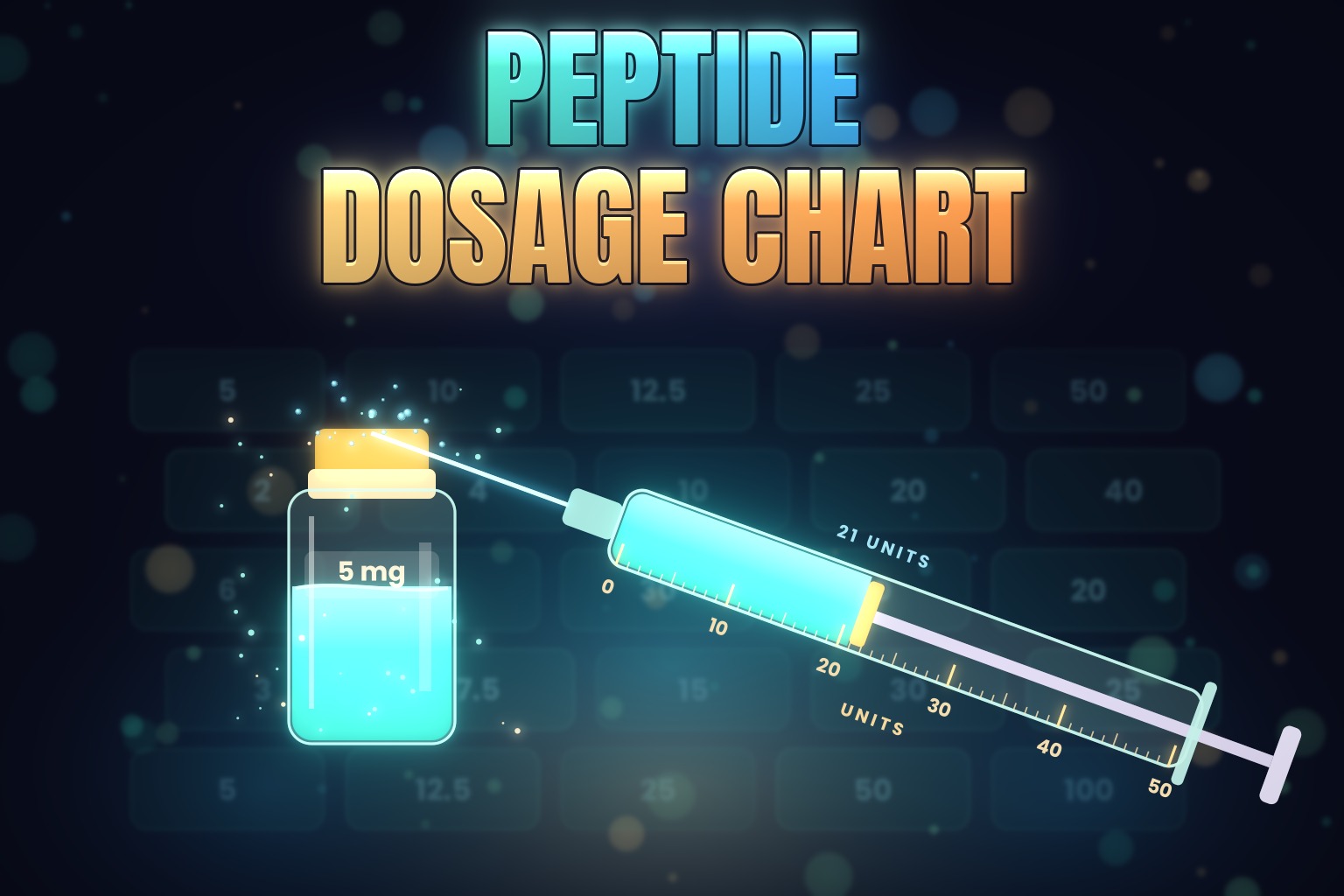
Every peptide dosage chart on the internet is the same three numbers wearing a different font: what the vial holds, how much water went into it, and how many units that puts on the syringe. Get those three right and the chart writes itself, for any peptide you’ll ever open.
So here is the chart, the doses a syringe can’t measure accurately, the arithmetic behind it so you can check me, and a tool that builds one for your own vial.
The Peptide Dosage Chart
“Units” here means the marks on a standard U-100 insulin syringe, which holds 100 units to the milliliter, so one unit is 0.01 mL. The only number you need from a vial is how many micrograms sit in each of those units, and that depends on two things: the milligrams in the vial and the milliliters of water you add. It never depends on which peptide it is.
Read the chart like this: find your vial size and water volume, note what one unit is worth, then read across for the dose you want.
| Vial + water | 1 unit = | 100 mcg | 250 mcg | 500 mcg | 1 mg |
|---|---|---|---|---|---|
| 2 mg + 1 mL | 20 mcg | 5 units | 12.5 units | 25 units | 50 units |
| 2 mg + 2 mL | 10 mcg | 10 units | 25 units | 50 units | 100 units |
| 5 mg + 1 mL | 50 mcg | 2 units* | 5 units | 10 units | 20 units |
| 5 mg + 2 mL | 25 mcg | 4 units | 10 units | 20 units | 40 units |
| 5 mg + 2.5 mL | 20 mcg | 5 units | 12.5 units | 25 units | 50 units |
| 5 mg + 3 mL | 16.7 mcg | 6 units | 15 units | 30 units | 60 units |
| 10 mg + 1 mL | 100 mcg | 1 unit* | 2.5 units* | 5 units | 10 units |
| 10 mg + 2 mL | 50 mcg | 2 units* | 5 units | 10 units | 20 units |
| 10 mg + 3 mL | 33.3 mcg | 3 units | 7.5 units | 15 units | 30 units |
| 10 mg + 5 mL | 20 mcg | 5 units | 12.5 units | 25 units | 50 units |
* Two units or fewer. Measured draws this small come out wildly over or under; the accuracy studies below put the floor at about 2 units, and 5 is where it gets comfortable. Add more water and the same dose becomes a bigger, readable number.
Notice that 2 mg in 1 mL, 5 mg in 2.5 mL and 10 mg in 5 mL give identical rows. That’s the whole trick: the chart is about concentration, and three different vials can land on the same one.
Looking for a specific peptide or goal? Start at Find Your Protocol, then use the chart to turn what you find into units.
Why Small Doses Go Wrong
These are the studies behind the asterisks in the chart.
In a 1993 study in Pediatrics, pediatric nurses were asked to draw 0.5, 1 and 2 units of U-100 insulin and then weighed what actually came out of the syringe. The 0.5-unit draws averaged 0.98 units, the 1-unit draws averaged 1.64, and the 2-unit draws averaged 2.15. Parents of children with diabetes did better on average, 1.06 units for an intended 1, but individuals ranged from 0.64 to 1.30, and only three of seven could hit 1 unit with acceptable precision. Switching from 0.5 mL syringes to 0.3 mL syringes didn’t improve accuracy or precision. The authors’ conclusion was blunt: anything under 2 units (20 microliters) carries an unacceptably large error, and the fix is to dilute so the dose becomes a bigger volume.
A 1998 British study weighed doses from nurses using 30-unit syringes and found the same curve. An intended 1 unit came out at 1.23 on average, a 23% error. An intended 10 units came out at 10.1. By ten units the error had collapsed to about 1%.
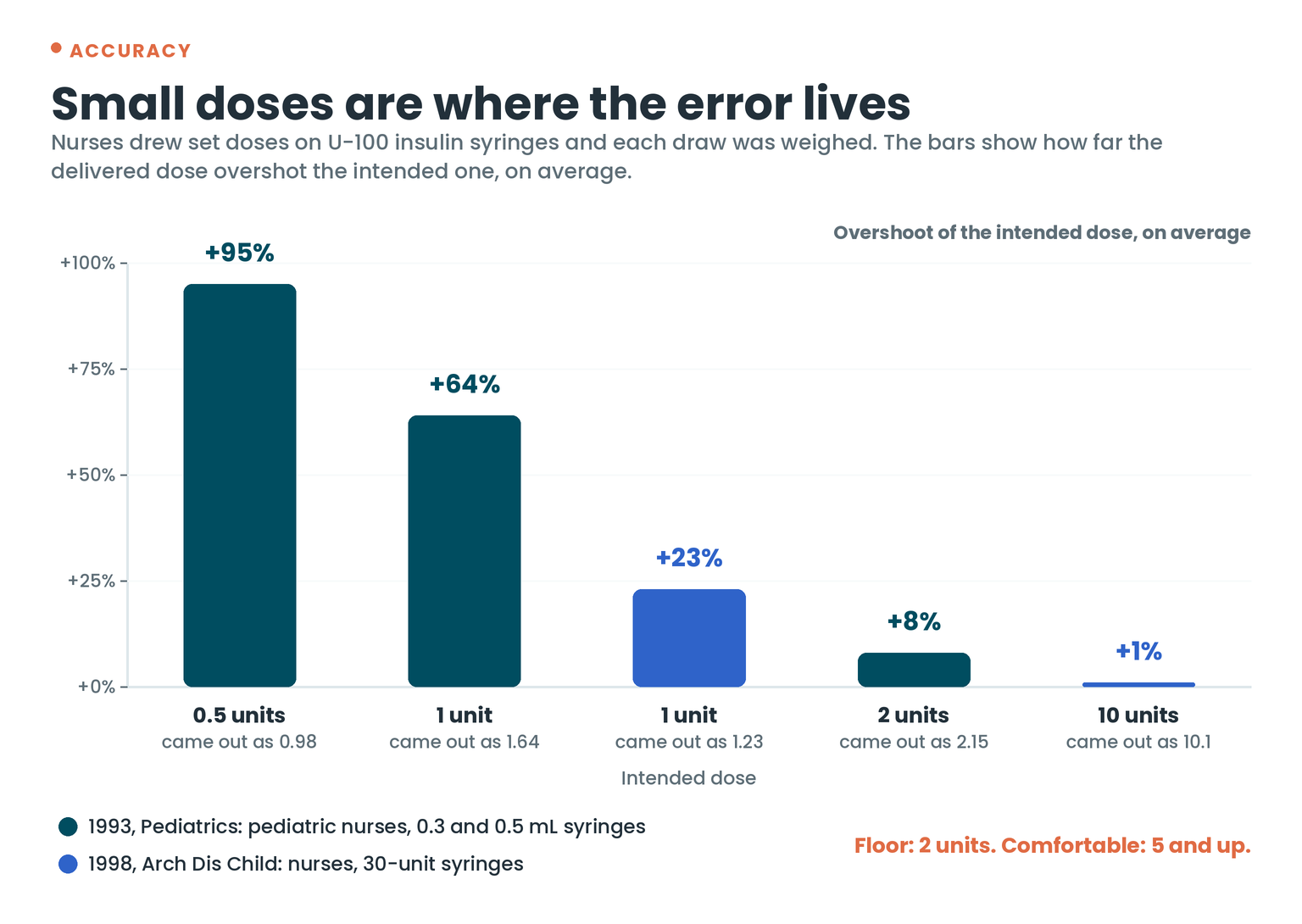
Put those two studies together and you get the rule the chart is built on: keep every dose at 5 units or more, and get there with water, not with a smaller syringe.
The Arithmetic Behind the Chart
Three steps, and the middle one is the only one worth memorizing.
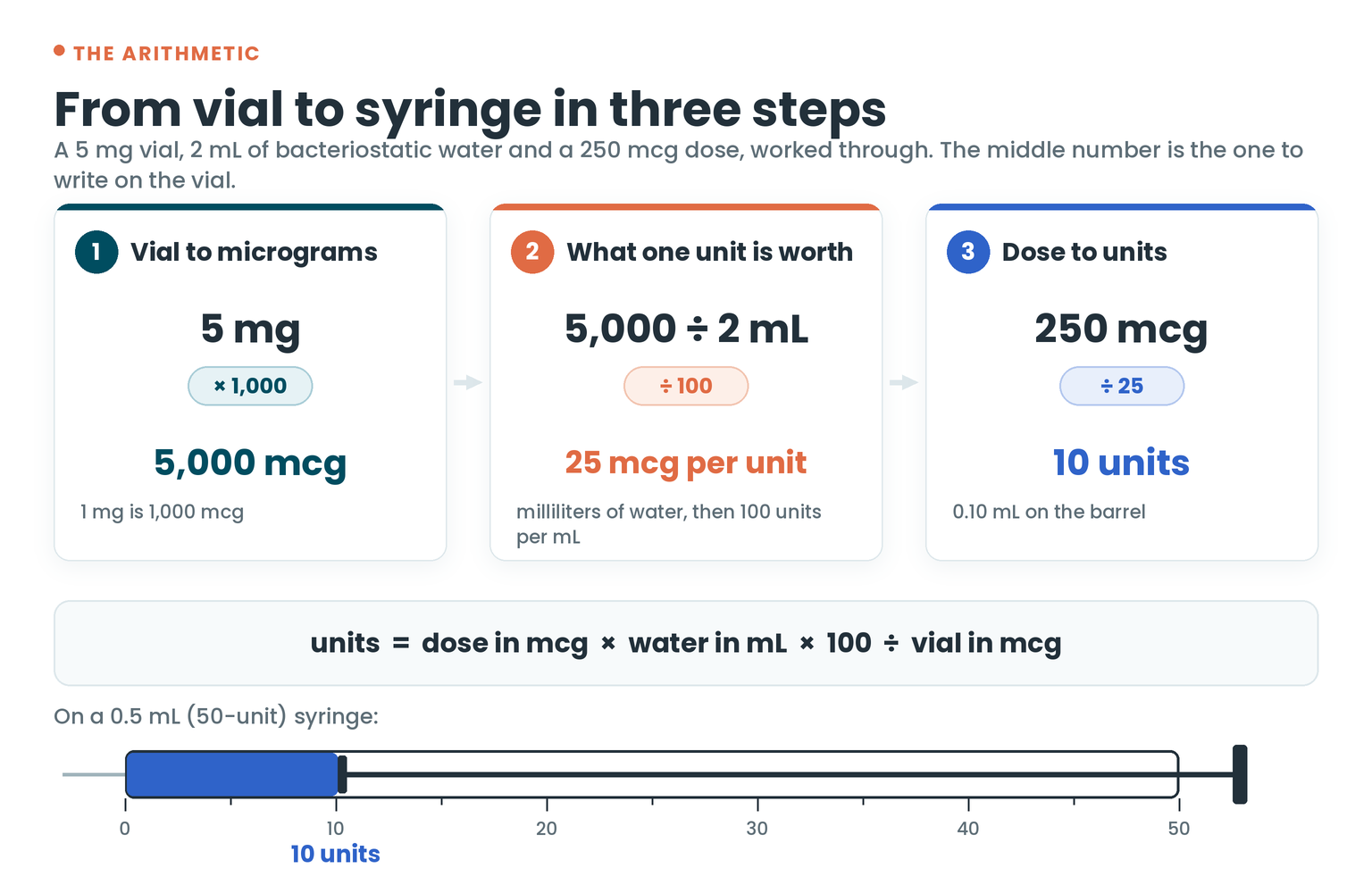
1. Turn the vial into micrograms. Multiply milligrams by 1,000. A 5 mg vial holds 5,000 mcg.
2. Work out what one unit is worth. Divide by the milliliters of water, then by 100. With 2 mL in a 5 mg vial: 5,000 ÷ 2 = 2,500 mcg per mL, and 2,500 ÷ 100 = 25 mcg per unit. Write that number on the vial.
3. Turn a dose into units. Divide the dose by that number. 250 mcg ÷ 25 = 10 units, which is 0.10 mL on the barrel.
As one line: units = dose in mcg × water in mL × 100 ÷ vial in mcg. Run 250 × 2 × 100 ÷ 5,000 and you get the same 10.
The water volume is the lever you control, so use it. The same 250 mcg out of a 10 mg vial is 2.5 units with 1 mL of water, 5 units with 2 mL and 10 units with 4 mL. None of those is more “correct” than the others; the bigger number is simply easier to draw and easier to read. I aim to have every dose on a chart land between about 5 and 50 units, and I’d rather add a milliliter than squint at a half mark.
Build Your Own Chart
Pick the vial, the water and the syringe you actually have, and the chart below redraws itself. Tap a row and the syringe fills to that mark. Anything that lands under 2 units gets flagged, and anything that overflows the syringe tells you to use less water or a bigger barrel.
Build your dosage chart
U-100 syringe: 100 units per mL
Vial
Water
Syringe
250 mcg on a 0.5 mL syringe: 10 units
| Dose | Units | mL | Read |
|---|
Aim for 5 to 50 units. Under 2 units the weighing studies found draws off by up to 100%; add water and the same dose becomes a bigger number. Over the barrel, use less water or a bigger syringe.
For a single peptide with its own quirks, the Melanotan 2 calculator does the same job with that peptide’s research doses built in.
Which Syringe?
U-100 insulin syringes come in three barrels: 0.3 mL (30 units), 0.5 mL (50 units) and 1 mL (100 units). The scale is fixed by an international standard, so a unit is the same 0.01 mL whichever brand you buy. Some 0.3 mL syringes, like the BD Ultra-Fine half-unit versions, carry marks every half unit; most 0.5 and 1 mL barrels mark every unit or every two.
Match the barrel to the biggest dose on your chart, not the smallest. If nothing on your chart goes past 30 units, the 0.3 mL syringe gives you the widest spacing between marks. If something does, step up to 0.5 mL. The 1 mL barrel is for doses above 50 units, which usually means the vial could have taken less water.
Bacteriostatic Water or Sterile Water?
Both are water for injection. The difference is one ingredient and one word on the label.
Bacteriostatic water for injection carries 0.9% benzyl alcohol (9 mg per mL) as a preservative and comes in a multiple-dose vial that is designed to be punctured again and again. Its pH sits around 5.7. Sterile water for injection has no preservative at all, comes only in single-dose containers, and its label says to use it promptly and discard what’s left.
So for a vial you’ll draw from over days or weeks, bacteriostatic water is the one that makes sense; sterile water is for the vial you’ll empty in one go. On how long an opened bottle of bacteriostatic water keeps, the label itself gives no date. Injection-safety guidance for any opened multi-dose vial is to write the date on it and discard it within 28 days unless the manufacturer says otherwise, and that 28-day habit is the working rule.
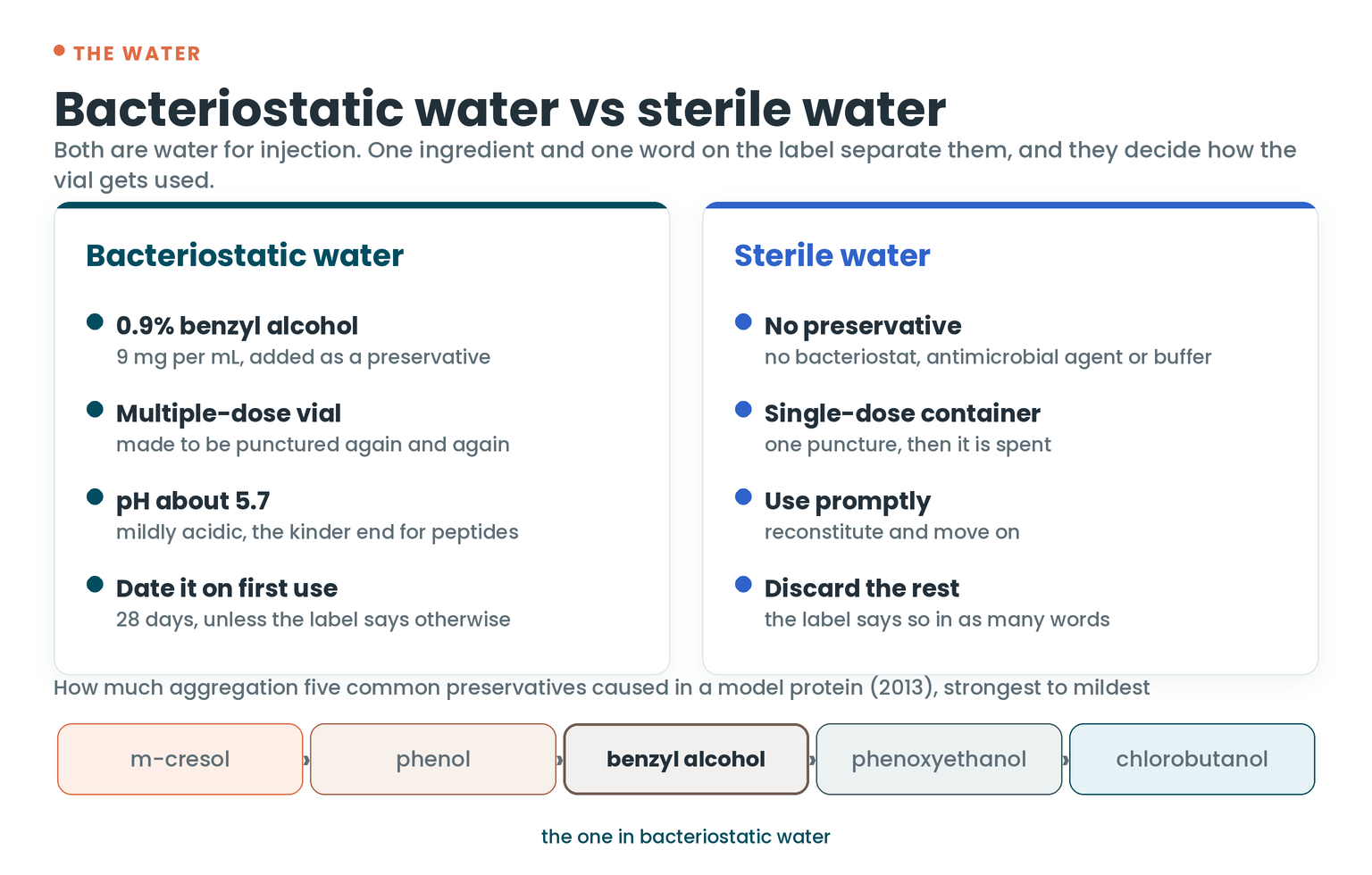
Preservatives can push proteins toward clumping, some harder than others. When five common ones were ranked for the aggregation they caused in a model protein, the order ran m-cresol, then phenol, then benzyl alcohol, then phenoxyethanol, then chlorobutanol, which puts benzyl alcohol in the gentler half.
Reconstituting, Storing and Keeping It Clean
The full reconstitution guide covers mixing, storage and shelf life step by step. These are the four habits that protect the number you just calculated.
- Let the vial reach room temperature before you open it, run the water down the inside wall rather than onto the powder, and swirl until it’s clear. Don’t shake.
- Write the date, the vial size, the water volume and the micrograms per unit on the label before the vial goes in the fridge.
- Keep it at 2 to 8 °C, out of the light, and use it within the same 28-day window as the water that went into it, sooner if it turns cloudy, changes color or shows particles.
- Use a fresh sterile syringe and needle for every draw, swab the stopper first, and never leave a needle parked in the stopper between draws.
FAQ
How many units is 250 mcg?
It depends entirely on what one unit is worth in your vial. With 5 mg in 2 mL (25 mcg per unit) it’s 10 units; with 10 mg in 2 mL (50 mcg per unit) it’s 5 units; with 2 mg in 1 mL (20 mcg per unit) it’s 12.5 units.
Does the chart change from peptide to peptide?
No. The chart converts milligrams, milliliters and units, and a milligram is a milligram whatever the molecule. Molecular weight only matters if a dose is given in moles, which is not how doses are written on a syringe.
My dose works out to 2.5 units. What now?
Either use a 0.3 mL syringe with half-unit marks or change the water. 10 mg in 1 mL puts 250 mcg at 2.5 units; 10 mg in 2 mL puts it at 5 and 10 mg in 4 mL puts it at 10. Changing the water is the better fix because it also moves the dose out of the range where draws are inaccurate.
What’s the smallest dose a syringe can measure reliably?
In the weighing studies, draws of 2 units or less were off by anywhere from 8% to nearly 100%, and a 10-unit draw was within about 1%. Treat 2 units as the floor and 5 as the comfortable minimum.
Can I reconstitute with sterile water instead of bacteriostatic water?
For a vial you’ll finish in one draw, yes; sterile water is made for exactly that and the leftover gets discarded. For a vial you’ll go back to, bacteriostatic water is the one built for repeated punctures.
How long does bacteriostatic water keep once opened?
The label gives no date. The general injection-safety rule for an opened multi-dose vial is 28 days from the first puncture, so date the bottle and treat 28 days as the limit.
References
- Casella SJ, Mongilio MK, Plotnick LP, Hesterberg MP. Accuracy and precision of low-dose insulin administration. Pediatrics. 1993;91(6):1155-1157. PubMed
- Gnanalingham MG, Newland P, Smith CP. Accuracy and reproducibility of low dose insulin administration using pen-injectors and syringes. Arch Dis Child. 1998;79(1):59-62. DOI
- International Organization for Standardization. ISO 8537:2016. Sterile single-use syringes, with or without needle, for insulin. ISO
- Hospira, Inc. Bacteriostatic Water for Injection, USP. Prescribing information. Label
- Hospira, Inc. Sterile Water for Injection, USP. Prescribing information. Label
- Centers for Disease Control and Prevention. Preventing unsafe injection practices. CDC
- Hutchings RL, Singh SM, Cabello-Villegas J, Mallela KM. Effect of antimicrobial preservatives on partial protein unfolding and aggregation. J Pharm Sci. 2013;102(2):365-376. DOI
Stay sharp,
Joe Mars
The Peptide Report
P.S. If your vial, your water and your syringe still don’t agree with each other, bring the three numbers to the Peptides and Biohacking Hub on Skool and someone will check the arithmetic with you. It’s free. Come join us.