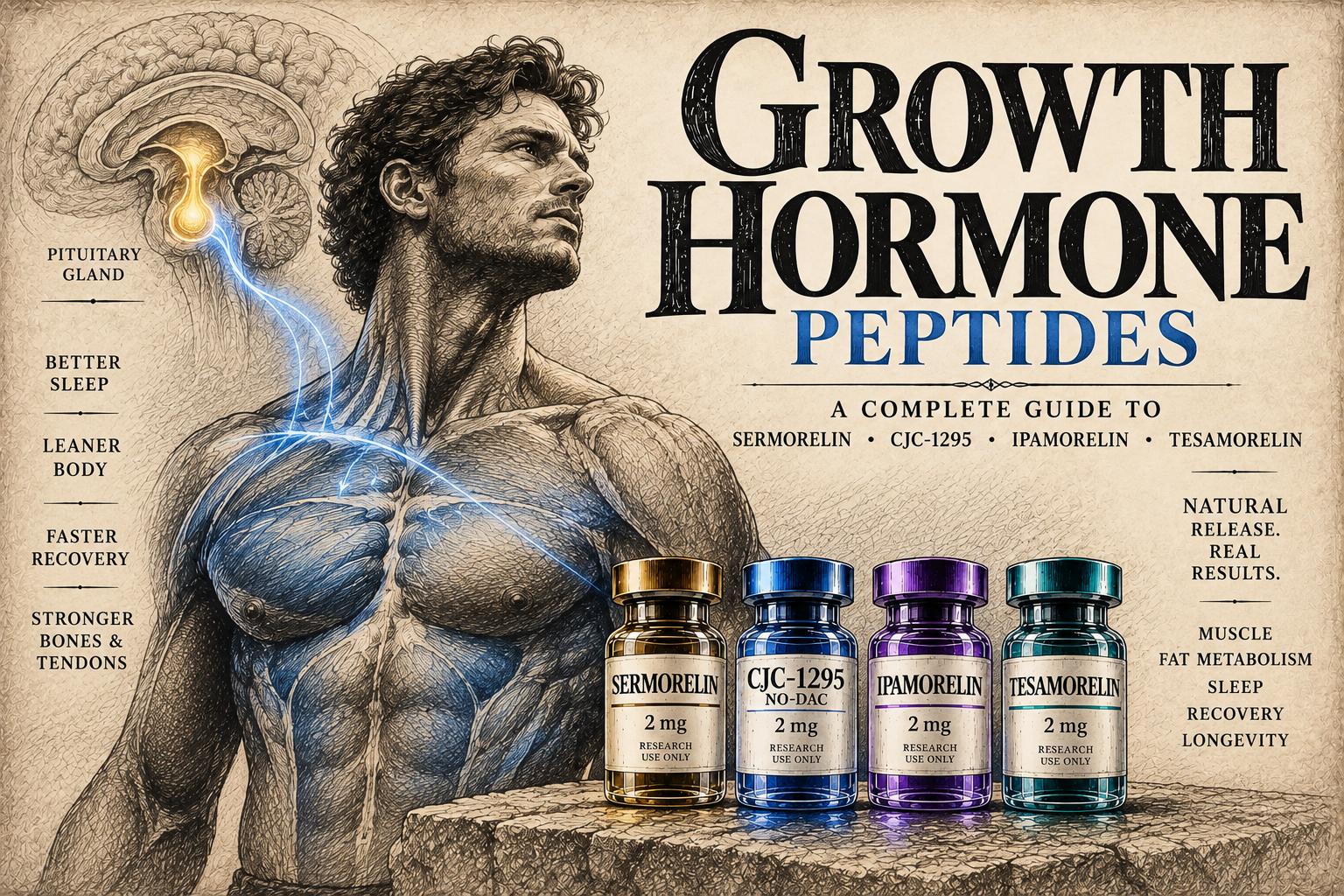
Growth hormone peptides are compounds that signal your pituitary gland to release more of its own growth hormone. When I started taking CJC-1295 and Ipamorelin, my deep sleep went from about 20 minutes a night to between 90 and 120 minutes. That matters because most of the growth hormone your body makes comes out in one large pulse during deep sleep, and that pulse shrinks as you get older.
This guide covers how growth hormone peptides work, how Sermorelin, CJC-1295, Ipamorelin, and Tesamorelin compare, the difference between CJC-1295 with DAC and without DAC, why so many people on GLP-1s pair them with a GH peptide, and the dosing, timing, and cycling protocols people are running right now.
What Are Growth Hormone Peptides?
Growth hormone is made by the pituitary, a pea-sized gland at the base of your brain. Its main job is to tell your liver to make IGF-1, and IGF-1 does much of the actual work in muscle, bone, connective tissue, and fat.
Growth hormone affects how you repair muscle after training, how your body burns stored fat for fuel, how strong your bones and tendons stay, and how deeply you sleep.
Growth hormone peptides don’t contain growth hormone. They are short chains of amino acids that copy the signals your brain uses to tell the pituitary to release it. Your body still makes the hormone itself, and it still releases it in pulses.
What Growth Hormone Does in Your Body
Growth hormone gets its name from childhood growth, but in adults its job is maintenance and repair. It touches almost every system in the body, and the effects people notice most fall into six areas.
Body Composition
Growth hormone tells your fat cells to release stored fat so your body can burn it for fuel, and it helps your muscles hold on to protein. That combination is why people with healthy growth hormone levels tend to carry less fat around the middle and keep their muscle more easily as they get older.
Recovery and Connective Tissue
Growth hormone and IGF-1 drive repair in muscle, tendons, ligaments, and cartilage. When levels are lower, the soreness from a hard workout hangs around longer, and small aches take longer to settle down.
Bone
Growth hormone and IGF-1 help keep the cycle of bone breakdown and rebuilding active. Your skeleton replaces itself slowly over the years, and growth hormone is one of the signals that keeps that process going.
Skin and Collagen
IGF-1 supports collagen production, which affects skin thickness and elasticity along with the strength of your connective tissue.
Sleep
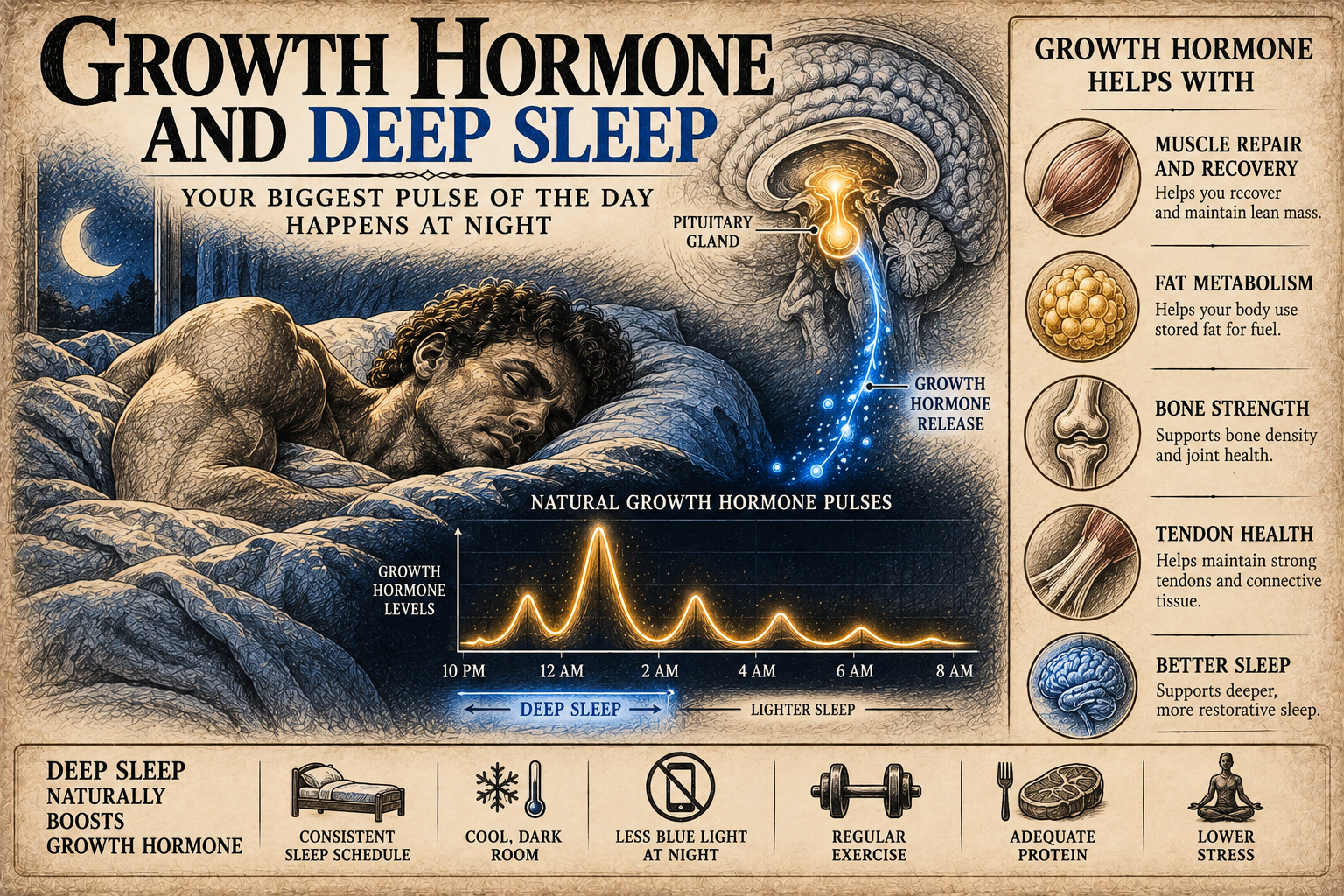
Growth hormone and deep sleep feed each other. Your biggest growth hormone pulse happens during deep sleep, and GHRH, the signal that triggers that pulse, also helps drive deep sleep. When one drops, the other usually follows.
Metabolism
Growth hormone affects how your body handles fat and sugar. It shifts your body toward burning fat for fuel, and it makes your cells a little more resistant to insulin while it does that. That second effect is one of the reasons people cycle GH peptides, which is covered later in this guide.
Signs Your Growth Hormone Is Running Low
Lower growth hormone rarely shows up as one big change. It usually shows up as a handful of small ones that build over a few years.
The most common one is recovery that takes longer than it used to, where a workout that used to leave you sore for a day now leaves you sore for three. Another is fat that collects around the waist even though your diet and training haven’t changed. People also notice sleep that feels lighter, where they wake up during the night and don’t feel rested in the morning.
None of these signs proves your growth hormone is low, because stress, diet, and other hormones can cause the same things. An IGF-1 blood test is the simplest way to see where you actually stand, and that’s covered later in this guide.
Why Growth Hormone Drops With Age
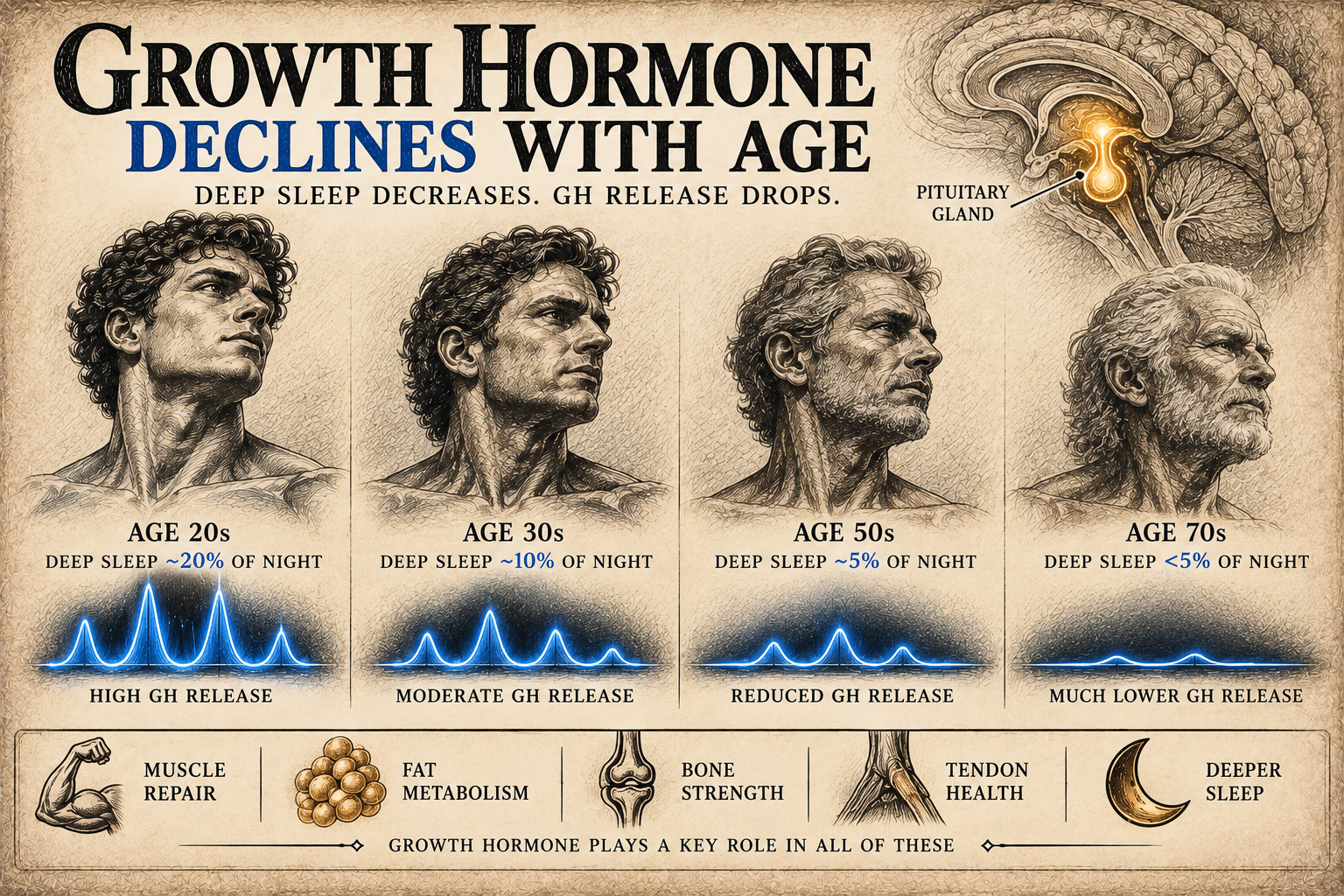
Your body releases growth hormone in pulses rather than a steady drip, and the biggest pulse of the day happens during deep sleep, shortly after you fall asleep.
In 2000, Eve Van Cauter and her team at the University of Chicago published a study in JAMA that tracked sleep and hormones in 149 healthy men between the ages of 16 and 83. In men under 25, deep sleep made up almost 20% of the night. In men over 35, it was less than 5%. Growth hormone secretion dropped by about 75% over that same span.
The biggest drop happened between the mid-20s and the mid-30s, which is much earlier than most people expect. Most people notice it as recovery that takes longer after a hard workout, along with fat that collects around the middle even when their diet hasn’t changed much.
Growth Hormone Peptides vs HGH
Synthetic HGH replaces the growth hormone your body makes. You inject a set amount, and your levels stay high for hours whether your body needs it or not. When growth hormone comes in from the outside, your pituitary senses it and makes less of its own.
Growth hormone peptides take a different route. They signal your pituitary to release more of its own growth hormone, so it still comes out in pulses and your feedback system stays in place. When levels rise, a hormone called somatostatin acts as a brake, which keeps the pattern closer to what your body does naturally.
HGH is also a prescription drug in the US, it’s expensive, and it’s tightly controlled. GH peptides are sold as research compounds and cost a fraction of the price. The tradeoff is that peptides depend on your pituitary still doing its job, so the response varies from person to person.
How GH Peptides Work: GHRH and GHRP
Growth hormone release is controlled by two main signals, and growth hormone peptides fall into two groups based on which one they copy.
The first group copies GHRH, which stands for growth hormone-releasing hormone. GHRH is the signal your brain sends to tell the pituitary to make and release growth hormone. Sermorelin, CJC-1295, and Tesamorelin all belong to this group.
The second group copies ghrelin, the hormone best known for making you hungry. Ghrelin also acts on a separate receptor in the pituitary that triggers growth hormone release. These peptides are called GHRPs, which stands for growth hormone-releasing peptides, and Ipamorelin is the one most people use.
Because the two groups work on different receptors, using one from each group produces a bigger release than either one alone. The GHRH peptide starts the release, and the GHRP makes it larger while pushing back against somatostatin. That’s why CJC-1295 and Ipamorelin are almost always run together.
It’s also why stacking two GHRH peptides doesn’t make sense. Sermorelin, CJC-1295, and Tesamorelin all work on the same receptor, so running two of them at once is like pressing the same button twice.
Growth Hormone Peptides Compared
| Peptide | Type | How long it lasts | Best known for |
|---|---|---|---|
| Sermorelin | GHRH | Minutes | The mildest option, and the one telehealth clinics prescribe |
| CJC-1295 (no DAC) | GHRH | About 30 minutes | A strong bedtime pulse, paired with Ipamorelin |
| Ipamorelin | GHRP | A few hours | Raising GH without raising cortisol or hunger |
| Tesamorelin | GHRH | Daily dosing | Visceral fat, liver fat, and focus, with the most human research |
Which Growth Hormone Peptide Should You Choose?
The right peptide depends on what you want out of it. These are the four most common starting points.
If You Want Better Sleep and Recovery
CJC-1295 without DAC and Ipamorelin is where most people start. It’s the most popular GH protocol, it’s easy to run as a single blend, and the change in deep sleep is usually the first thing people notice.
If You Want to Lose Visceral Fat
Tesamorelin has the strongest human research for visceral fat, and it also has trials behind it for liver fat and brain function. It’s the first one to look at for anyone on a GLP-1.
If You’re Sensitive or New to Peptides
Sermorelin is the mildest of the group. It’s the one to use if the others feel too strong or you’ve had a reaction to one of them.
If You Want the Best of Both
Rotating is the answer. Running Tesamorelin for 12 weeks, taking 4 weeks off, and then running CJC-1295 and Ipamorelin for 12 weeks gives you both sets of benefits without stacking two GHRH peptides at once.
Sermorelin: The First GH Peptide
Sermorelin was the first version of these peptides, and it’s also the weakest. It’s the first 29 amino acids of your own GHRH, which researchers found is the shortest piece that still does the full job. The FDA approved it in 1997 under the name Geref for children with growth hormone deficiency.
In 2008 the manufacturer stopped making it. That was a business decision, and the FDA didn’t pull it over safety. Today it’s the GH peptide most people get prescribed through telehealth clinics, because it’s the only one of the group those clinics are able to sell.
The most interesting Sermorelin research was done in older adults. In a 1997 study, healthy older men and women injected it every night, and their IGF-1 rose within 2 weeks and stayed up through 12 weeks. The researchers concluded that the pituitary in older people still works, and that what fades with age is mostly the signal from the brain. That finding is the case for this whole category.
Sermorelin breaks down within minutes, so its effect is the mildest of the four. If the others feel too strong for you, or you’ve had a reaction to one of them, Sermorelin is the one to use.
CJC-1295 With DAC vs Without DAC
CJC-1295 was developed by a Canadian company called ConjuChem as a longer-lasting version of GHRH. There are two versions, and people mix them up all the time. Almost every protocol uses the version without DAC, and that’s the one I’d steer you toward.
| CJC-1295 with DAC | CJC-1295 without DAC (Mod GRF 1-29) |
|---|---|
| Lasts about a week (half-life of 6 to 8 days) | Lasts about 30 minutes |
| Keeps growth hormone elevated around the clock | Creates one strong pulse, then drops back down |
| Can’t be stopped quickly if you get side effects | Out of your system the same night |
| Rarely used in current protocols | The standard partner for Ipamorelin |
CJC-1295 With DAC
DAC stands for Drug Affinity Complex. It’s an extra piece attached to the peptide that grabs onto albumin, a protein in your blood, and keeps it active for days. In a 2006 study in the Journal of Clinical Endocrinology and Metabolism, a single injection raised growth hormone 2 to 10 times for 6 days or more, and IGF-1 stayed elevated for 9 to 11 days.
That sounds convenient, but it creates a problem. Your body is built to release growth hormone in pulses, with levels dropping low in between. A second 2006 study found that with DAC, the lowest point of growth hormone between pulses was about 7.5 times higher than normal. People call this a GH bleed, because growth hormone stays elevated all day and night.
That constant exposure is where most of the complaints about DAC come from. People report more water retention, numbness and tingling in the hands, sluggishness, and injection site reactions. Because one injection lasts about a week, you also can’t stop it quickly if you don’t like how you feel.
CJC-1295 Without DAC
CJC-1295 without DAC is also called Modified GRF 1-29. It’s basically Sermorelin with four amino acids swapped so it holds up longer in the blood, and it lasts about 30 minutes.
That short window is the advantage. Most people inject it at bedtime, where it adds one strong pulse on top of the natural nighttime pulse, and then it’s gone. Your levels drop back down between pulses the way they’re supposed to, and if you have a side effect, it clears out the same night. When you buy CJC-1295, check the label so you know which version you’re getting.
Ipamorelin: The Selective GHRP
Ipamorelin was developed by Novo Nordisk in the 1990s. A 1998 paper in the European Journal of Endocrinology introduced it as the first selective growth hormone secretagogue.
Selective is the reason people like it. Older GHRPs like GHRP-6 and GHRP-2 raise growth hormone, but they also raise cortisol and prolactin, and GHRP-6 makes a lot of people very hungry. In the research, Ipamorelin raised growth hormone without raising cortisol, ACTH, or prolactin, which makes it the gentlest option in its class.
Why the CJC-1295 and Ipamorelin Blend Works
CJC-1295 and Ipamorelin are one of the most common peptide blends you’ll find, and there are three good reasons for it.
The first reason is the two-pathway effect covered above. Studies going back to the early 1990s found that a GHRH peptide and a GHRP given together release far more growth hormone than the two would add up to on their own.
The second reason is that they line up perfectly. Both are short-acting, both are taken on an empty stomach, usually at bedtime, and both are run at the same 250mcg dose on the same 5 days on, 2 days off schedule. When two peptides share the same dose, timing, and cycle, there’s no reason to draw them from two vials.
The third reason is convenience. A blend means one injection a night instead of two, and the people who stick with a protocol for the full 12 weeks are the ones who get results.
I’m usually not a fan of blends, because a lot of them force you to compromise. BPC-157 works best with small daily doses while TB-500 works best with larger doses twice a week, so mixing them means one of them isn’t dosed the way it should be. CJC-1295 and Ipamorelin don’t have that problem, which is why this is the one blend I’m comfortable recommending.
Tesamorelin: More Than a Belly Fat Peptide
Tesamorelin is the only one of the four that is an FDA-approved drug today. It’s sold as Egrifta for reducing excess belly fat in people with HIV-associated lipodystrophy, a condition where fat builds up around the organs.
In the trial published in the New England Journal of Medicine in 2007, 410 patients received either 2mg of Tesamorelin a day or a placebo. After 26 weeks, the Tesamorelin group had lost about 18% of their visceral fat, which was about a 20% difference compared with placebo. Visceral fat is the fat stored around your organs, and it’s the type most closely tied to metabolic problems.
Keep in mind who was in that trial. Everyone had HIV-associated lipodystrophy, a condition that keeps pushing fat into the belly. When some of them stopped Tesamorelin, the condition was still there, so the fat came back. That result reflects the disease, and it doesn’t describe what happens to a healthy person who runs a cycle and keeps up with their diet and training.
Tesamorelin and Liver Fat
In a 2019 trial published in The Lancet HIV, 61 people with fatty liver took Tesamorelin or a placebo for a year. Liver fat dropped by about 37% in the Tesamorelin group and didn’t change on placebo. About 35% of the Tesamorelin group got their liver fat back into the normal range, compared with 4% on placebo, and liver scarring got worse in 10% of the Tesamorelin group compared with 37% on placebo.
Tesamorelin and Brain Function
In a 2012 study published in Archives of Neurology, 152 adults with an average age of 68 took 1mg of Tesamorelin a day or a placebo for 20 weeks. Executive function, which covers planning, focus, and switching between tasks, improved in the Tesamorelin group. That held true for healthy older adults and for people with mild cognitive impairment.
People who run Tesamorelin also report deeper sleep, better recovery, and an easier time holding on to muscle while they lose fat.
Growth Hormone Peptides and GLP-1s
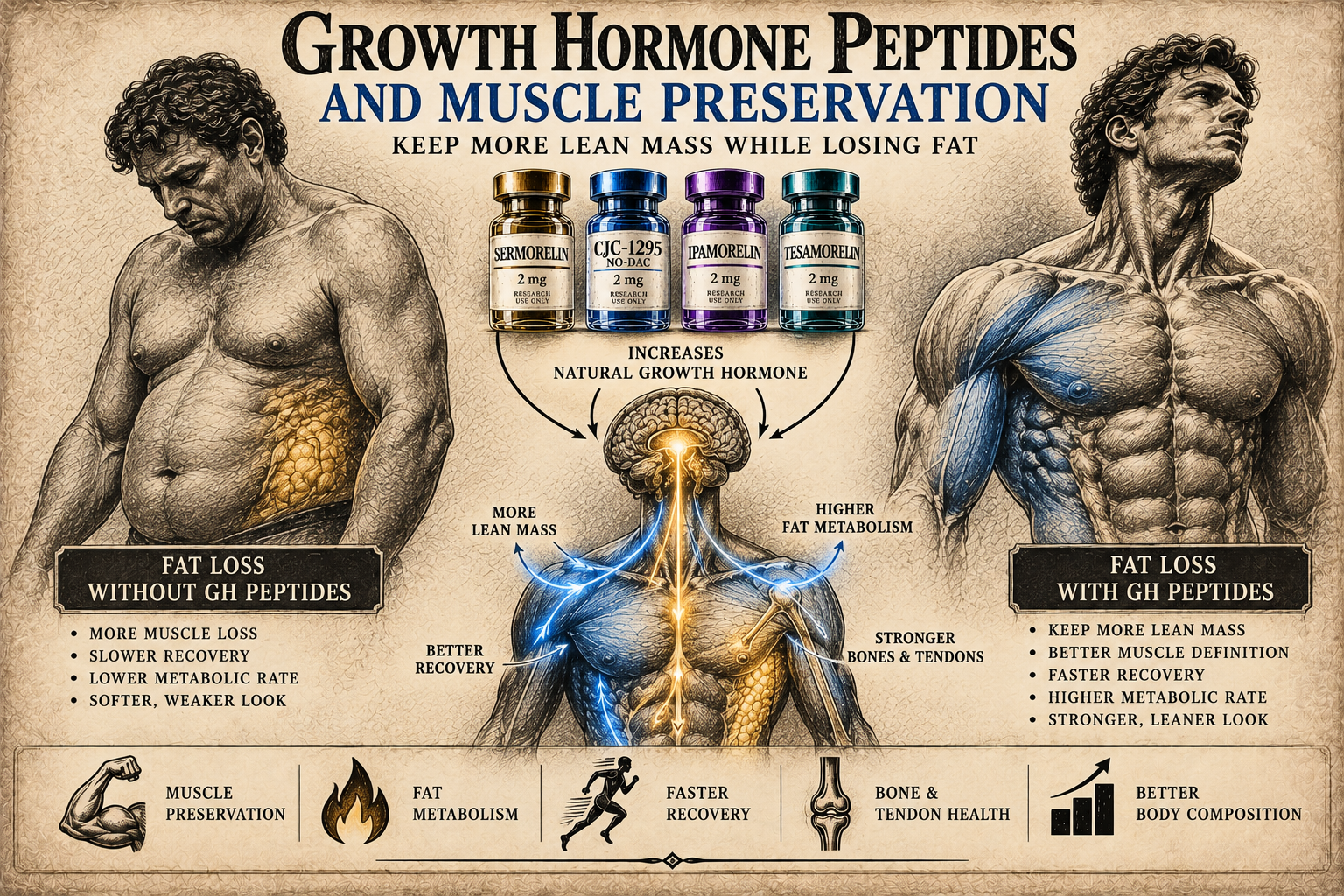
GLP-1s like semaglutide and tirzepatide work, and people lose a lot of weight on them. The problem is what kind of weight comes off.
In the STEP 1 trial, people on semaglutide lost about 15% of their body weight over 68 weeks, and body scans showed that 38 to 39% of the weight they lost was lean mass rather than fat. In the SURMOUNT-1 trial on tirzepatide, about 25% of the weight lost was lean mass. Lean mass on a scan includes water and other tissue along with muscle, but it’s still a lot of non-fat tissue, and most people on these drugs are eating far less protein than they used to.
Growth hormone tells your body to burn stored fat for fuel and to hold on to the protein in your muscle, which is the opposite of what tends to happen on a GLP-1.
There’s a second reason to pair them. Extra body fat suppresses growth hormone. A 1995 study in the Journal of Clinical Endocrinology and Metabolism compared 18 people with obesity to 18 normal-weight people of the same age. The group with obesity released less growth hormone over 24 hours, and the more belly fat someone carried, the lower their growth hormone was. After nine of them lost about 30kg through diet, their growth hormone release went back to normal.
That means a lot of people starting a GLP-1 already have low growth hormone, and they’re heading into months of eating less while their body pulls from muscle. Tesamorelin is a natural fit because it was studied for visceral fat, and CJC-1295 with Ipamorelin works well too, especially for people whose sleep has gotten worse. Either way, the GH peptide doesn’t replace eating enough protein and lifting weights.
Growth Hormone Peptide Dosage, Reconstitution, and Timing
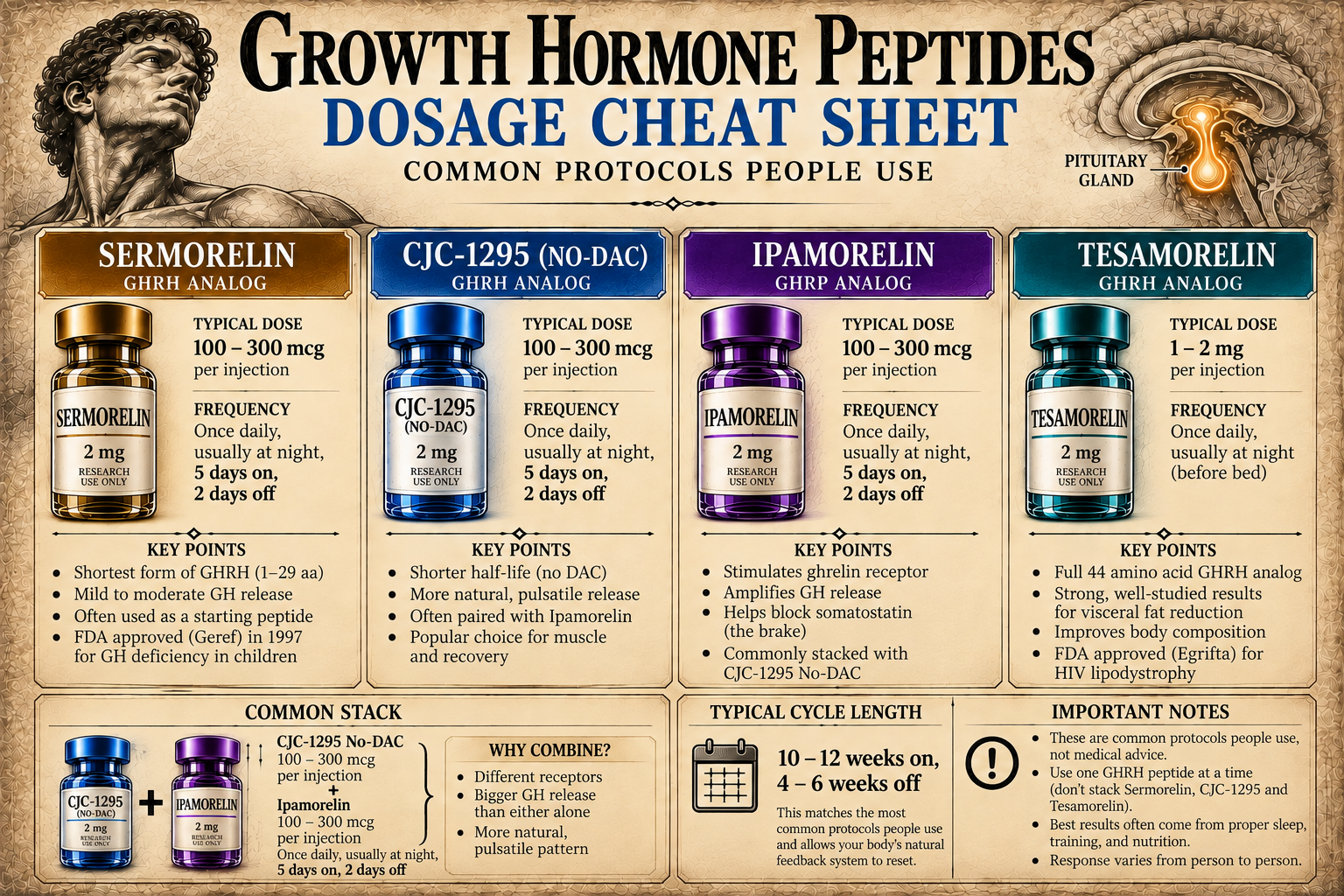
CJC-1295 and Ipamorelin Dosage and Other Protocols
These are the protocols people in the community are running right now. This is what’s out there, not a prescription.
| Peptide | Common dose | Timing | Cycle |
|---|---|---|---|
| CJC-1295 (no DAC) + Ipamorelin | 250mcg + 250mcg | Bedtime, or morning while fasted | 5 days on, 2 off, for 10 to 12 weeks, then 4 to 6 weeks off |
| Sermorelin | 200 to 300mcg | Bedtime, or morning while fasted | Once daily at night for 12 weeks then 4 to 6 weeks off |
| Tesamorelin | 2mg daily | Bedtime, or morning while fasted | 5 days on, 2 off, for 10 to 12 weeks, then 4 to 6 weeks off |
CJC-1295 and Ipamorelin are injected together subcutaneously. Tesamorelin doesn’t need Ipamorelin paired with it. Don’t run Tesamorelin, CJC-1295, or Sermorelin at the same time, because they all work on the same receptor.
I rotate them. I run Tesamorelin for 12 weeks, take 4 weeks off, and then run CJC-1295 and Ipamorelin for 12 weeks. Tesamorelin covers visceral fat, liver fat, and focus, CJC-1295 with Ipamorelin leans toward recovery, and both of them improve deep sleep.
Best Time to Take Growth Hormone Peptides
Night is the recommended time to inject. Your biggest natural pulse happens in the first few hours of sleep, so a bedtime dose adds to it. Research on GHRH given during the first half of the night found that it raised growth hormone, increased deep sleep, and lowered cortisol. When a 1997 study gave GHRH in the early morning instead, growth hormone still went up, but deep sleep didn’t change.
Morning dosing still works, as long as you’re fasted. Fasting is one of the strongest natural boosters of growth hormone. In a 1988 study in the Journal of Clinical Investigation, men’s growth hormone pulses during a five-day fast were about twice as large as on a normal eating day. A dose first thing in the morning, before breakfast, lands in the fasted window you’re already in after a night’s sleep. You’ll get the growth hormone boost, but you’ll give up the deep sleep benefit of a bedtime dose.
Either way, don’t eat for 2 to 3 hours before your dose. Food raises insulin, and insulin blunts growth hormone release. In a 2002 study in Clinical Endocrinology, a dose of sugar cut the growth hormone response to ghrelin, the hormone Ipamorelin copies, by about 60%, and a dose of fat cut it by about 42%.
A few other habits help. Go easy on alcohol at night, because drinking before bed cuts into deep sleep. Lift weights or do high-intensity training, since exercise raises growth hormone on its own. Eat enough protein, because growth hormone can’t rebuild tissue without the raw material.
Growth Hormone Peptides for Deep Sleep
If you track your sleep with an Oura ring, a Whoop, an Apple Watch, or something similar, deep sleep is where you’ll see the biggest change.
Deep sleep is also called slow-wave or delta wave sleep, because your brain waves slow down into long, steady delta waves. It’s when your body releases its biggest pulse of growth hormone and repairs muscle, tendons, and other tissue. It’s also when your brain cleans itself out. A 2013 study published in Science found that in mice, the space between brain cells opened up by about 60% during sleep, and waste like beta-amyloid cleared out about twice as fast as it did while they were awake.
Deep sleep shrinks as you get older, so a lot of people spend 7 or 8 hours in bed and only get a small slice of that time in real repair mode. My jump from about 20 minutes of deep sleep to 90 to 120 minutes on CJC-1295 and Ipamorelin is the change people notice most when they track their sleep, and it usually shows up in the first couple of weeks.
Tesamorelin improves deep sleep too. It works through the same GHRH signal as CJC-1295, and GHRH is one of the signals your brain uses to drive deep sleep.
Be clear on what to expect, though. These peptides won’t make you sleepy, and they won’t help you fall asleep. If falling asleep is your problem, you’ll need to solve that separately. What they change is how much deep sleep you get once you’re out.
Cycling and Stacking Growth Hormone Peptides
Why People Cycle Growth Hormone Peptides
Most people run GH peptides in cycles, usually 10 to 12 weeks on and 4 to 6 weeks off, and there are four good reasons for it.
The first reason is to keep the response strong. When the pituitary gets the same signal night after night for months, it can start to respond less. In a 1998 study in the Journal of Clinical Endocrinology and Metabolism, people took hexarelin, a stronger GHRP, twice a day for 16 weeks. Their growth hormone response dropped by about 45% over that time, and four weeks after they stopped, it was back to where it started.
The second reason is to keep IGF-1 from staying high all the time. Your body is built for growth hormone to rise and fall, and a break brings your levels back to baseline before the next round.
The third reason is blood sugar. Growth hormone makes your body a little more resistant to insulin, which is part of how it frees up stored fat. A few weeks off gives your blood sugar a chance to settle, and that matters more for anyone whose blood sugar already runs high.
The fourth reason is that the time off is a good window to retest your bloodwork. The 5 days on and 2 days off schedule works the same way on a smaller scale, giving the pituitary a short break every week.
What to Stack With Growth Hormone Peptides
Growth hormone peptides pair well with a few other compounds, depending on your goal. These are the three stacks I see most often.
For Recovery and Injuries
A GH peptide plus BPC-157 and TB-500 is the go-to recovery stack. Growth hormone and IGF-1 drive repair across the whole body, while BPC-157 and TB-500 work on the injured tissue itself. The protocols in circulation are BPC-157 at 400mcg daily and TB-500 at 5mg twice a week.
For Fat Loss and Metabolism
A GH peptide plus MOTS-c is the metabolic stack. Growth hormone frees up stored fat, and MOTS-c works on the mitochondria that burn it. MOTS-c is usually run at 5mg three times a week, because a bigger dose a few times a week works better than a small dose every day. Some people add 5-Amino-1MQ to this stack as well, and anyone on a GLP-1 is already covered in the GLP-1 section above.
For Sleep and Longevity
A GH peptide plus Epithalon or Pinealon is the sleep and longevity stack. The GH peptide deepens sleep, and these Russian bioregulators work on the pineal gland and your sleep rhythm. Epithalon is usually run at 1 to 2mg a day for a short cycle once or twice a year.
NAD+ and GHK-Cu also fit well alongside any of these stacks. The rule that doesn’t change is to avoid running two GHRH peptides at the same time.
Results, Mistakes, and Side Effects
How to Tell If Your GH Peptide Is Working
The easiest way to check is an IGF-1 blood test. Growth hormone itself goes up and down all day, so a single blood draw doesn’t tell you much. IGF-1 stays steady, and it reflects how much growth hormone your body has been releasing over time.
Get a baseline IGF-1 test before you start, and test again around weeks 6 to 8. If your number has gone up, the peptide is doing its job. If it hasn’t moved, look at your timing and your diet first. More isn’t better here, and most people aim for the upper part of the normal range for their age. In most states you can order an IGF-1 test through an online lab service without a doctor’s visit.
Sleep usually changes first, often within the first week or two. Recovery between workouts tends to improve over the first month, and changes around the waist usually show up between weeks 8 and 12.
Common Growth Hormone Peptide Mistakes
The most common mistake is buying CJC-1295 with DAC when you meant to buy the version without it. Check the label before you start.
The second mistake is stacking two GHRH peptides. Running Tesamorelin with CJC-1295, or Sermorelin with either one, mostly adds cost because they all compete for the same receptor.
The third mistake is eating right before the injection. A late dinner followed by a dose at bedtime blunts the pulse you’re paying for.
The fourth mistake is expecting results in the first week, and the last one is running it nonstop without the time off.
Side Effects and Who Should Avoid GH Peptides
The side effects people mention most are water retention, tingling in the hands, and a flushed feeling right after the injection. These usually ease up after the first couple of weeks.
Anyone with a history of cancer should stay away from growth hormone peptides, because growth hormone and IGF-1 drive cell growth. If your blood sugar already runs high, watch it closely and test it during your cycle.
Who Growth Hormone Peptides Are For
The first group is people who have noticed the slip, where recovery takes longer than it used to, sleep feels lighter, and fat collects around the middle even though nothing else has changed. That includes people who train hard and want their recovery back closer to where it was.
The second group is people on a GLP-1 who want to hold on to their muscle while the weight comes off. If you’re sleeping deeply and recovering fast, your natural pulse is probably still strong, and these peptides aren’t the right tool for you yet.
Growth Hormone Peptides FAQ
Stay sharp,
Joe Mars
The Peptide Report
P.S. I go through these protocols and answer questions in my Skool community, the Peptides and Biohacking Hub. Join here.
Disclaimer: This content is for educational and informational purposes only and is not medical advice. Products mentioned are sold for research use only and are not intended for human consumption, diagnosis, or treatment of any disease. Talk to a qualified healthcare provider before starting any new protocol. The Peptide Report may earn a commission or other compensation from links on this page.