 There are hundreds of peptides out there now, and if you read about them long enough you end up with a list of 20 you want to try. I’ve been guilty of that myself. So I ran a different exercise and asked which ones I’d keep if I had to cut that list way down.
I didn’t care which ones were the most popular. I wanted a small group that covers what matters to me now that I’m 54 and thinking about the next 30 years.
What’s in the Superman Stack
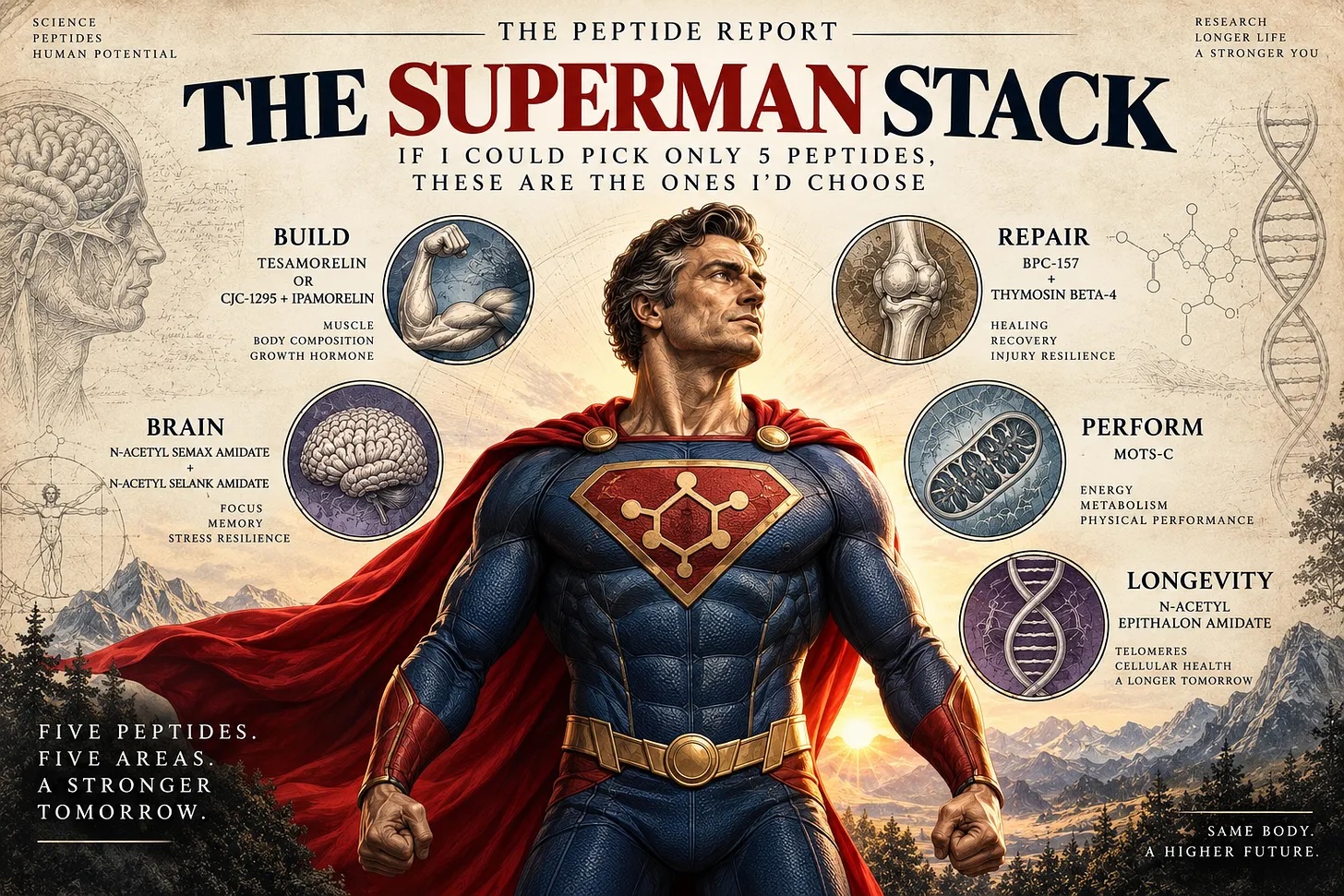
My one rule was that no two picks could do the same job. Here’s the whole thing in one place, along with the doses people commonly run.
| Category | Peptide | Common dose people run |
|---|---|---|
| Build | Tesamorelin, or CJC-1295 with Ipamorelin | Tesamorelin 2 mg daily. CJC/Ipa 250 mcg of each at night, 5 days on and 2 days off |
| Repair | BPC-157 with TB-500 | BPC-157 400 mcg daily. TB-500 5 mg twice a week |
| Brain | N-Acetyl Semax Amidate with N-Acetyl Selank Amidate | 250 mcg of each once a day |
| Perform | MOTS-c | 5 mg three times a week |
| Longevity | N-Acetyl Epithalon Amidate | 1 mg to 2 mg a day |
Build covers muscle, body fat, and growth hormone. Repair covers healing and recovery. Brain covers focus, memory, and stress. Perform covers energy and metabolism. Longevity covers what happens inside your cells as you age.
This isn’t a medical plan, and I’m not telling anyone to go take five peptides. It’s how I’d narrow things down if I only got one pick per area. It isn’t a men’s stack either, since every one of these areas matters just as much for women.
A few good ones didn’t make it, including SS-31, NAD+, Humanin, and FOXO4-DRI. I get to those at the end.
A few words you’ll see a lot
A peptide is a short chain of amino acids, and amino acids are the building blocks your body uses to make proteins. Your body makes plenty of its own peptides and uses them to pass messages from one place to another.
A receptor is a spot on a cell where a certain chemical can attach. When the right chemical attaches, the cell gets told to do something.
A randomized, placebo-controlled trial is one of the strongest ways to test whether something works. People get split into groups by chance, one group gets the real thing, the other gets a placebo with nothing active in it, and the researchers compare the two.
I also point out whether research was done in people, in animals like mice and rats, or on cells in a lab dish. All three are useful, but what happens in a mouse or a dish doesn’t always happen the same way in a person.
Build: Tesamorelin or CJC-1295 with Ipamorelin
I’m cheating right away by giving you two options here, and I’ll explain below why I’d pick one instead of running both.
I’ve been at 240 pounds, and I worked my way down to 185. Keeping that fat off while holding onto muscle is a big reason this category comes first for me.
Why growth hormone matters
Growth hormone comes from the pituitary gland, a small gland at the base of your brain. It has a hand in building muscle, burning fat, and repairing tissue. It also tells your liver to make IGF-1, a second hormone that carries out a lot of growth hormone’s work, which is why researchers usually measure both. Your body puts out less growth hormone as you age, and that’s part of why muscle gets harder to keep and fat around the middle gets easier to gain.
Tesamorelin
If belly fat and body composition were my main concern, I’d go with Tesamorelin. It’s a man-made version of GHRH, the hormone that tells your pituitary gland to release growth hormone, so it switches on that same system.
Tesamorelin is an FDA-approved prescription drug called Egrifta. It’s approved to reduce extra belly fat in adults with HIV who have lipodystrophy, a condition that changes where the body stores fat. The fat it goes after is visceral fat, which sits deep in your belly around your organs, not the fat right under your skin that you can pinch.
A 2026 meta-analysis pulled together five randomized trials that compared Tesamorelin with a placebo. People on Tesamorelin lost a significant amount of visceral fat and trunk fat, their waists got smaller, and their liver fat dropped by about 4.3 percentage points. They also gained an average of 1.42 kg of lean body mass, which is a little over three pounds. Their body weight barely changed, and neither did the fat under their skin. That lines up with the FDA label, which says Tesamorelin isn’t meant for weight loss. Side effects in the trials included joint and muscle pain, tingling, and reactions where the shot went in.
Most of those trials were done in people with HIV, so a healthy 50-year-old shouldn’t expect the exact same numbers. Even so, very few compounds in the peptide world have that much human data behind them.
CJC-1295 with Ipamorelin
The other option is CJC-1295 paired with Ipamorelin. CJC-1295 works on the same GHRH side as Tesamorelin. Ipamorelin works through the ghrelin receptor, which is a separate route to growth hormone release, and that’s why people put the two together.
CJC-1295 has been tested in people. A 2006 study in healthy adults found it raised growth hormone and IGF-1, and the increase lasted for days after a single shot. Nobody has shown yet that CJC-1295 and Ipamorelin together shrink visceral fat and add lean mass the way Tesamorelin did in its trials. I’m giving you both options, but the research behind them isn’t equal, and I’m not going to pretend it is.
Why I wouldn’t run both
Tesamorelin and CJC-1295 both push on the GHRH side of the growth hormone system, so stacking them doubles up on the same signal. I’d choose one or the other.
Doses people run
The big Tesamorelin trials used 2 mg injected under the skin once a day. That’s the dose studied in those patients, and it isn’t a recommendation for everyone.
CJC-1295 and Ipamorelin have no FDA-approved protocol for body composition. The one you’ll see most in peptide communities is 250 mcg of each at night, 5 days on and 2 days off, for about 10 to 12 weeks. That schedule comes from the community, and it hasn’t been tested in a clinical trial of the combination.
People run it at night on an empty stomach because food raises insulin, and higher insulin works against the growth hormone release these peptides are meant to trigger. Nighttime also lines up with your biggest natural growth hormone release, which happens during deep sleep.
At 25, putting on muscle is mostly about how you look. At 70, your muscle is what gets you up off the floor, lets you carry your own groceries, and keeps you living on your own. That’s why Build gets the first spot.
Repair: BPC-157 with TB-500
Anyone who’s followed me for a while probably saw this one coming.
I ruptured my Achilles in 2019, and I’ve also watched my daughter work her way back from an ACL injury. Between the two of us, I’ve spent a lot of time thinking about how the body heals.
TB-500 is the name most people know, and the version I want is full-length Thymosin Beta-4, the complete 43-amino-acid molecule. I’m picky about that because the TB-500 name doesn’t always mean the same material from one source to the next, and I wrote a whole article on why that matters.
Tendons connect muscle to bone, and ligaments connect bone to bone. Both have a smaller blood supply than muscle, which is one reason those injuries heal so slowly. In your twenties you can beat yourself up in the gym and feel fine a few days later. Once you’re older, a sore shoulder or knee that used to be a minor annoyance can hang around for months.
TB-500, also called Thymosin Beta-4
Your body makes Thymosin Beta-4 on its own. Researchers have studied it for helping cells move into injured areas, for angiogenesis, which is the growth of new blood vessels, and for tissue repair.
It has some human research too. One randomized, placebo-controlled trial tested TB4 as a gel on 73 people with venous ulcers, which are slow-healing sores on the legs. People handled it well, and one of the strengths they tested looked like it helped the sores heal faster. That study doesn’t show that injected TB-500 does anything for a sports injury, but it does show the molecule has been studied for wound repair in people.
BPC-157
BPC-157 is a 15-amino-acid peptide based on a sequence from a protein found in stomach juice. It’s one of the most widely used recovery peptides out there, and a large body of animal research stands behind it, covering tendons, ligaments, muscle, bone, and the gut.
The human research is still early. A 2025 review counted three small human pilot studies, and a separate 2025 pilot gave BPC-157 by IV to two people with no problems showing up in what the researchers measured. When I size up a peptide, I look at the human data, the animal data, and the biology together, and BPC-157 is strongest on the animal and biology side.
Why they get paired
Both peptides have been studied for tissue repair and new blood vessel growth, and TB-500 has an especially well-known role in helping repair cells move into the injured spot. That’s why people run them together so often, and the combination usually goes by the name Wolverine Stack.
Doses people run
One of the most common protocols is 400 mcg of BPC-157 every day and 5 mg of TB-500 twice a week, with the two TB-500 doses a few days apart. These are community protocols, and they haven’t been proven in controlled human trials for injury recovery.
Because the two run on different schedules, a lot of people keep them in separate vials instead of using a blend. A blend locks you into giving both on the same days.
I still want to lift and stay active, and I don’t want to give up things I enjoy because my body takes longer to bounce back than it did at 25. If the plan is staying active for decades, recovery has to be part of it.
Brain: N-Acetyl Semax Amidate with N-Acetyl Selank Amidate
My first draft had Semax here by itself. When I thought about what I actually wanted from this category, memory and focus weren’t enough. I also want my head to stay calm and clear when life gets stressful, so I added Selank.
Both peptides came out of Russian research and are used as medicines there. Neither one is FDA approved in the United States.
Semax
Semax is a seven-amino-acid peptide made from a piece of ACTH. Normally ACTH tells your adrenal glands to release cortisol, your main stress hormone, but the piece used to make Semax doesn’t carry ACTH’s full hormone effect.
A lot of Semax research focuses on BDNF, which stands for brain-derived neurotrophic factor. BDNF is a protein that helps brain cells survive and helps them form and reshape their connections with each other. In a 2006 rat study, Semax raised BDNF protein in the hippocampus, the part of the brain most tied to memory, and it changed how active the genes for BDNF and its receptor were. That’s animal work, but it’s a big reason people got interested in Semax for thinking and memory. There’s also older human research on Semax for attention and memory.
Selank
Selank is also seven amino acids long, and it was built from a sequence related to tuftsin, a small peptide connected to the immune system.
In a 2008 study, 62 people with generalized anxiety disorder or neurasthenia got either Selank or medazepam, a benzodiazepine from the same drug family as Valium. Selank eased anxiety, and the people taking it also reported less fatigue and more energy. It’s a small study by modern standards, but it’s a real comparison against an active drug.
What happens when you run them together
There’s also a human brain scan study on both peptides. Researchers gave 52 healthy people Semax, Selank, or a placebo and used fMRI to see which brain areas were working together. They found changes involving the amygdala, which handles fear and stress, along with areas in the temporal lobe. It doesn’t show that Semax makes healthy people smarter or that Selank wipes out anxiety, but it does show both peptides change brain activity in ways a scan can pick up.
Why the N-Acetyl Amidate versions
Your body has enzymes that break peptides apart, and some of them attack from the two ends of the chain. The N-Acetyl Amidate versions put a small chemical cap on each end. The front end gets an acetyl group, the back end gets an amide group, and the amino acid chain in the middle stays exactly the same. Capping both ends makes it harder for those enzymes to chew the peptide up, so it should hold up longer in the body. Plenty of the body’s own hormones already have an amide group on the end.
The studies above used the original Semax and Selank, and the capped versions haven’t been compared head to head with them yet.
Doses people run
In Russia, regular Semax and Selank have mostly been given as nasal sprays. For the N-Acetyl Amidate versions, the protocol you’ll see most is 250 mcg of each once a day, injected under the skin. No human trial has tested that dose for the modified versions.
You can have great abs, low belly fat, and all the muscle in the world, but none of it means much if your brain isn’t working well. That matters more to me every year.
Perform: MOTS-c
MOTS-c was an easy pick, partly because your own body already makes it. My mom runs MOTS-c along with NAD+, so I’ve spent a lot of time reading about both.
Mitochondria are tiny structures inside your cells that turn the food you eat into energy your cells can use, and that energy gets stored in a molecule called ATP. Mitochondria also have their own small set of DNA, and they use it to make their own signaling molecules. MOTS-c is one of them, a 16-amino-acid peptide coded right in your mitochondrial DNA. It sits where mitochondria, metabolism, muscle, and exercise all meet, which is why I filed it under Perform.
Researchers first described MOTS-c in 2015. In mice, it helped control blood sugar and protected against weight gain and insulin resistance. Insulin resistance means your cells stop responding well to insulin, the hormone that moves sugar out of your blood.
A 2021 study took it further. In people, exercise raised the body’s own MOTS-c in both muscle and blood. In mice, giving MOTS-c improved physical performance at every age the researchers tested, and very old mice that started getting it late in life gained physical ability and stayed healthier longer.
A separate 2021 study in people measured several mitochondrial peptides after endurance exercise and weight training. Several of them changed, but the rise in MOTS-c after endurance exercise was too small to count as a clear result in that study.
So we know MOTS-c exists in people and that exercise affects it. We don’t have a controlled human trial yet showing that injecting MOTS-c gives healthy people the kind of results seen in the mice.
Why MOTS-c is run three times a week instead of daily
The most common MOTS-c protocol is 5 mg three times a week on days that aren’t back to back, like Monday, Wednesday, and Friday. People ask me all the time why it isn’t 1 mg every day instead, and there are a few reasons.
MOTS-c switches on a protein in your cells called AMPK, which acts as the cell’s energy sensor. AMPK turns on when energy runs low, like during exercise or after you haven’t eaten for a while, and it tells your cells to pull more sugar out of the blood, burn more fat, and build more mitochondria.
Your body releases MOTS-c in bursts. It goes up when you exercise and comes back down afterward, and a bigger dose a few times a week follows that same up-and-down pattern. A small daily dose keeps a low, steady signal going instead, and the concern is that cells can start responding less to a signal that never shuts off.
The weekly total is also very different. Three 5 mg doses come to 15 mg a week, while 1 mg a day comes to 7 mg, which is less than half.
The schedule matches the research too. The old mice in the 2021 study that got stronger were given MOTS-c three times a week, not every day. Nobody has tested the two schedules against each other in people, so this approach is based on how MOTS-c works and on the animal research.
I want to keep my muscle, train hard, and recover, and underneath all of that I need my body to keep making and managing energy well. That’s the job MOTS-c has in this stack.
Longevity: N-Acetyl Epithalon Amidate
This was the hardest pick. I went back and forth between SS-31, NAD+, Thymosin Alpha-1, and a few others before I noticed that my first four picks were all about keeping different systems running. I wanted the fifth to be about aging itself, so I went with Epithalon, specifically the N-Acetyl Epithalon Amidate version.
I’ve written two full articles on Epithalon because it’s one of the strangest stories I’ve run into in the peptide world. It also hits close to home. I’ve gone through long stretches of waking up at 1am, 3am, and 5am, and Epithalon’s story starts in the pineal gland, the small gland in your brain that makes melatonin and helps run your sleep cycle.
What telomeres are
Your DNA is packed into long strands called chromosomes, and each end of a chromosome has a protective section called a telomere. Telomeres get a little shorter each time a cell divides, and when they get too short, the cell stops dividing. Your body has an enzyme called telomerase that can add length back, but most adult cells make very little of it.
Where Epithalon came from
Epithalon comes out of the work of Russian researcher Vladimir Khavinson and his team. Their early research used Epithalamin, an extract made from the pineal gland. Epithalon is a synthetic peptide made of only four amino acids, alanine, glutamic acid, aspartic acid, and glycine, which gets written as AEDG.
The telomere research
In 2003, Khavinson’s group reported that Epithalon switched on telomerase and made telomeres longer in human cells grown in a lab.
In 2025, a separate team at Brunel University London tested Epithalon on human cells. In normal fibroblasts, which build connective tissue, and normal epithelial cells, which line the body’s surfaces, telomeres got longer and telomerase activity went up. The team also tested breast cancer cells, and those telomeres got longer too, but through a different process called ALT, which stands for alternative lengthening of telomeres. The paper later had a correction because some of the figures were wrong, which is worth knowing if you go read it.
I’m still interested because a different research group went back to this question more than 20 years after the original work and landed in a similar place. These were still cells in a dish, though, so this research doesn’t show that Epithalon helps people live longer.
The N-Acetyl Amidate version uses the same two end caps I described in the Brain section to protect those four amino acids from breaking down too fast.
Doses people run
A lot of people online run 10 mg of Epithalon a day, and that number comes from a mix-up. The Russian protocols that used 10 mg a day were using Epithalamin, the pineal extract, and not synthetic Epithalon. Epithalamin is a crude mix of many peptides, while Epithalon is the pure, isolated peptide, so it takes far less of it to do the job.
The most common dose for Epithalon is 1 mg to 2 mg a day, injected under the skin. I broke the whole dosing story down in my article on the real Epithalon dose.
How long I run each cycle
People ask about cycle length more than almost anything else, so here’s how I space mine out. Most of my cycles run 12 weeks.
| Peptide | How I cycle it |
|---|---|
| MOTS-c and SS-31 | 12-week cycles, two to three times a year |
| Tesamorelin and CJC/Ipa | 12 weeks of Tesamorelin, 4 weeks off, then 12 weeks of CJC/Ipa |
| BPC-157 and TB-500 | A 12-week cycle once or twice a year, as needed |
| Epithalon | Once or twice a year |
| Semax and Selank | As needed, usually a 12-week cycle |
That’s what I do, not a recommendation for anyone else.
The ones that almost made it
Every one of these could be a top pick for someone else.
SS-31, also called Elamipretide
SS-31 was the hardest one to leave off. It’s a small peptide that goes straight to the mitochondria and attaches to cardiolipin, a fat in the inner wall of the mitochondria that the ATP-making machinery depends on.
It also has something most peptides in this article don’t, which is an FDA-approved drug behind it. In September 2025, the FDA gave elamipretide accelerated approval under the name Forzinity to improve muscle strength in people with Barth syndrome who weigh at least 30 kg. Barth syndrome is a rare genetic disease, so that approval doesn’t make SS-31 an anti-aging drug for healthy people.
It missed the cut because MOTS-c already covers the mitochondria side of the stack.
FOXO4-DRI
As you age, some cells stop dividing but don’t die off. Researchers call them senescent cells, and they hang around sending out signals that affect the tissue around them. FOXO4-DRI was designed to break up a connection between two proteins, FOXO4 and p53, inside those cells so the cells can die off the way they should.
In a well-known 2017 mouse study, FOXO4-DRI cut down signs of senescence and improved several measures of tissue function and physical condition. It stays off my list because it hasn’t been through human clinical trials yet.
It’s also not something anyone runs often. With senolytics, more isn’t better, and overdoing it can cause harm. The approach people use is a one-week protocol, run twice a year at the most.
Humanin
Humanin is another peptide made by the mitochondria. Researchers first found it while studying brain cells that had survived in tissue affected by Alzheimer’s disease, and it’s since been studied for cell stress, metabolism, brain protection, and aging. Most of that work is in animals and lab cells, and it covers a lot of the same ground as MOTS-c, so it didn’t make the five.
NAD+
NAD+ technically isn’t a peptide, but it comes up in every longevity conversation. Your cells use it to make energy, and the enzymes that repair DNA need it too. It belongs in any conversation about aging, but it didn’t add a new category to this stack.
Thymosin Alpha-1
Thymosin Alpha-1 is an immune peptide with far more human clinical history than most compounds in the peptide world, and it’s been used as a medicine in a number of countries outside the US. It came close because immune health is the biggest area this stack doesn’t cover. If I ever turned this into a six-part stack, it’d be one of the first ones I’d look at.
Frequently asked questions
What is a peptide stack?
A peptide stack is a group of peptides run together, usually picked so each one covers a different job. The Superman Stack has five parts, one each for muscle and body fat, recovery, brain function, energy and metabolism, and the biology of aging.
Can you run all five of these peptides at the same time?
The five categories were built so they don’t overlap, but that doesn’t mean everyone should run all five at once. Most people add one category at a time and see how they respond before adding another. The one combination I’d avoid is Tesamorelin together with CJC-1295, since both work on the same growth hormone pathway.
How long should a peptide cycle be?
Most of my cycles run 12 weeks. I rotate Tesamorelin and CJC/Ipa with a 4-week break in between, run MOTS-c two to three times a year, and run Epithalon once or twice a year. Cycle lengths in the peptide world come from community practice, not from clinical trials.
Why is MOTS-c dosed at 5 mg three times a week instead of daily?
Your body releases MOTS-c in bursts around exercise rather than at a steady level, and a larger dose a few times a week follows that same pattern. Three 5 mg doses also come to 15 mg a week, while 1 mg daily comes to 7 mg. The old mice in the 2021 study that gained physical ability were dosed three times a week.
What’s the correct Epithalon dosage?
The most common dose is 1 mg to 2 mg a day. The 10 mg a day number you see online came from protocols that used Epithalamin, a crude pineal gland extract, rather than the pure synthetic peptide.
What’s the difference between TB-500 and TB4?
TB-500 is the name most people know, and full-length TB4, or Thymosin Beta-4, is the complete 43-amino-acid molecule. Not every product sold under the TB-500 name is the full-length molecule, so it’s worth knowing which one you’re getting.
Is this stack only for men?
No. Every category in the stack covers something that matters just as much for women, including muscle, recovery, brain function, energy, and aging.
Wrapping up
If you forced me to narrow everything down, this is where I’d land. Build gets Tesamorelin or CJC-1295 with Ipamorelin, but not both. Repair gets BPC-157 with TB-500. Brain gets N-Acetyl Semax Amidate with N-Acetyl Selank Amidate. Perform gets MOTS-c. Longevity gets N-Acetyl Epithalon Amidate.
Every pick does a different job, and that was the point of the whole exercise.
What I care about has changed as I’ve gotten older. I still want to look good, carry muscle, and stay lean, but I’m thinking a lot further down the road now. I want to still be training at 70, recovering from it, getting up off the floor without thinking twice, staying sharp, and running on a metabolism that still works.
I’m 54, and I’m not trying to be 25 again. I’m trying to make 70 look a hell of a lot different than what most people picture.
If I made this list again in five years, it could look completely different, because the research keeps moving.
After Facebook banned me, I moved our community over to Skool, and that’s where the best peptide conversations happen now. If you want to talk peptides, biohacking, and research, or you just have questions, join us in the Peptides & Biohacking Hub: https://www.skool.com/peptides-biohacking-hub
See you inside,
Joe Mars
This is not medical advice. Research use only. Some compounds discussed are investigational and haven’t been approved by the FDA for the uses described. Tesamorelin and elamipretide are FDA-approved prescription drugs for specific indications, which doesn’t mean the other uses discussed here are FDA approved. Talk with a licensed physician about your own health before using any prescription medication.
References
- Body composition, hepatic fat, metabolic, and safety outcomes of Tesamorelin in HIV-associated lipodystrophy: a meta-analysis of randomized controlled trials (2026). https://pubmed.ncbi.nlm.nih.gov/41545261/
- Prolonged stimulation of GH and IGF-1 secretion by CJC-1295 in healthy adults (2006). https://pubmed.ncbi.nlm.nih.gov/16352683/
- The effect of thymosin treatment of venous ulcers. https://pubmed.ncbi.nlm.nih.gov/20536470/
- Regeneration or Risk? A Narrative Review of BPC-157 for Musculoskeletal Healing (2025). https://pubmed.ncbi.nlm.nih.gov/40789979/
- Safety of Intravenous Infusion of BPC157 in Humans: A Pilot Study (2025). https://pubmed.ncbi.nlm.nih.gov/40131143/
- Dolotov OV, et al. Semax regulates BDNF and trkB expression in the rat hippocampus. Brain Research (2006). https://pubmed.ncbi.nlm.nih.gov/16996037/
- Zozulia AA, et al. Efficacy and possible mechanisms of action of the peptide anxiolytic Selank (2008). https://pubmed.ncbi.nlm.nih.gov/18454096/
- Functional Connectomic Approach to Studying Selank and Semax Effects. https://pubmed.ncbi.nlm.nih.gov/32342318/
- Lee C, et al. The mitochondrial-derived peptide MOTS-c promotes metabolic homeostasis. Cell Metabolism (2015). https://doi.org/10.1016/j.cmet.2015.02.009
- Reynolds JC, et al. MOTS-c is an exercise-induced mitochondrial-encoded regulator of age-dependent physical decline. Nature Communications (2021). https://www.nature.com/articles/s41467-020-20790-0
- Acute endurance exercise stimulates circulating levels of mitochondrial-derived peptides in humans (2021). https://pubmed.ncbi.nlm.nih.gov/34351816/
- Epithalon peptide induces telomerase activity and telomere elongation in human somatic cells (2003). https://pubmed.ncbi.nlm.nih.gov/12937682/
- Al-Dulaimi S, et al. Epitalon increases telomere length in human cell lines through telomerase upregulation or ALT activity. Biogerontology (2025). https://pubmed.ncbi.nlm.nih.gov/40908429/
- Correction to the above Epitalon study (2025). https://pubmed.ncbi.nlm.nih.gov/41240216/
- Stealth BioTherapeutics announces FDA accelerated approval of Forzinity (elamipretide HCl) (2025). https://www.prnewswire.com/news-releases/stealth-biotherapeutics-announces-fda-accelerated-approval-of-forzinity-elamipretide-hcl-the-first-therapy-for-progressive-and-life-limiting-ultra-rare-genetic-disease-barth-syndrome-302562058.html