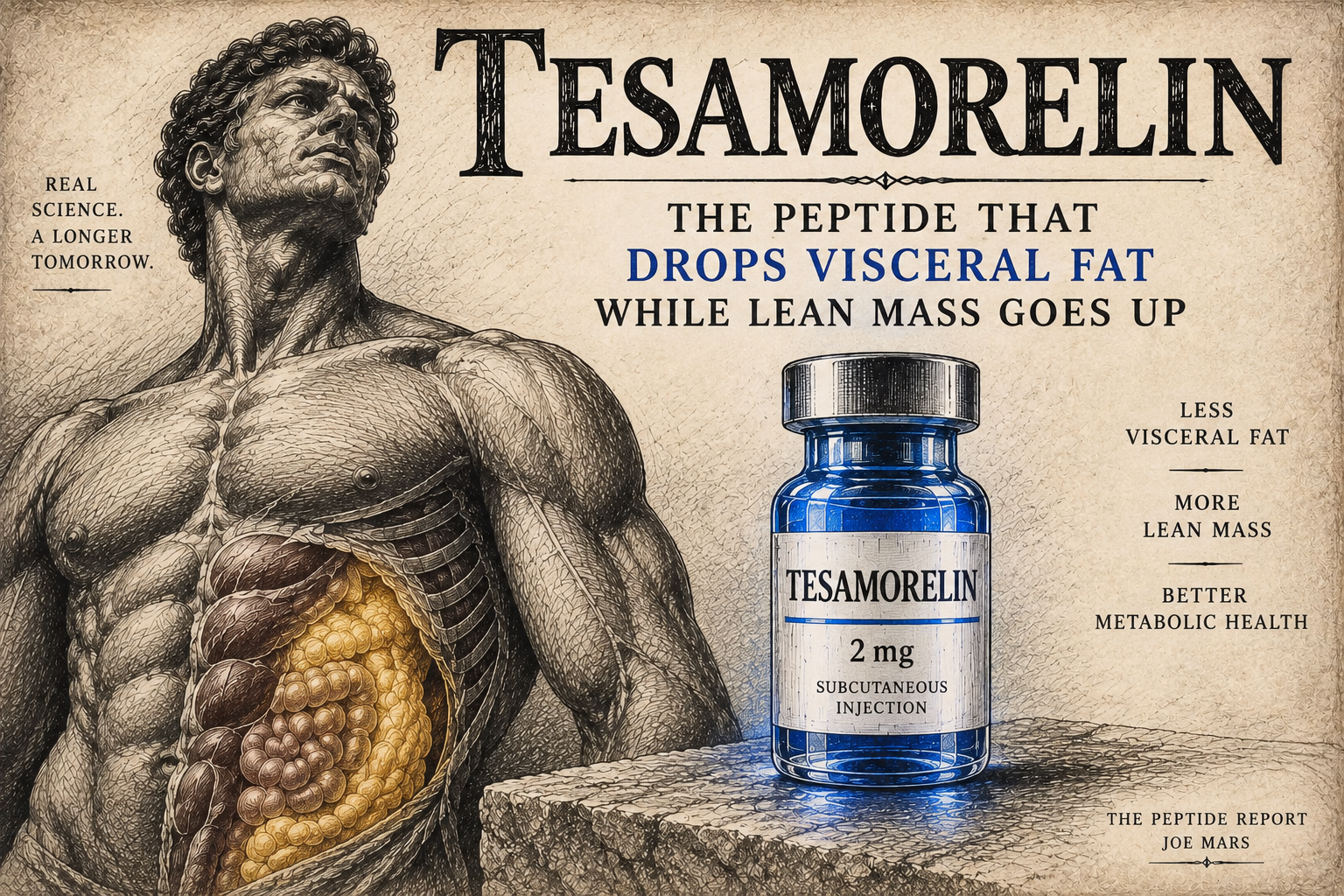
Tesamorelin is a growth hormone releasing hormone analog that the FDA approved in 2010. In five randomized human trials, tesamorelin reduced visceral fat while lean body mass went up at the same time. Most compounds studied for body composition move one of those numbers, not both.
This guide covers what the tesamorelin research actually found, the dosage used in the trials, a blood sugar finding buried in the FDA label, and the question a lot of people are asking right now about muscle loss on GLP-1 medications.
What Is Tesamorelin?
Tesamorelin is a synthetic version of GHRH, the hormone your brain uses to tell your pituitary gland to release growth hormone.
Scientists hunted for GHRH for decades without finding it, because your body only makes a tiny amount. Then a patient turned up with a pancreatic tumor producing it in bulk. That is how Roger Guillemin’s team at the Salk Institute isolated it and published the structure in Science in 1982. A second group pulled another version out of a different patient’s tumor the same year.
Turning it into a drug did not work at first. An enzyme in your blood called DPP-IV finds GHRH and cuts the first two amino acids off it within minutes, so natural GHRH does not last long enough in the body to do anything.
A company in Montreal called Theratechnologies fixed that. They attached a small chemical cap to the front of the molecule, sitting right on the spot where the enzyme makes its cut. The enzyme cannot reach what it needs to reach, and the working end of the molecule stays free.
Tesamorelin is that same 1982 molecule with a guard on its nose. The FDA approved it on November 10, 2010. It was the first GHRH analog ever approved in the United States.
Why Tesamorelin Was Developed
In the mid 1990s, combination therapy turned HIV from a death sentence into something people survived. Then the survivors started changing shape. Fat drained out of the face, arms and legs and piled up deep in the abdomen.
The condition was named HIV associated lipodystrophy. The pattern was so recognizable that it effectively announced a person’s diagnosis to anyone who knew what to look for, which was a serious thing to carry at the time.
Every tesamorelin trial was run in people with a specific, measurable problem with deep abdominal fat. That is who the compound was built for, and the research reflects it.
Visceral Fat vs Subcutaneous Fat
There are two kinds of belly fat and only one of them is the real problem.
The layer you can pinch sits just under the skin. That is subcutaneous fat and it is mostly harmless. The other kind sits deeper, wrapped around your liver, your pancreas and your intestines. That is visceral fat, and it does not behave like fat anywhere else in your body.
Visceral fat acts more like an organ. It puts out signals that raise inflammation and make your cells stop listening to insulin. You cannot see it and you cannot pinch it. Two people at the same weight on the same scale can carry completely different amounts of it.
| Feature | Subcutaneous Fat | Visceral Fat |
|---|---|---|
| Location | Just under the skin | Deep in the abdomen, around organs |
| Can you pinch it | Yes | No |
| How it is measured | Calipers, tape, visible | CT or MRI scan |
| Metabolic effect | Relatively inactive | Drives inflammation and insulin resistance |
| Order it comes off | Slower, more stubborn | Earlier, but invisibly |
Why Most People Never Notice Visceral Fat Leaving
Visceral fat usually comes off early when you lose weight, and it comes off invisibly. Blood pressure, blood sugar and liver enzymes often improve months before the belly looks any different in the mirror. A lot of people quit right there, because nothing is happening as far as they can see.
You also do not get to choose. A review pooling 89 studies across diet and exercise, weight loss drugs and bariatric surgery found that no approach preferentially targets visceral fat. It comes off in proportion to everything else, and the only way most people know it happened is a lab result.
That is what makes the tesamorelin data unusual. Its trials measured visceral fat directly, by CT scan, rather than by scale or by tape measure.
Tesamorelin Research: What Five Human Trials Found
A meta analysis published in 2026 pooled five randomized controlled trials of tesamorelin against placebo. These were human trials, scored with standard tools for bias and evidence quality.
| Outcome | Result vs Placebo |
|---|---|
| Visceral fat | Down 27.71 square centimeters by CT |
| Trunk fat | Reduced |
| Waist circumference | Reduced |
| Liver fat | Reduced |
| Lean body mass | Increased |
The lean body mass result is the one worth sitting with. Fat was falling and lean tissue was moving the other way at the same time.
The underlying work was two double blind, placebo controlled phase 3 trials called LIPO-010 and CTR-1011, running across more than 800 people. The pooled treatment arms held 543 subjects with a median age of 47.
How Tesamorelin Works
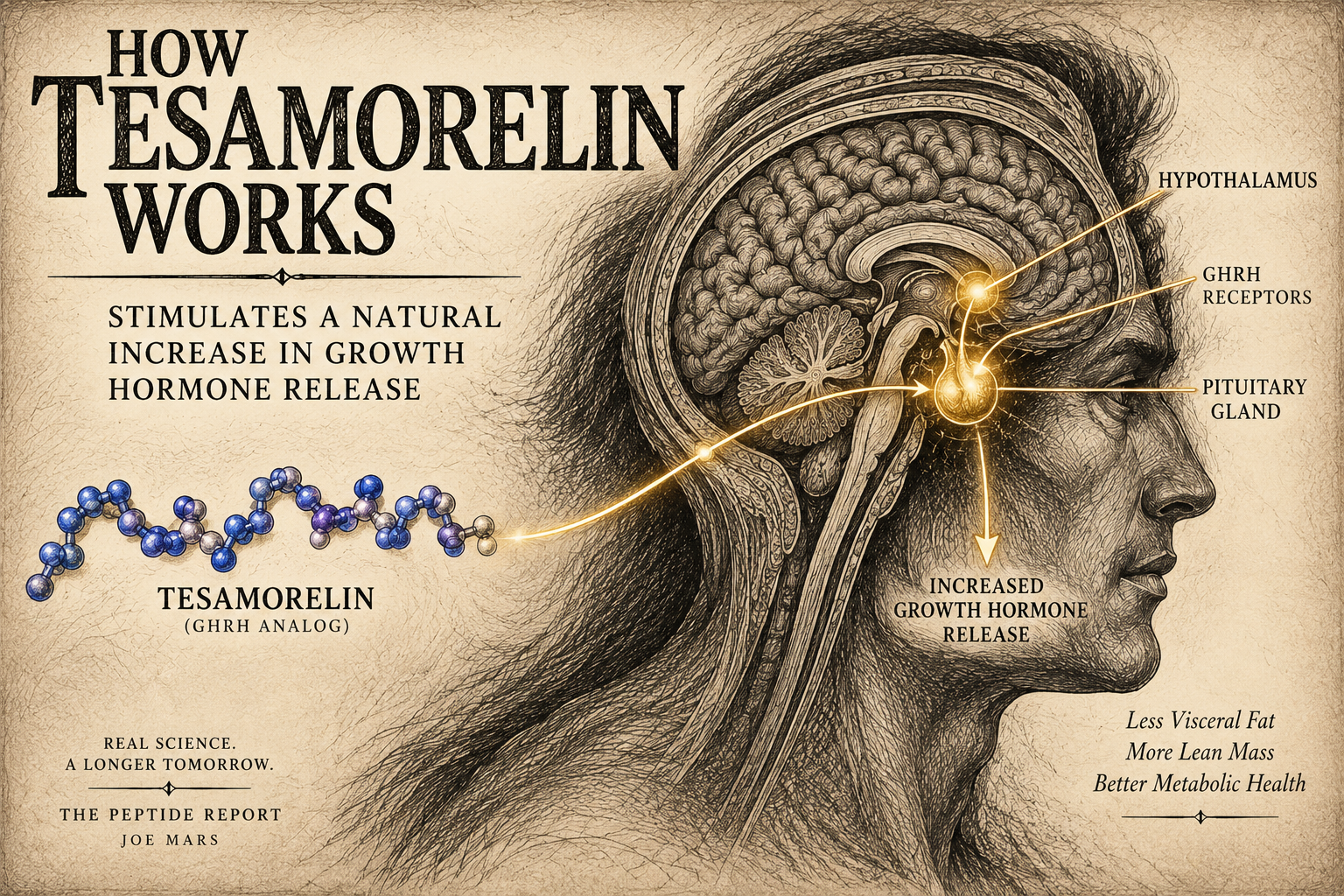
Your body releases growth hormone in pulses, mostly while you sleep. It does two jobs that matter here. It pushes your body to pull energy out of fat stores, and it makes your body hold onto protein instead of breaking it down for fuel.
That second job is the one people miss. When you eat far less than you burn, your body has to find energy somewhere. It can take it from fat or from muscle protein. Growth hormone tilts that choice toward fat.
Growth hormone output also drops steadily with age. Someone at 50 makes a small fraction of what they made at 25.
You could inject growth hormone directly, and people do. That overrides your own timing completely, it costs a lot, and it causes real trouble with blood sugar.
Tesamorelin works one step upstream. It hands your pituitary the signal it is no longer making enough of, and your pituitary keeps control of everything after that. Your body still decides when the pulses fire and how big they are. That is the difference between replacing a hormone and restoring the instruction to make it.
Tesamorelin Dosage in the Research
There are two different tesamorelin doses in circulation and they belong to two different products. Getting this wrong is easy and common.
| Product | Dose | Route | Note |
|---|---|---|---|
| EGRIFTA SV (original) | 2 mg once daily | Subcutaneous | The dose both phase 3 trials used |
| EGRIFTA WR (2025 formula) | 1.28 mg once daily | Subcutaneous | FDA label states it is not interchangeable with SV |
If you see a single tesamorelin dose quoted with no formula attached to it, whoever wrote it did not check. Mixing and storage instructions differ between the two products as well.
Cycling and Duration
Tesamorelin was studied as a daily, ongoing protocol rather than in short cycles. People stayed on it through 52 weeks and still showed results. That puts it in a different category from the Khavinson bioregulators, which get run for ten to twenty days a couple of times a year.
What happened when trials took people off it matters. In one extension phase, the group switched to placebo saw their visceral fat climb 24.5% over the following six months, while the group that stayed on it held steady.
This is not a reset button. It is a signal being supplied, and when the signal stops, the body goes back to what it was doing before.
Tesamorelin Side Effects and the A1C Finding
This is the section to read twice if you have any interest in this compound.
Growth hormone has a known problem with blood sugar, because it tends to make the body less sensitive to insulin. The pooled trial data looks reassuring at first, since averaged across those five randomized trials, glucose markers and lipid panels did not get worse.
The FDA label shows what the average hides. In the registration trials, 5% of treated patients reached an A1C of 6.5% or higher, compared with 1% on placebo. A1C reflects average blood sugar over the previous few months, and 6.5% is the number where a doctor starts using the word diabetes.
| Group | Reached A1C of 6.5% or higher |
|---|---|
| Tesamorelin | 5% |
| Placebo | 1% |
Both findings are true at once. Most people did not move on blood sugar and a real minority did. An average can stay flat while a subgroup slides.
The label also notes that long term cardiovascular safety has not been established, and that IGF-1 is another marker needing monitoring. Swelling, joint aches and injection site reactions are reported as well.
Anyone running this should have an A1C and a fasting glucose before starting and again a few months in. Bloodwork shows changes you will never notice from how you feel or how your clothes fit.
Tesamorelin and Muscle Loss on GLP-1 Medications
More people are on a GLP-1 than at any point in history, and the weight is coming off faster than the human body has ever really had to handle. The question a lot of them are asking is how much of that weight is muscle.
What the GLP-1 Body Composition Data Actually Shows
In the SURMOUNT-1 body composition study published in 2025, 160 people had DXA scans at the start and again 72 weeks later while taking tirzepatide.
| Measure | Tirzepatide | Placebo |
|---|---|---|
| Body weight | Down 21.3% | Down 5.3% |
| Fat mass | Down 33.9% | Down 8.2% |
| Lean mass | Down 10.9% | Down 2.6% |
| Share of loss that was fat | About 75% | About 75% |
Roughly 25% of the weight lost was lean tissue. Most articles stop there and call it a scandal. The placebo group lost weight in almost exactly the same ratio, which means the drug is not doing something strange to your muscle. This is what happens to nearly everyone who loses a lot of weight in a short time.
That does not make it fine. It means the problem is different from the one most people have been sold.
Who Actually Loses the Most Muscle
A much larger study published in 2026 found the part that matters. Researchers started with 670,422 people beginning GLP-1 treatment and narrowed to 7,965 who had real before and after body composition measurements across twelve months.
Higher doses meant more lean mass lost. Longer time on the drug meant more lean mass lost. Both held for semaglutide and tirzepatide.
They also found a specific pattern, where a person loses more than 20% of body weight along with more than 5% of lean mass. It showed up in 10.3% of tirzepatide users and 6.7% of semaglutide users in the first year.
When they searched the medical records for what predicted it, the strongest signal was not age and it was not starting weight. It was reduced exercise tolerance. Baseline knee pain and neck pain tracked the same direction. The people who could not move much were the people losing the most muscle.
So this is not a drug stealing muscle from everybody. People who cannot train hard while losing weight quickly end up paying for it in lean tissue, and these drugs are very good at making weight come off quickly. If a bad knee is the reason someone stopped lifting, being told to go lift is not advice.
Has Tesamorelin Been Tested With GLP-1s?
No. Nobody has run tesamorelin alongside a GLP-1 in a published trial.
Everything covered above was studied in people with HIV associated lipodystrophy. They had a specific cause for their deep abdominal fat, and they were not eating in a steep deficit while the trials ran.
The reasoning holds together. Growth hormone spares protein during a deficit. Tesamorelin raises growth hormone output through your own pituitary. In five randomized trials it raised lean mass while cutting fat. Every link in that chain has support behind it. The full chain has never been tested end to end.
Anyone claiming otherwise is guessing, and most of the people making that claim are selling something.
Muscle, Aging, and Why Lean Mass Matters Later
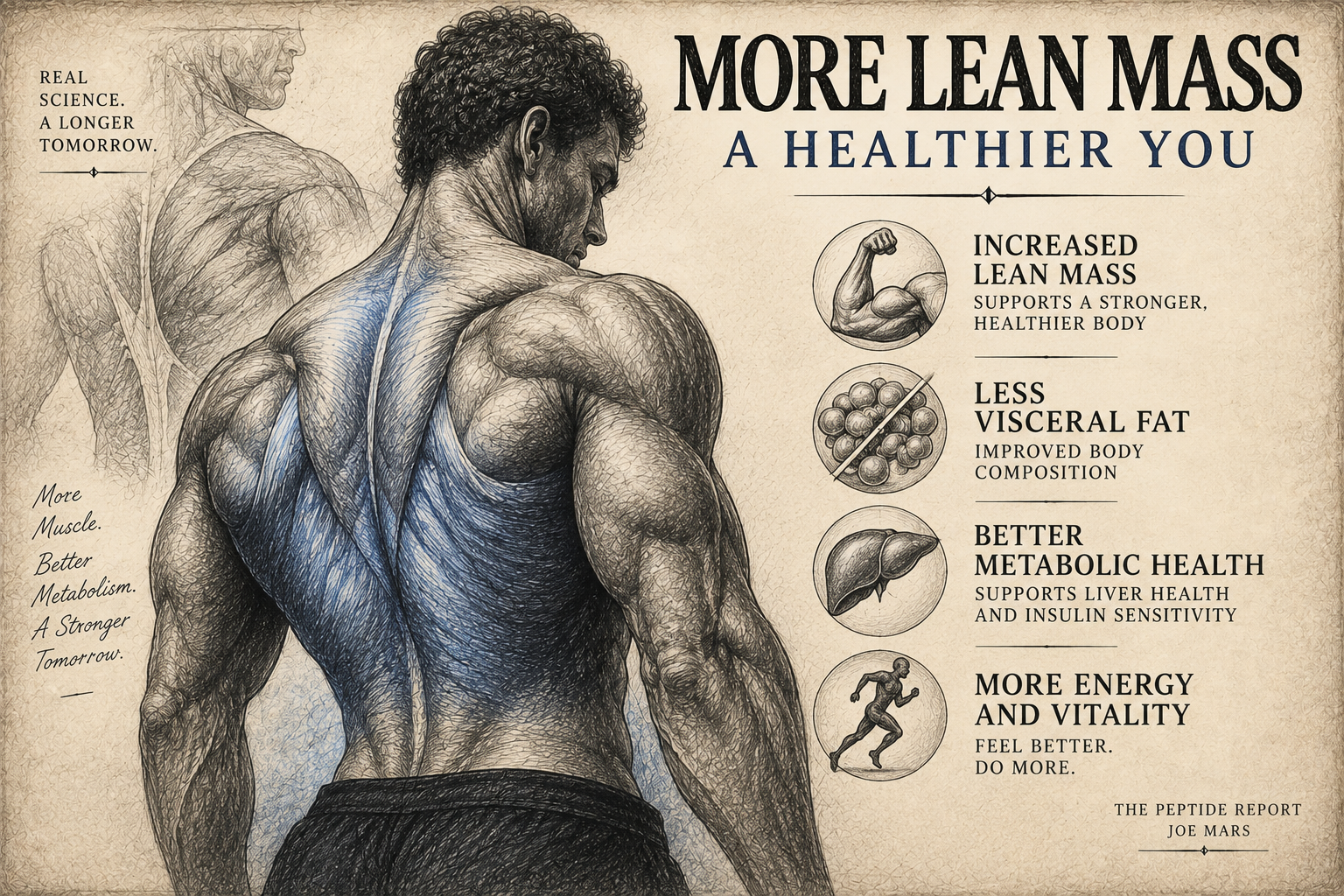
The lean mass finding matters for a reason that has nothing to do with GLP-1s.
Muscle mass starts slipping somewhere in your thirties and the pace picks up each decade after. It happens a pound or two at a time, so nobody notices until something they used to do easily has gotten hard. You lose a little strength. Getting off the floor gets harder. Stairs become something you avoid.
Eventually you see the things people associate with getting old, like the hunched posture, the walker, and needing your hands to push out of a chair. That is not just age. A big part of it is what happened to the muscle along the way.
Muscle is also one of the largest places your body has to dispose of glucose, so it affects insulin sensitivity, metabolic health, balance, bone strength and how well you recover when something goes wrong.
Muscle is something you want to build before you desperately need it. The more you carry into your later years, the more you have to lose before normal life starts getting difficult.
The tesamorelin trials were not longevity studies and they do not prove it keeps anybody out of a walker twenty years from now. What they show is that while visceral fat was coming down, lean mass went up. For anyone thinking about body composition with age in mind, that is a result worth paying attention to.
Who the Tesamorelin Research Applies To
The first group is people losing weight fast who cannot train the way they would need to in order to hold onto muscle. That comes out of the 2026 data, where reduced exercise tolerance was the strongest predictor of heavy lean mass loss. It covers anyone whose knees or back are the reason they stopped lifting in the first place, and people running high doses for a long stretch.
The second group is people not on a GLP-1 at all who are carrying deep abdominal fat. This is where the trial evidence is strongest, because reducing exactly that fat, measured by CT scan rather than by scale or mirror, is the entire thing tesamorelin was approved to do.
If you want to talk through any of this with people running similar protocols, I host a free community called the Peptides and Biohacking Hub on Skool. Join here.
Frequently Asked Questions About Tesamorelin
Stay sharp,
Joe Mars
The Peptide Report
Nothing here is medical advice. Tesamorelin has an FDA approved prescription use for excess abdominal fat in adults with HIV and lipodystrophy. It is not approved for general weight loss, for muscle preservation, or for use alongside GLP-1 medications. Compounds sold for laboratory research are not approved medicines for personal use. Talk to a licensed physician about your own health.
References
Guillemin R, et al. Growth hormone-releasing factor from a human pancreatic tumor that caused acromegaly. Science, 1982. View study
Growth hormone-releasing hormone and its analogues in health and disease. Nature Reviews Endocrinology, 2024. View review
Tesamorelin body composition, hepatic fat, metabolic and safety outcomes: meta-analysis of five randomized controlled trials, 2026. View meta-analysis
Tesamorelin clinical review including LIPO-010 and CTR-1011 phase 3 trials and extension phase data. CADTH, 2016. View review
EGRIFTA prescribing information including A1C data and EGRIFTA WR dosing. FDA, 2025. View label
Body composition changes during weight reduction with tirzepatide, SURMOUNT-1. Diabetes, Obesity and Metabolism, 2025. View study
Lean body mass decline with tirzepatide and semaglutide in routine care, 670,422 patients, 2026. View study
Subcutaneous and visceral fat loss with diet, exercise, weight-loss drugs and bariatric surgery: review and meta-analysis of 89 studies. View meta-analysis