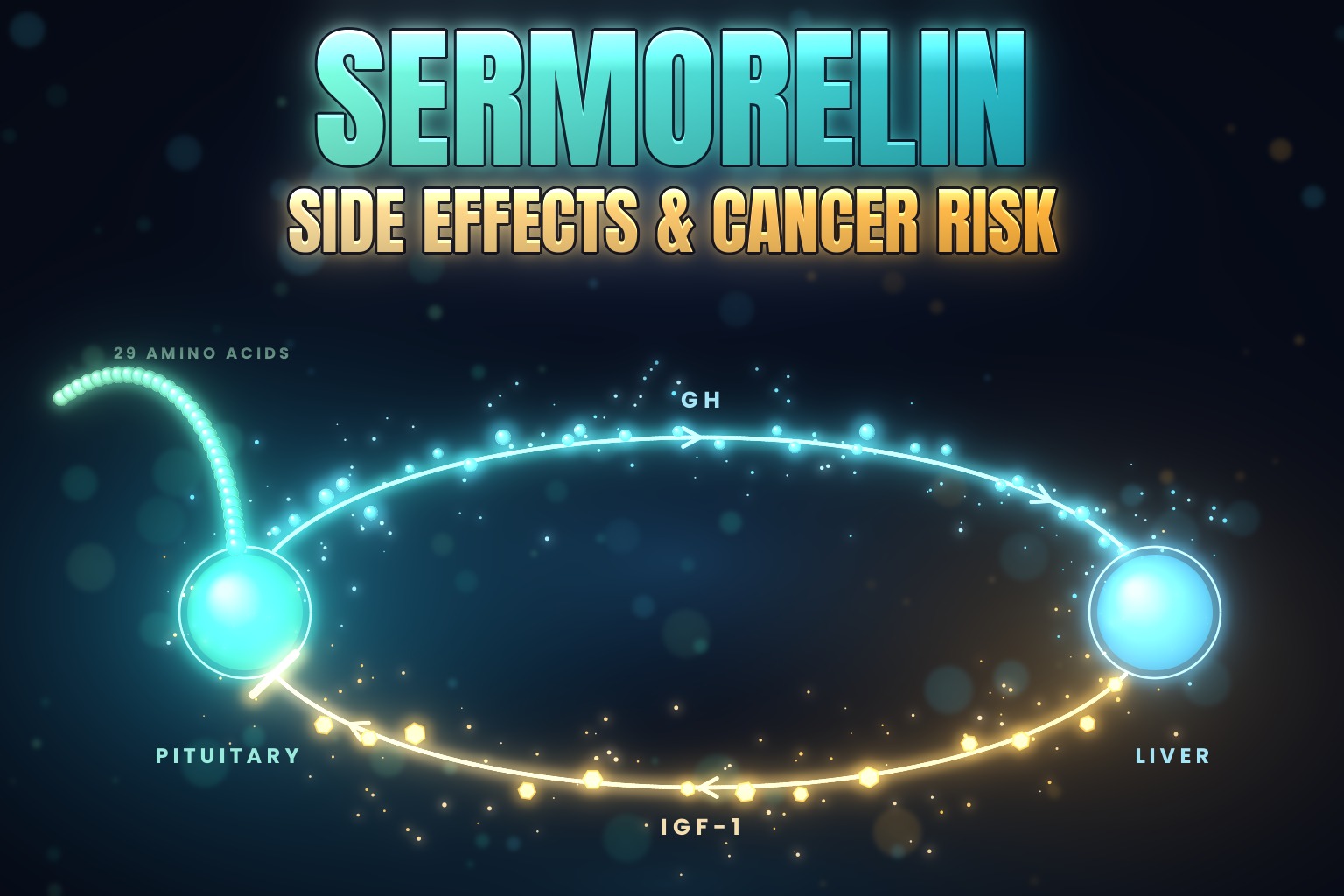
Sermorelin’s own side-effect record is short. Flushing, a sore injection site, and antibodies that turned out not to matter. The bigger question people bring to it is cancer, and that one belongs to growth hormone and IGF-1, the two things sermorelin raises.
It’s a question with better data than most people expect: acromegaly cohorts followed for decades, IGF-1 measured in thousands of people with and without cancer, and a community in Ecuador born without a working growth hormone receptor. Here’s what each of them shows, and where sermorelin sits among them.
The Sermorelin Trials Behind the Side-Effect Data
Sermorelin is GHRH(1-29), the first 29 amino acids of growth hormone releasing hormone and the shortest piece of it with full activity. It lands on the GHRH receptor in your pituitary and gets the gland to release its own growth hormone. If you want the molecule itself in detail, our tesamorelin vs sermorelin breakdown covers it, and sermorelin vs CJC-1295 covers how long it lasts.
Everything in the side-effect sections below comes from these studies, so here’s who was in them and what they took.
| Study | Participants | Dose and length | What it checked |
|---|---|---|---|
| Ross 1987 | 18 children with growth hormone deficiency | Injections twice a day, 6 to 18 months | Growth, GH response, antibodies |
| Corpas 1992 | 10 men averaging 68, plus 9 young men as a reference | 0.5 mg or 1 mg twice a day, 14 days each | 24-hour GH, IGF-1, glucose, C-peptide, blood pressure, blood chemistry |
| Chen 1993 | 40 children with growth hormone deficiency (20 more got GH) | 30 or 60 µg/kg a day by continuous infusion, 6 months | Growth, IGF-1, antibodies |
| Thorner 1996 | 110 children with growth hormone deficiency | 30 µg/kg at bedtime, 12 months | Growth, bone age, blood chemistry, glucose, IGF-1 |
| Vittone 1997 | 11 men aged 64 to 76 | 2 mg at night, 6 weeks | Night-time GH, IGF-1, strength, glucose tolerance, lipids |
| Khorram 1997 | 19 men and women aged 55 to 71 | 10 µg/kg at night, 16 weeks (Nle27 version) | IGF-1, insulin sensitivity, body composition, lipids, sleep |
| Merriam 2001 | Older men and women, two studies | Nightly, 6 months | IGF-1, body composition, sleep, fluid |
The Khorram trial used [Nle27]GHRH(1-29), sermorelin with the methionine at position 27 swapped for norleucine so it doesn’t oxidize. Everything else on the list is sermorelin as written.
The Side Effects the Trials Recorded
Flushing and injection-site pain
A 1999 review of the sermorelin literature named transient facial flushing and pain at the injection site as the most commonly reported adverse events, for both the one-off intravenous test dose and daily injections. In the Chen infusion trial, three children reported mild irritation where the infusion went in, and nobody had a serious side effect. Thorner’s year-long trial called sermorelin well tolerated, and Vittone’s six weeks of 2 mg nightly produced no significant adverse effects.
Antibodies to GHRH
Your immune system can make antibodies against an injected peptide, and sermorelin is no exception. In the 1987 trial, 14 of the 18 children developed anti-GHRH antibodies, and they had no adverse effect on growth or on the pituitary’s GH response.
The 1993 infusion trial saw the same thing at a higher rate: antibodies in all 20 children on the high dose and 19 of 20 on the low dose. Antibody levels had nothing to do with how much each child grew, and they had almost disappeared nine months after treatment stopped.
Blood sugar
Growth hormone works against insulin. It blunts insulin’s effect on glucose in the liver and in tissues like muscle, mostly by raising fatty acid levels, which is why people with acromegaly are consistently insulin resistant. Anything that raises GH carries some of that pull. Our MK-677 side effects post shows what that looks like over a full year.
In the sermorelin trials it barely showed. Fasting glucose, urinary C-peptide and blood pressure were unaffected in the Corpas men. Fasting glucose didn’t move over Thorner’s 12 months. Glucose and insulin on a glucose tolerance test were unchanged after Vittone’s six weeks. In the Khorram trial fasting glucose and insulin held steady, and insulin sensitivity actually improved in the men.
Blood lipids
The one adverse effect in the Khorram trial was a transient rise in blood fats, which had resolved by the end of the 16 weeks. Vittone’s men had no lipid change.
Fluid, swelling and joint stiffness
The six-month Merriam studies recorded mild fluid retention, and the Khorram trial measured thicker skin in both men and women.
These are the classic signs of growth hormone running high, and they’re clearest in trials of GH itself. Across 54 placebo-controlled trials in more than 3,400 adults with GH deficiency, GH made edema 6.07 times as likely and joint stiffness 4.17 times as likely. In fit young adults given GH, soft-tissue swelling and fatigue were the side effects that showed up more often.
Why Cancer Comes Up at All
IGF-1 is a growth factor. It tells cells to divide and makes them less likely to die off, and both of those matter to how a tumor gets started and keeps going. Growth hormone drives IGF-1 production in the liver, so any question about growth hormone and cancer is really a question about how much IGF-1, for how long.
There are three natural experiments that answer it: people with far too much growth hormone for years, people whose IGF-1 sits a little higher within the normal range, and people born with none of its signal at all. A fourth comes from children given growth hormone after surviving cancer.
Acromegaly: Years of Too Much Growth Hormone
Acromegaly is a pituitary tumor that pumps out growth hormone on its own, keeping IGF-1 high for as long as it goes untreated. It’s the closest thing to a long-term overdose study the field has.
A 2023 meta-analysis of 19 studies found overall cancer incidence in acromegaly 1.45 times that of the general population. The biggest ratios were thyroid (6.96) and brain and nervous system (6.14), with colorectal and anal cancer at 1.95 and raised figures for stomach, urinary, blood, pancreatic and connective tissue cancers. Breast, prostate, skin, lung, liver and reproductive cancers showed no association.
A Danish national cohort gives the population-wide view. Following 529 acromegaly patients from 1978 to 2010, overall cancer came out at 1.1 times the national rate, and colorectal at 1.4, with neither statistically clear. Overall mortality was up, at 1.3 times expected, but cancer deaths were not. The same authors pooled 23 studies and got higher figures (overall 1.5, colorectal 2.6, thyroid 9.2), and noticed that single-center studies and those with fewer than ten cancer cases ran the highest, a sign of selection bias in the older literature.
The colon is where acromegaly’s effect is most consistent. A 2008 meta-analysis of controlled colonoscopy studies put the odds at 3.70 for hyperplastic polyps, 2.54 for adenomas and 4.35 for colon cancer.
Breast cancer is the one that keeps getting asked about, given IGF-1’s effect on breast tissue. A 2025 review of 24 studies and 17,413 patients pooled the ten that reported incidence ratios and got 1.20, with a confidence interval from 0.94 to 1.54. The authors pointed to surveillance bias and study design, and concluded that breast screening in acromegaly can follow the same guidelines as everyone else.
A 2025 New York study looked at exposure directly. It followed 598 acromegaly patients and, as a comparison, 292 people with pituitary tumors that don’t secrete hormone. By last follow-up, 22.6% of the acromegaly group had had cancer against 12.7% of the comparison group, an odds ratio of 1.99. The predictor was cumulative exposure to IGF-1 excess, along with years since diagnosis and age, and the authors’ conclusion was that risk relates to the degree and the duration of IGF-1 excess together.
Higher IGF-1 in People Without Acromegaly
Inside the normal range, the association is much smaller. A 2004 Lancet meta-analysis of 21 studies and 3,609 cancer cases compared people at the 75th percentile of IGF-1 with those at the 25th. Odds were 1.49 for prostate cancer and 1.65 for premenopausal breast cancer, and the authors described the associations as modest and varying between sites.
The prostate link held up in the larger 2009 review: 42 studies covering 7,481 cases, with odds of 1.21 for every standard deviation higher IGF-1. The association was smaller in prospective studies, which measure IGF-1 before anyone is diagnosed, than in retrospective ones.
For colorectal cancer, the EPIC cohort matched 1,121 cases with 1,121 controls and found no association overall. Pooled with nine earlier prospective studies, the relative risk came to 1.07 per standard deviation of IGF-1.
Growth Hormone Given After Childhood Cancer
Children treated for cancer often end up growth hormone deficient, especially after radiation to the brain, and many are treated with GH. The Childhood Cancer Survivor Study tracked 361 GH-treated survivors among 13,539. The relative risk of their original cancer coming back was 0.83, with a confidence interval from 0.37 to 1.86, and GH wasn’t linked to risk of death.
Second, new tumors were a different story. GH-treated survivors had 15 of them, all solid tumors, for a relative risk of 3.21, mostly among survivors of acute leukemia. With 32 more months of follow-up the count reached 20 and the relative risk fell to 2.15, with meningiomas the most common at nine. The excess shrank the longer the children were followed. This is injected growth hormone, in children who had already been through cancer treatment.
Here are the ratios from this section and the two before it on one scale.
Cancer risk ratios on one scale
Tap any row for the study behind it
Where the Feedback Loop Comes In
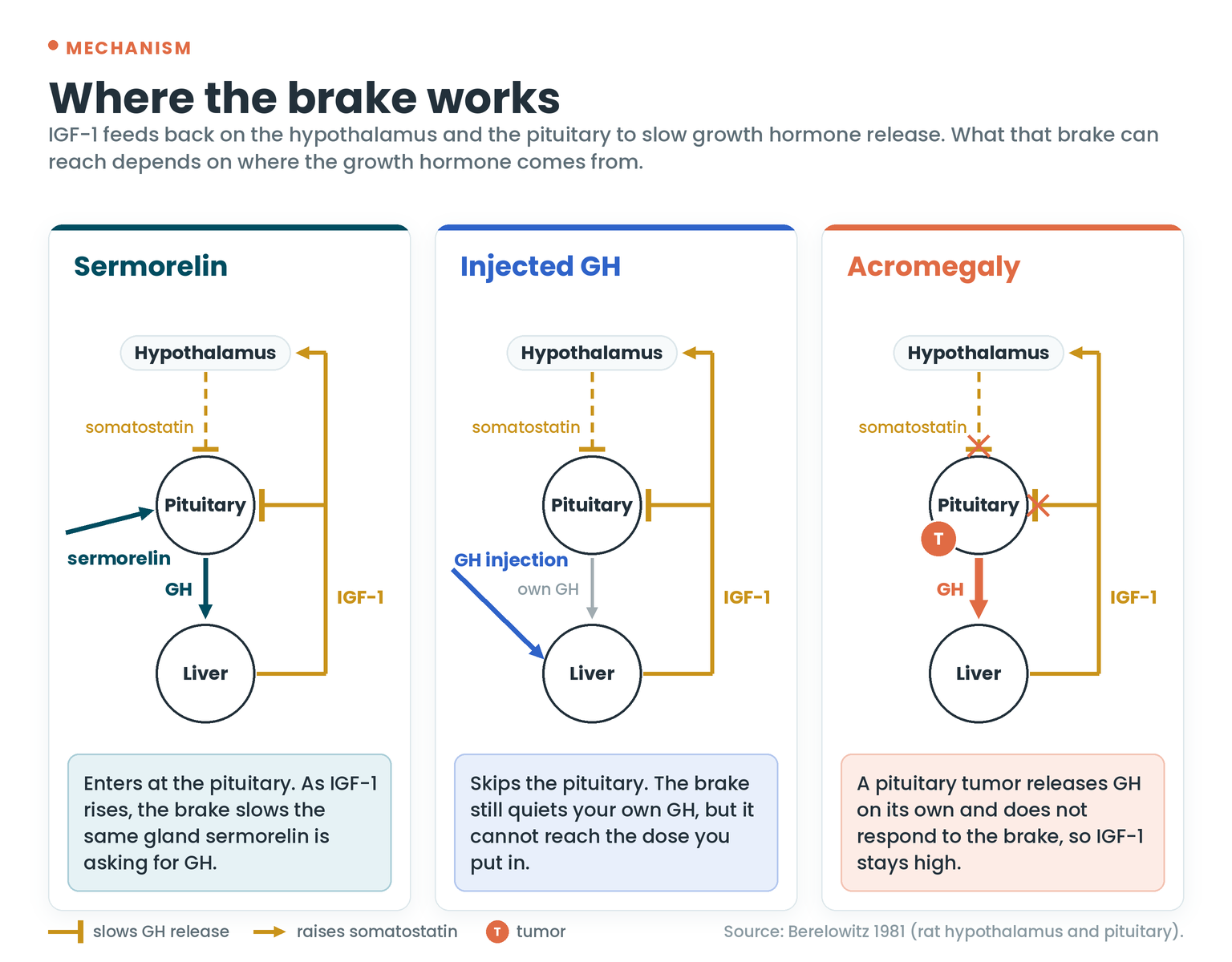
Your growth hormone system has a brake built in, and IGF-1 is the foot on it. A 1981 study in rat tissue showed both halves. IGF-1 raised somatostatin release from the hypothalamus to as much as 390% of its resting level within 20 minutes, and somatostatin is the signal that tells the pituitary to stop releasing GH. At the pituitary itself, IGF-1 did nothing for four hours, then cut stimulated GH release by more than 90% after 24 hours.
That brake decides how the three ways of raising growth hormone differ. Sermorelin enters at the top of the loop: it asks the pituitary for GH, and as IGF-1 climbs, the brake pushes back on the same pituitary. Injected GH skips the pituitary entirely. The brake still quiets your own output, but it can’t touch the dose you put in. An acromegaly tumor ignores the brake altogether, which is why IGF-1 stays high for years.
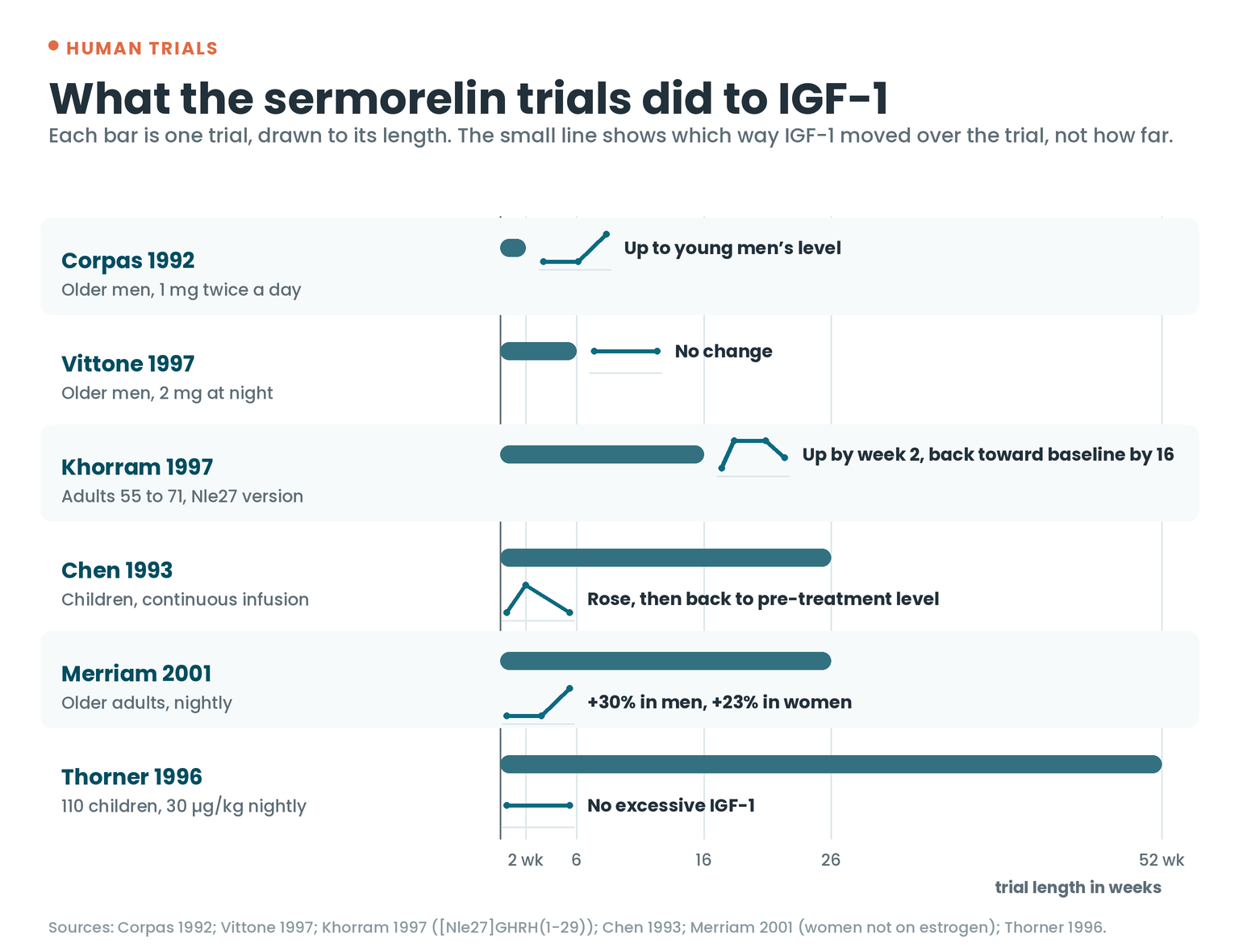
You can see the loop at work in how the sermorelin trials moved IGF-1. In the Corpas study, 1 mg twice a day brought the older men’s 24-hour GH and IGF-1 up to the level of the young men, with no significant difference left between the two groups; the 0.5 mg dose didn’t reach significance. Vittone’s 2 mg at night raised night-time GH and left IGF-1 unchanged. The Khorram analog raised IGF-1 within two weeks, held it for twelve, and saw it drift back toward baseline by sixteen. In the Chen infusion trial IGF-1 rose at first, then fell back to pre-treatment values. Thorner’s 110 children showed no excessive IGF-1 over a year, and the Merriam studies recorded IGF-1 up 30% in men and 23% in women not taking estrogen at six months.
When the Signal Is Missing: Laron Syndrome
The other end of the scale is people born unable to use growth hormone. In Laron syndrome the GH receptor doesn’t work, so IGF-1 stays extremely low for life.
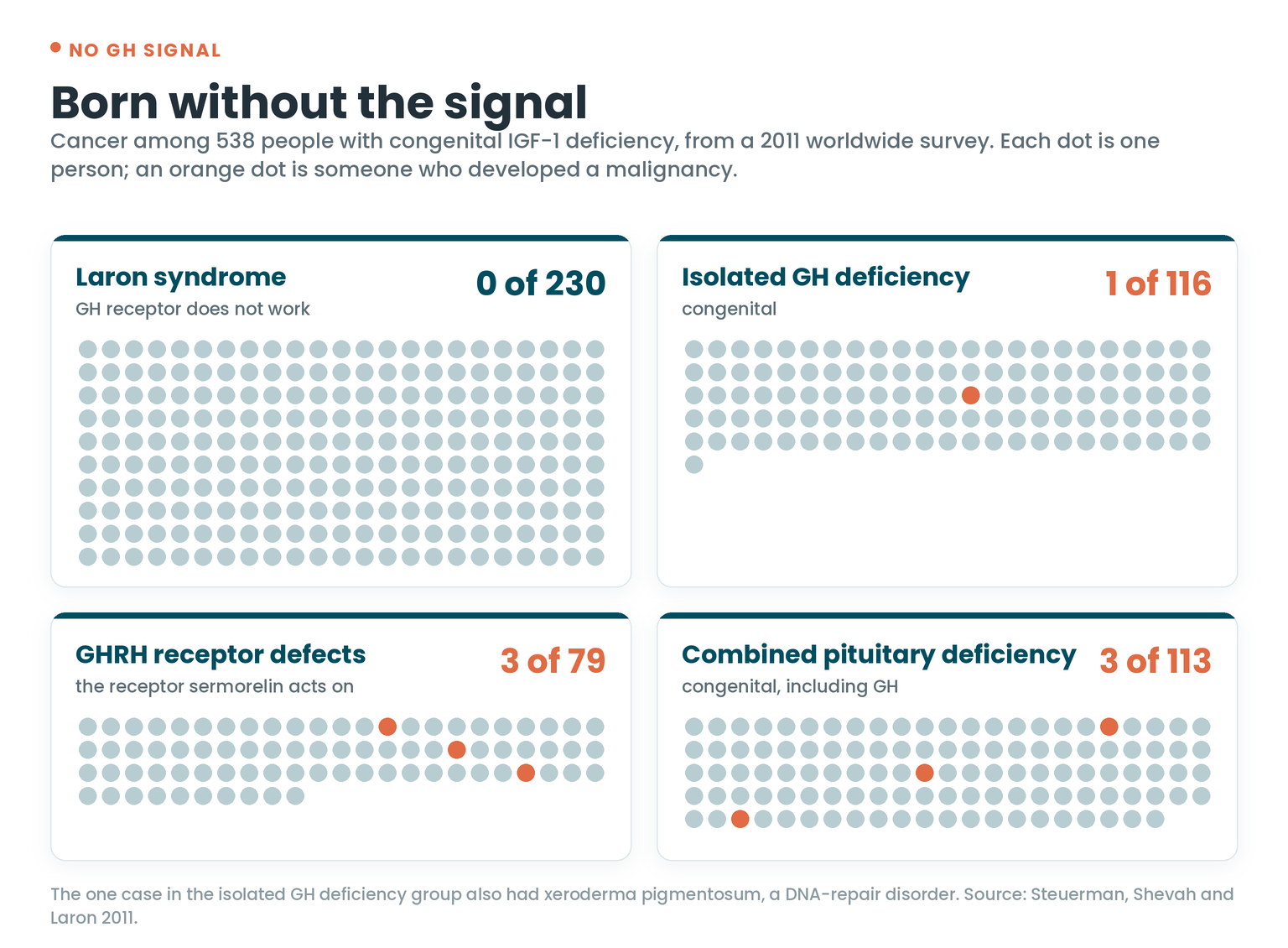
A 2011 worldwide survey gathered 538 people with congenital IGF-1 deficiency. None of the 230 with Laron syndrome had developed cancer. One of 116 with isolated GH deficiency had, and that person also had xeroderma pigmentosum, a DNA-repair disorder. Three of 79 with defects in the GHRH receptor (the receptor sermorelin acts on) and three of 113 with combined pituitary hormone deficiency had a malignancy. Among their first-degree relatives the survey counted 30 cancers, and 31 among further relatives.
The Ecuador cohort tells the same story with 22 years of monitoring. People with GH receptor deficiency had a single non-lethal cancer between them, while 17% of the control relatives had cancer. None had diabetes, against 5% of relatives, and their insulin averaged 1.4 μU/mL against 4.4.
GHRH Receptors on Tumor Cells
There’s one more angle that’s specific to GHRH rather than growth hormone. Several kinds of human cancer cells carry the pituitary GHRH receptor and a splice variant of it called SV1, which raises the question of what a GHRH agonist does to them directly.
Andrew Schally’s lab tested that in 2018 with MR409, a potent synthetic GHRH agonist. In the dish it did what an agonist should: lung cancer cells stayed more viable, died off less and made more cAMP and more GHRH receptors. In mice carrying human lung tumors the result reversed. At 5 µg a day under the skin for four to eight weeks, MR409 slowed tumor growth by 48%, 49% and 66% in three lung cancer lines, and also in gastric, pancreatic, urothelial, prostate, breast and colorectal tumors. GHRH receptors dropped in both the tumors and the pituitary, the same down-regulation that LHRH agonists use against sex-hormone-dependent cancers.
The Numbers Worth Watching
IGF-1 is the measurement that matters. Growth hormone comes in pulses, so a single blood draw tells you very little. IGF-1 is stable through the day and gets read against a range for your age, which makes it the number the sermorelin trials tracked. Given what the New York acromegaly data say about degree and duration, keeping IGF-1 inside the normal range for your age is the whole point of measuring it.
Fasting glucose and HbA1c are the second pair, because growth hormone pushes against insulin. A lipid panel covers the transient rise the Khorram trial saw. And swelling, tight rings or joint stiffness are the body’s own signal that growth hormone is running above where it should.
FAQ
Does sermorelin cause cancer?
The cancer data sit with growth hormone and IGF-1. In pooled studies, acromegaly, years of uncontrolled excess, raises overall cancer incidence by roughly half and colorectal cancer about twofold, while higher IGF-1 within the normal range carries far smaller associations. Sermorelin’s trials, which ran up to 18 months, moved IGF-1 anywhere from not at all to young-adult levels.
What are the most common side effects of sermorelin?
Brief facial flushing and pain at the injection site. Mild injection-site irritation, mild fluid retention and a short-lived rise in blood fats also turned up in individual trials.
Does sermorelin raise blood sugar?
Fasting glucose stayed flat in sermorelin trials lasting from two weeks to a year, and one analog trial found insulin sensitivity improved in men. Growth hormone opposes insulin, so the effect grows with how far GH is pushed.
Do antibodies stop sermorelin from working?
Most children in two trials made anti-GHRH antibodies, and neither growth nor the GH response suffered. In the infusion trial they had largely gone nine months after stopping.
How is sermorelin different from injecting growth hormone?
Sermorelin asks your pituitary to release its own GH, so IGF-1 feedback can still slow the pituitary down. Injected GH bypasses the pituitary, so the feedback can only quiet your own output, not the dose.
Can sermorelin push IGF-1 too high?
The trials recorded anything from no change to young-adult levels, and in several IGF-1 drifted back toward baseline over weeks or months. Checking IGF-1 against your age range is how you’d know.
References
- Prakash A, Goa KL. Sermorelin: a review of its use in the diagnosis and treatment of children with idiopathic growth hormone deficiency. BioDrugs. 1999;12(2):139-157. DOI
- Ross RJ, et al. Treatment of growth-hormone deficiency with growth-hormone-releasing hormone. Lancet. 1987;1(8523):5-8. DOI
- Corpas E, et al. Growth hormone (GH)-releasing hormone-(1-29) twice daily reverses the decreased GH and insulin-like growth factor-I levels in old men. J Clin Endocrinol Metab. 1992;75(2):530-535. DOI
- Chen RG, et al. A comparative study of growth hormone (GH) and GH-releasing hormone(1-29)-NH2 for stimulation of growth in children with GH deficiency. Acta Paediatr Suppl. 1993;388:32-35. DOI
- Thorner M, et al. Once daily subcutaneous growth hormone-releasing hormone therapy accelerates growth in growth hormone-deficient children during the first year of therapy. J Clin Endocrinol Metab. 1996;81(3):1189-1196. DOI
- Vittone J, et al. Effects of single nightly injections of growth hormone-releasing hormone (GHRH 1-29) in healthy elderly men. Metabolism. 1997;46(1):89-96. DOI
- Khorram O, Laughlin GA, Yen SS. Endocrine and metabolic effects of long-term administration of [Nle27]growth hormone-releasing hormone-(1-29)-NH2 in age-advanced men and women. J Clin Endocrinol Metab. 1997;82(5):1472-1479. DOI
- Merriam GR, et al. Growth hormone releasing hormone treatment in normal aging. J Anti Aging Med. 2001;4(4):331-343. DOI
- Møller N, Jørgensen JO. Effects of growth hormone on glucose, lipid, and protein metabolism in human subjects. Endocr Rev. 2009;30(2):152-177. DOI
- Hazem A, et al. Body composition and quality of life in adults treated with GH therapy: a systematic review and meta-analysis. Eur J Endocrinol. 2012;166(1):13-20. DOI
- Liu H, et al. Systematic review: the effects of growth hormone on athletic performance. Ann Intern Med. 2008;148(10):747-758. DOI
- Xiao Z, et al. Risk of cancer in acromegaly patients: an updated meta-analysis and systematic review. PLoS One. 2023;18(11):e0285335. DOI
- Dal J, et al. Cancer incidence in patients with acromegaly: a cohort study and meta-analysis of the literature. J Clin Endocrinol Metab. 2018;103(6):2182-2188. DOI
- Rokkas T, et al. Risk of colorectal neoplasm in patients with acromegaly: a meta-analysis. World J Gastroenterol. 2008;14(22):3484-3489. DOI
- Lee HC, et al. Acromegaly and breast cancer risk: evidence from a systematic review and meta-analysis. Front Endocrinol. 2025;16:1696291. DOI
- Freda PU, et al. Prospective, longitudinal study of cancer predictors and rates in a New York City cohort of 598 patients with acromegaly. J Clin Endocrinol Metab. 2025;110(5):1247-1257. DOI
- Renehan AG, et al. Insulin-like growth factor (IGF)-I, IGF binding protein-3, and cancer risk: systematic review and meta-regression analysis. Lancet. 2004;363(9418):1346-1353. DOI
- Rowlands MA, et al. Circulating insulin-like growth factor peptides and prostate cancer risk: a systematic review and meta-analysis. Int J Cancer. 2009;124(10):2416-2429. DOI
- Rinaldi S, et al. Serum levels of IGF-I, IGFBP-3 and colorectal cancer risk: results from the EPIC cohort, plus a meta-analysis of prospective studies. Int J Cancer. 2010;126(7):1702-1715. DOI
- Sklar CA, et al. Risk of disease recurrence and second neoplasms in survivors of childhood cancer treated with growth hormone: a report from the Childhood Cancer Survivor Study. J Clin Endocrinol Metab. 2002;87(7):3136-3141. DOI
- Ergun-Longmire B, et al. Growth hormone treatment and risk of second neoplasms in the childhood cancer survivor. J Clin Endocrinol Metab. 2006;91(9):3494-3498. DOI
- Berelowitz M, et al. Somatomedin-C mediates growth hormone negative feedback by effects on both the hypothalamus and the pituitary. Science. 1981;212(4500):1279-1281. DOI
- Steuerman R, Shevah O, Laron Z. Congenital IGF1 deficiency tends to confer protection against post-natal development of malignancies. Eur J Endocrinol. 2011;164(4):485-489. DOI
- Guevara-Aguirre J, et al. Growth hormone receptor deficiency is associated with a major reduction in pro-aging signaling, cancer, and diabetes in humans. Sci Transl Med. 2011;3(70):70ra13. DOI
- Schally AV, et al. Agonists of growth hormone-releasing hormone (GHRH) inhibit human experimental cancers in vivo by down-regulating receptors for GHRH. Proc Natl Acad Sci U S A. 2018;115(47):12028-12033. DOI
Stay sharp,
Joe Mars
The Peptide Report
P.S. If IGF-1 ranges and lab numbers are the part you want to dig into, bring your questions to the Peptides and Biohacking Hub on Skool. It’s free. Come join us.